






In August 2020, we spent a week in Belarus, witnessing the days that would prove a breaking point – for Belarus, for us in Lithuania, and, finally, for Ukraine. This is what we saw on those summer days.
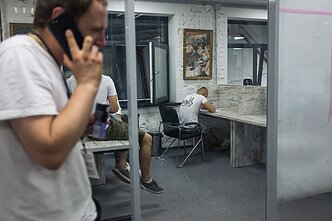
Stream upon stream of people began making their way to the centre of Minsk. Myself, Denis Vėjas, a Lithuanian photographer, and a Belarusian photographer then working for a state newspaper, made our way to the headquarters of Svetlana Tikhanovskaya.
The activist at the door met us with a stone-cold face. She stared at us up and down, fixing her gaze on our press cards. Finally, she motioned us to go in. Once across the door, our Belarusian friend whispered silently, giggling – “death to dictatorship!” – as she cut off a press tag from an earlier Lukashenko conference she had to photograph.
Inside, the air was stiff.
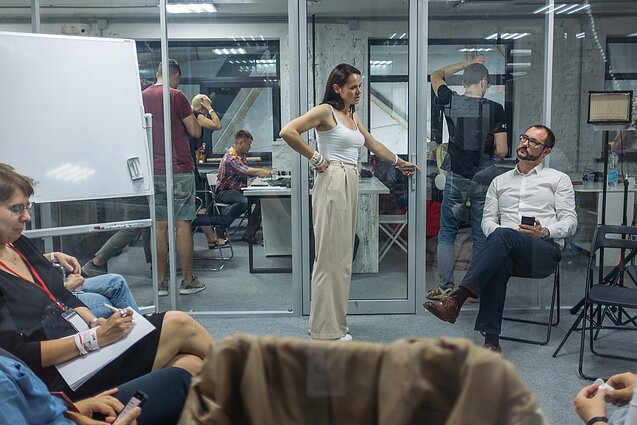
Maria Kolesnikova, now already two years behind bars in Belarus, was making the final adjustments to her post-election speech. She threw an angry glance, yet smiling, when I kept leaning up and above her with a camera. I retreated politely.
Meanwhile, Tikhanovskaya was pacing around the opposition headquarters. Activists were hovering over phones and laptops, transmitting the official election results.
Although it seems naive now, many were hoping Alexander Lukashenko would choose a peaceful transition, a theory that then seemed plausible due to the Kremlin’s silence as the first signs of mass protests were showing. Many spoke of a peaceful, so-called Armenian, revolution scenario that could play out in Minsk.
But fraudulent vote figures kept stacking up in Lukashenko’s favour. One district did declare, as they said, true results, showing a sweeping victory for Tikhanovskaya. Kolesnikova, one of the trio of women who had united for the election behind Svetlana, began jumping with joy.
Reporters in the room threw her an awkward glance, as first reports of people injured in central Minsk had already flagged up on social media.
Read more: Inside Minsk. Swarms of OMON use ambulances and extreme violence to suppress dissent
The room grew hotter. One of the staff opened a window, filling the loft-style office space with deafening shouts, slogans, and car horns from hundreds of people outside.
They kept flowing, weaving past the headquarters, seemingly oblivious to their candidate just metres away. In many ways, this would hold true in the protests in the months to come – the self-organisation led the way, not a single political figure.
“If you are for Belarus, brothers, follow us,” beckoned one flag-draped protester as he passed us downstairs.
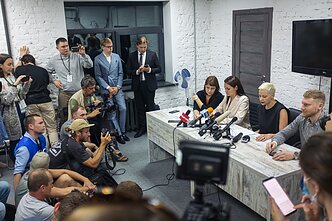
The window above was promptly closed, reporters squeezing closer to the table of four, as Tikhanovskaya’s team prepared their first post-election press conference.
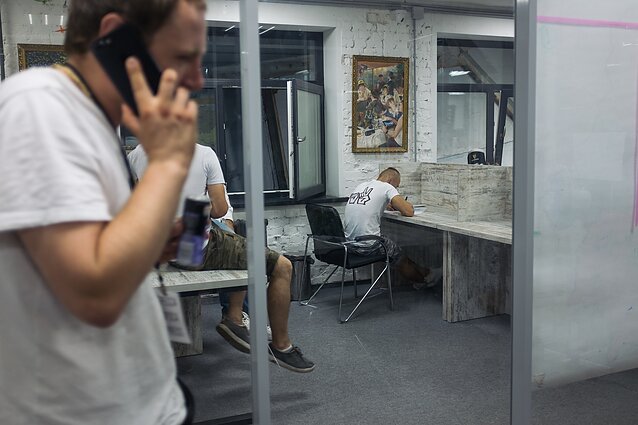
I’d like to say the world was waiting for each word, but the reality was different.
The room at the centre of events that would, arguably, change the course of history was filled with just several dozen reporters – most international media had stayed out, confident that nothing new would surface in Europe’s post-Soviet backwaters. The ‘mea culpa’ editorials would follow later.
I snapped a picture, later jokingly referred to by a Belarusian friend as the last photo of independent Belarusian media – in one frame.
Tikhanovskaya adjusted her microphone.
A Belsat journalist next to me whispered – “if they don’t announce a general strike from tomorrow, it’s all over.”
Then Tikhanovskaya spoke.

The first night
Amid cries outside, reporters began to leave one by one – the press conference fell apart. Tikhanovskaya’s team did not know the first victims were already being announced on Telegram, the messaging app driving the protests on the ground, refusing to comment.
The Belsat reporter who uttered the forewarning shook his head in disapproval. Tikhanovskaya’s team fluctuated between calling for dialogue, asking to refrain from violence, and trying to define a strategy.
“We were afraid of blood,” Svetlana Alexievich, the famed Belarusian author who was then part of the opposition Coordinating Council, would tell reporters two years later. “They were not afraid of blood.”
“It seemed to us then that we had already won,” Tikhanovskaya also recalled in an interview published on the two-year anniversary of the election.
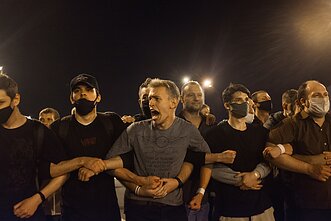
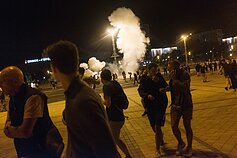
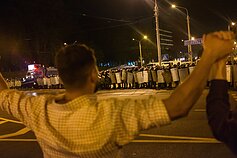
We headed out, joining a marching mass of white-clad, white-braceleted Belarusians gravitating toward the centre. Explosion sounds were getting nearer.
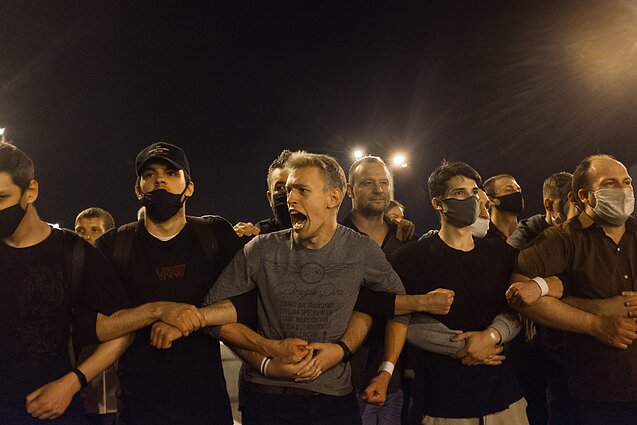
We didn’t know then that almost everyone in that room would be forced to flee or be arrested. Some would be tortured.
We didn’t know then that, by various estimates, some 100,000 people would have to leave the country.
We also didn’t know that this would mark a turning point, the first in a series of events leading to a border crisis in Lithuania and, finally, a full-scale war in Ukraine. Without Lukashenko’s full submission to the Kremlin, critics say, Russia would not have been able to launch such a multi-pronged attack on Ukraine and its capital Kyiv.
Weeks later, we found ourselves asking the question – what would have happened if Lukashenko had declared victory with 60 percent of the vote? Maybe 55? Would there still be a mass outcry? After all, even hardcore opposition activists never doubted that Lukashenko had a large chunk of the country in his hands.
In the first days of the protests, with internet blackout and connection interruptions, we knew little of what was happening around the country, let alone in Minsk.
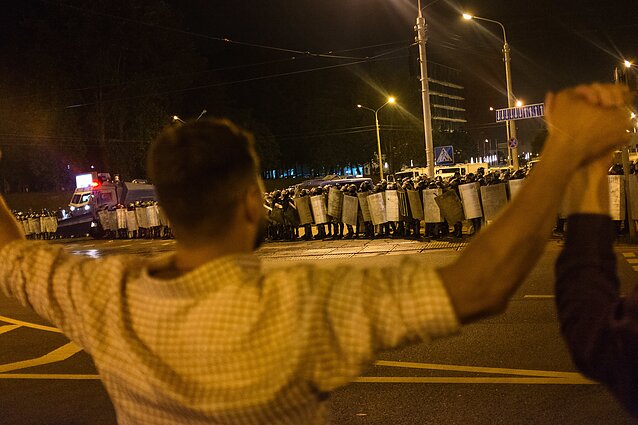
News trickled down of armoured vehicles ringing the city. Our colleagues would be sending text messages from Lithuania to inform us about what was happening several streets away. We were completely blind.
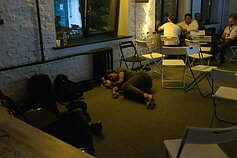
On the second day, Denis and I sat inside the balcony of the apartment we were renting in a newly-built complex. A few blocks from our window, we could see police vans leave in convoys, heading out into the city brimming with masses of white-clad protesters.
Even on the top floor, the air was filled with shouts, cries, and songs. Fragmented bitter chords of the ever-present Changes by Viktor Tsoy were reaching up to our window.
Sporadic graffitis would appear inside lifts of the apartment block, keeping up the clandestine fight against the regime. Simultaneously, Telegram channels of neighbours, districts, housing blocks began to balloon.
“Guys, you came here to support the protests?” the owner of the flat said to us when we were checking out.
We shook our heads, beginning to recite our mantra that we were mere tourists.
“Ok, ok, fine,” she cuts us short. “Malaci [well done].” Eyeing her cheeky smile, we immediately knew what side she was on. Instinctively, we also knew we were safe in that apartment – news of journalists and activists picked up at night, likely guided by informants, never escaped our minds.
The climate of fear, even for your own neighbour, was being broken apart all across Belarus.
The escape
We left the country in an empty bus, passing by hundreds of people who were lining the streets of Minsk, flowers in hand. The border checkpoint separating Belarus and Lithuania was deserted. It seemed everyone was occupied with the shockwaves fracturing the country.
The chatty bus driver turned silent as a KGB officer, judging by his uniform, emerged from the border post. “I haven’t seen this guy here before,” the driver uttered.
Read more: As shots and explosions shake Minsk, people call for help from Lithuania
What followed was a round of questions about what we had seen. Dressed in shorts and sleeveless t-shirts, tattoos showing and cigarettes in hand, we played the role of tourists caught up in the violence. It worked.
After a brief silence, the KGB officer waved us across. The sight of Lithuanian border guards wiped the last remnants of adrenaline; I felt like hugging the woman checking my bags. We were back in Lithuania.
The same sight and a sense of relief would be relived by thousands of Belarusians fleeing across the very same border checkpoint in the months to come.
Others would have to wade through swamps and dense forests separating the two countries to get away.
Tikhanovskaya also ended up in Lithuania on the same day as us.
The Belarusian relocant community, as they call themselves, kept growing. Almost everyone we had met in Belarus was forced to flee.
Read more: 'Maybe I left too soon'. Belarusian exiles in Vilnius fight survivors' guilt
Two years later
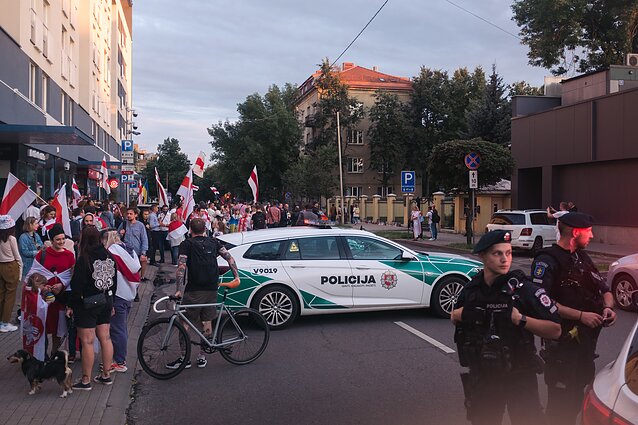
The second anniversary of the election felt different.
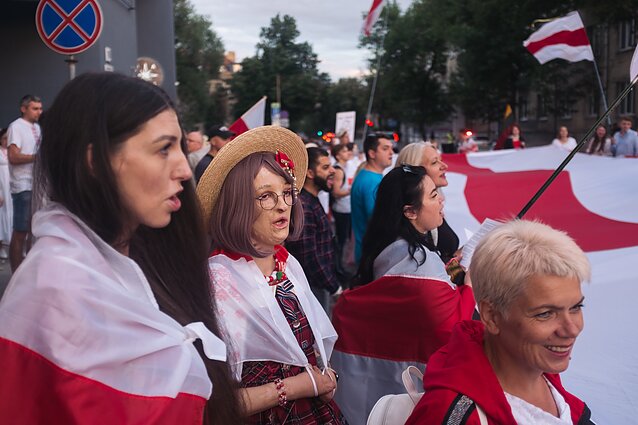
The energy of two years ago, even in Vilnius, was gone. People were chatting more than shouting, smiling at the camera and joking with one another. This is a mood we, as reporters, had never noticed before.
Now, a war-time elephant stood in the room – the invasion of Ukraine that Belarus had become part of.
“For some Belarusian people, it’s hard to realise and accept that Belarus is also part of the war and we are the aggressor, too,” said Maya, standing outside the Belarusian embassy on August 9, 2022. She first left Belarus to Ukraine, but had to flee again following the invasion.
“People have a hard time understanding why Ukrainians are angry with Belarusians,” she said. “I accept that it is very hard for Ukrainians and they have also earned the right to be angry with Belarus.”
She is now helping, donating to organisations that provide “rape kits” to women in Ukraine, as well as in Belarus. Russian troops also raped women there, she said.
“I think we fight harder than Russians against this war – despite the propaganda, most Belarusians are still against the war,” Maya added. “But if it’s not enough for Ukrainians, I can accept that.”
As one activist put it, vividly: those who wanted to “really do something” now had the chance – go fight for Ukraine. A success there was a prerequisite for any changes in Minsk, as the Belarusians themselves say.
Thus, the “flag waving” that left many in Vilnius disillusioned over the months that followed no longer had much of a purpose.
We stood on the sidelines, looking at the several hundred people in Vilnius who had gathered in front of the Belarusian embassy. But the building stood with its flag coiled up, lights out, and (likely) no more than a guard inside.
The diplomats were long gone, sent out amid the tit-for-tat moves and the incremental progression toward what at times seemed like an imminent border conflict.
Outside, among the usual slogans, a new one appeared – “the protests will finish when the dictator is finished.”

Newsletter
Every Friday morning.