













Lithuania is initiating a “coalition of the willing” to help escort Ukrainian grain exports out of the Black Sea port of Odessa, Foreign Minister Gabrielius Landsbergis said on Tuesday.
"First of all, we are looking for diplomatic support and we will make efforts for a certain group of states to form to unblock Odessa according to the Ukrainians' vision," he said.
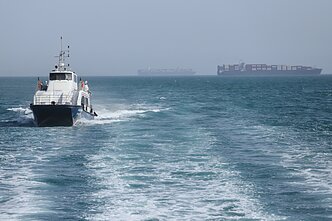
The port of Odessa, Ukraine's largest port and a major gateway for grain shipments, is currently blockaded by Russian forces. Any plan would involve escorting ships past Russian military vessels.
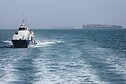
"This would be a non-military humanitarian mission and is not comparable with a no-fly zone," Landsbergis told reporters in the United Kingdom. "We would need a coalition of the willing – countries with significant naval power to protect the shipping lanes and countries that are affected by this."

Landsbergis discussed the idea with his UK counterpart Liz Truss during a visit to London on Monday. She said Britain supports the proposal "in principle".
"What we need to do is deal with this global food security issue and the UK is working on an urgent solution to get the grain out of Ukraine," Truss told reporters in the UK.
According to Landsbergis, Britain has the military infrastructure it could send to the Black Sea to escort ships with grain, but the two countries agreed not to discuss specific capabilities at this stage.
The Lithuanian minister said that the proposed coalition would not be coordinated at the NATO level, but "this does not mean that individual NATO countries could not take part in this operation".
"It is important that not only NATO and EU countries but also the countries that need grain today know exactly what the idea is," Landsbergis said.
"The aim is to inform countries in North Africa, the Middle East, and the Sahel that their well-being and access to food depends on the Russian blockade and its lifting," he added.

Turkey's role
Lithuania's top diplomat dismissed fears that the participation of NATO countries in the coalition could be seen as the alliance's involvement in the war.
"This would not be escalation [or] involvement in the war," he said. "This is about securing food supplies. The coalition would not be responsible for [...] making it possible for Ukraine to feed the world."
However, countries that decide to send their vessels to the Black Sea to protect grain ships are likely to face logistical challenges. Turkey has prevented military vessels from sailing through the Bosporus Strait since Russia's invasion of Ukraine.
"There can be no agreement without Turkey," Landsbergis said. "Turkey must be part of this coalition."
"Turkey itself is an importer of grain, including from Ukraine," he noted.
Landsbergis said he discussed the issue with Turkish Foreign Minister Mevlüt Çavuşoğlu by phone a few weeks ago.
Çavuşoğlu "acknowledged that this is a very important issue and that we need to find ways to make it concrete", the Lithuanian minister said.

Demining port approaches
Landsbergis also said that "it would be ideal but not very realistic" if the United Nations started dealing with the issue of moving grain out of Ukraine, noting that this would require approval from the Security Council where Russia has a veto.
The minister said that countries are also talking about demining the approaches to the port of Odesa, which "requires a coalition with strong maritime powers".
"We have agreed not to comment in more detail on this issue until there are clear decisions," he said.
Last week, United Nations chief Antonio Guterres warned of mass hunger and famine if the growing global food crisis is not contained.
He called on Russia to end its blockade of Ukrainian grain exports through Black Sea ports.

Alternative routes
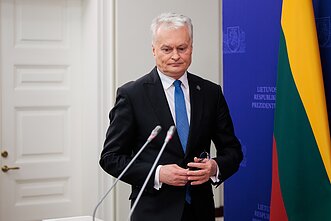
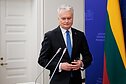
Meanwhile, Lithuanian President Gitanas Nausėda said Baltic ports could be used as an alternative export route for Ukraine.
"I think we have to find alternative transit routes and the Baltic states and Poland could be an alternative route when Ukrainian grain travels and finds its supply chains," he said in a comment sent to BNS.
The president arrived at the Davos World Economic Forum on Monday where he is set to discuss the issue with world leaders.
However, Landsbergis previously said alternative routes had severe drawbacks, meaning it would take Ukrainian grain five to nine weeks to reach ports by road either in Romania, Poland, or Lithuania.
Read more: Lithuania ‘ready’ to accept Ukraine’s grain export corridor via Belarus, says minister

Newsletter
Every Friday morning.