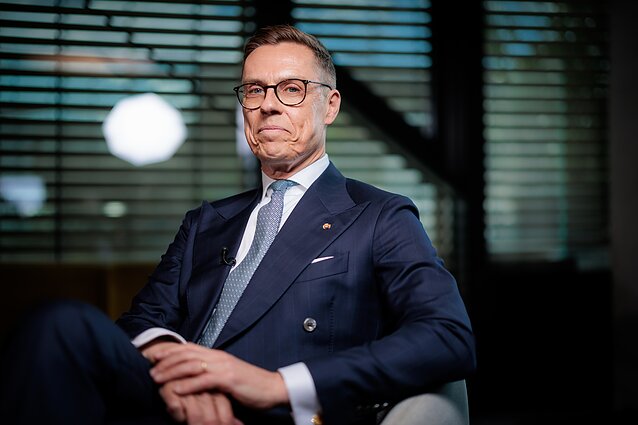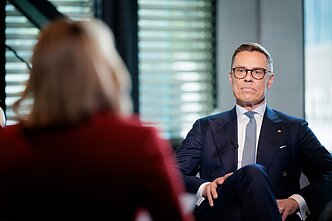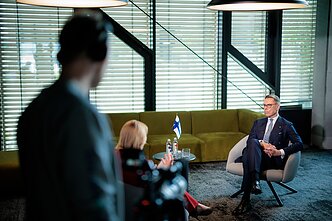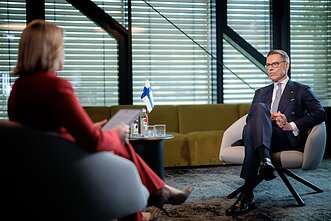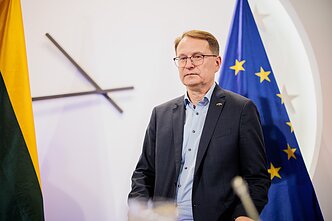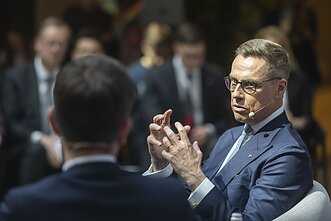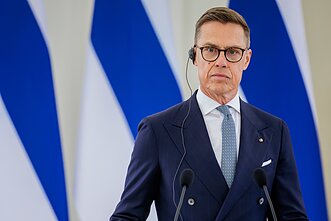







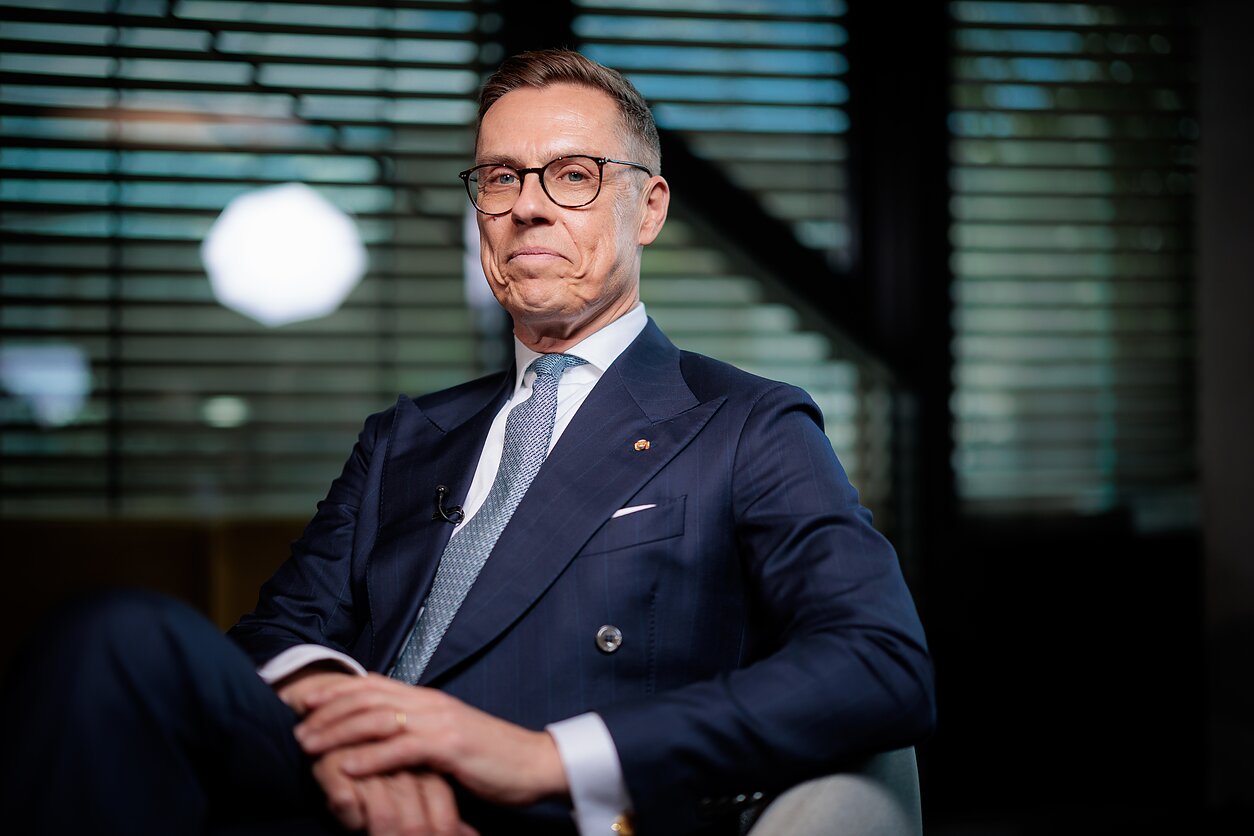
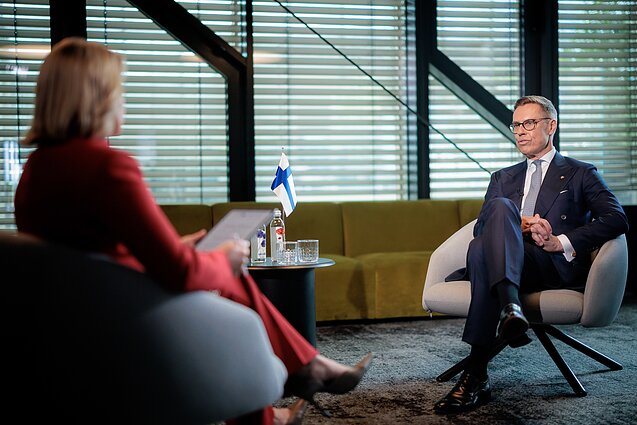
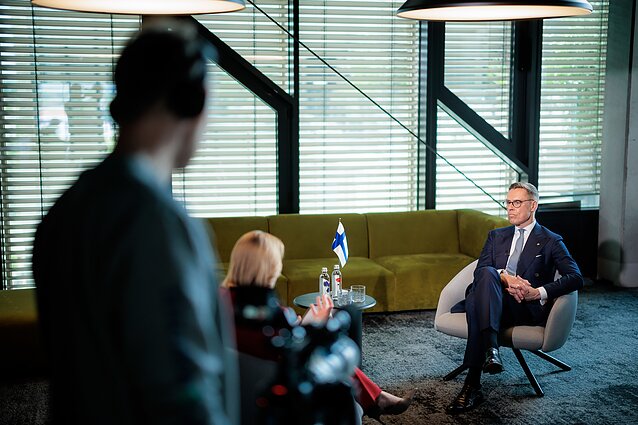
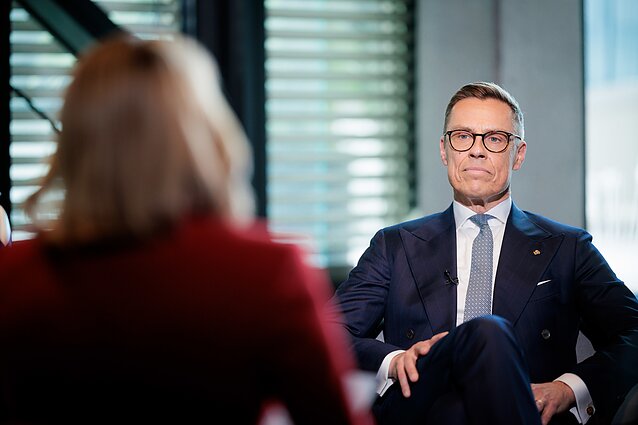
In an interview with LRT TV, Finnish President Alexander Stubb talks about drone incidents, Ukraine, NATO and Europe’s nuclear umbrella.
I would like to start with the events we are facing in our region. In early May, several Ukrainian drones entered your country's airspace. How should our region react or respond to such incidents?
There are probably two answers. The first one is that anytime your airspace is violated and there are active drones flying in it, it's obviously a serious concern. Every leader – in Lithuania, in Finland – is worried about it. Fortunately, the damage has been limited.
My second observation is that this is part of the collateral damage resulting from Russia's ongoing aggression. Ukraine has the right to defend itself, and right now, some of the defence is happening in our region, and that is teaching us a few things.
The first one is that we are not necessarily fully prepared for drone activity, not during peacetime [and] wartime. And the second is that we have a lot to learn from the Ukrainians.
So, the paradox is that we have Ukrainian drones, but we need to learn how to defend them from the Ukrainians themselves.
Do you think and do you feel that Ukrainians are attentive to these concerns and our requests?
Definitely. I speak to Volodymyr Zelensky at least once a week, sometimes more than once a week.
After the first [drone] incident, I called him immediately. I said, "Volodymyr, what's going on?" And he said, "Oh, sorry, we didn't mean to. You know, it was a mistake, and it was our drone, but because the GPS system was jammed." So yes, the Ukrainians are listening to us.
Don't blame them for conducting a defensive war. The collateral damage is very unfortunate, and we are right to raise it and deal with it.
We are hearing a threatening Russian narrative of Ukrainian strikes targeting Kaliningrad. In such a case, drones would have to cross Polish or Lithuanian territory. In your opinion, what consequences could such an attack have for the region?
I don't deal with hypotheticals and rumours. I deal with intelligence, and I don't share that intelligence, but I am not aware of anything like this going on. But just from a layman's perspective, if Kaliningrad was hit, would it not happen from international waters in the Baltic Sea?
That's what's happened in [...] Primorsk, so we don't allow our airspace, our sea space, or our land space to be used, and I'm sure that Lithuania and Poland won't allow that either.
You are among those European politicians who speak about the need to renew dialogue with Russia because Europe's interests are not being reflected now. What conditions or even red lines should Europe set for Russia in such a dialogue?
First of all, there's no return to what used to be. Finland is a good example of that – we joined NATO because Russia attacked Ukraine, so we're not gonna have a similar relationship that we did.
The conditions, I think, are quite classic. They have to do with trying to end the war, with having diplomatic relations in general. And there are two reasons why I think the time is approaching for Europe to do this.
The first one is that Ukraine is now in a position of strength, and Russia is in a position of weakness. And you can say that Ukraine is actually winning this war, so it'll be in the interest of Russia to begin this conversation.
And the second one is European interests. If you're not around the table, you're gonna be eaten on that table. I think it's better to engage in some kind of dialogue. Who does it, what the conditions are, I think it's too early to say. But it's important.
Do you think that Europe is already sufficiently united for this kind of dialogue with Russia?
Definitely. To be honest, I've never seen the European Union more united than we are right now. We were united during Covid, we were united when Russia's war of aggression in Ukraine began. We have been united in our support for Ukraine, apart from a few differences, like Viktor Orbán of Hungary.
So now that that impediment is out, we're able to help Ukraine. It's gonna be impossible to have only one person discussing on behalf of everyone, but I think the important thing is that we have one, two, three, or four people, however many, discussing with the Russians about practical things on how to take things forward and how we can help in the peace process.
I think the first thing we need to start working on is a ceasefire. That's been out of the question now. We've had ceasefires for a few days, but perhaps the Europeans could help the Americans on this, because the Americans are right now very preoccupied with Iran.
Lithuania and Poland are facing some light pressure from the United States to renew diplomatic dialogue with Minsk. Do you see this situation as similar to the dialogue with Russia?
I think the country that knows Belarus the best outside of Belarus is Lithuania, and the Poles as well.
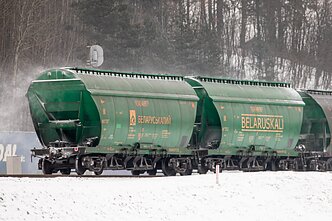
We have very often listened to what you want to do. To me, it would seem like the Americans are very engaged in big business deals with Belarus right now. But for us, Belarus is just an instrument for Russia's war of aggression in Ukraine. So we don't see it as a business deal, we see Belarus as a security threat, which is very serious for a country like [Lithuania]. That's why we will give all the possible support that we can, not least during our visit tomorrow to the border.
A former United States army commander in Europe said that he has a feeling that he missed a sense of urgency in Europe, including in countries like Lithuania that have a direct border with Russia. Do you agree that we are not acting quickly enough?
I think you're probably talking to the wrong person about a sense of urgency. We have 1,340-kilomete border with Russia, we understand that Russia is a long-term threat.
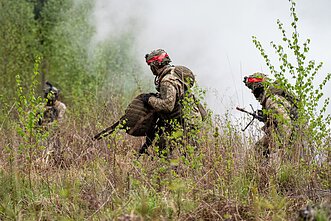
That's why we joined NATO, that's why we have obligatory military service, and one million men and women have done it. That's why we can, uh, have 280,000 reserves within weeks at wartime. That's why we have over 60 F-18s; that's why we just bought 64 F-35s. That's why we have long-range missiles, air, land, and sea, and that's why we have the biggest artillery [capability] in Europe. So, we have seen the urgency always, and we shall continue to see the urgency.
I take comfort in the fact that most NATO states are pushing their defence expenditure towards 5 percent of GDP, with Lithuania being 5.4 percent. But we all know that you don't fight wars with percentages, you fight wars with capabilities, and that's why we need to ramp up both our defence industry and our capabilities.
Finland is a very good example, but in Lithuania, for instance, we can struggle by arguing where to invest – drones, air defence systems, new training areas. How do you address these questions in Finland?
First of all, we are in this together – Finland and Lithuania. Remember that we are not only members of the European Union, but we are allies,we're bound by Article 5, and that means that if you're in trouble, we help you. If we're in trouble, you help us.
Now, the key is to coordinate our investment and basically have a plan, an operative plan, and then have capabilities to fit those, and then we start working on it. I think that modern warfare is a moving target. Actually, it doesn't move annually, certainly not every five years – it moves monthly, and that means that we need to work on modern warfare, whether it's drones, whether it's missile defence, or whether it's drone production.
That's why we need to forge close relationships and deal with Ukraine. For instance, co-production – we produce, say, in Finland or in Lithuania, and then 90 percent of those drones, because you need them immediately, are in Ukraine, and 10 percent stay in Finland. And when the war is over, we have the capability to conduct modern warfare.
You often underline that Europe must take bigger responsibility for its own defense. At the same time, both in Finland and Lithuania, there are doubts that nothing will be effective without nuclear deterrence. How do you see this challenge?
NATO has three pillars of its defence, and remember, it's the biggest defence alliance in the world. Secondly, we have missiles. And thirdly, we have nuclear, and that nuclear umbrella comes essentially from the US, and secondarily from the United Kingdom, and thirdly from France.
Do you think that we need to think about a European programme to enlarge, perhaps, France's nuclear umbrella?
It’s not black and white, it's not binary, it’s not either/or. We need all of it, and nuclear is a part of our deterrence, whether it's French, British, or American.
I don't see the American nuclear umbrella disappearing anywhere. Quite the contrary, they are now developing their nuclear umbrella because they understand that the Russians are actually quite advanced in tactical nuclear [weapons]. We are also seeing China with 600 nuclear warheads going up to 1,000 by the end of this decade and going up to 1,500 by 2035.
So, all of us need to develop our nuclear capabilities. By all, I mean within the deterrence framework, and that's why we need to ramp up also Europe's nuclear capability.

Newsletter
Every Friday morning.