

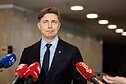





Proposals to build a broader political community of democratic states around the European Union are an attempt to cover up the lack of political will to grant EU candidate status to Ukraine, Lithuanian President Gitanas Nausėda said on Tuesday.
Nausėda’s comment came after French President Emmanuel Macron said that it would take “decades” for a candidate like Ukraine to join the EU and suggested building a broader “European political community” around the bloc.
“I can welcome proposals to create parallel political communities, well, as an example of generating ideas, but I have the impression that this is an attempt to cover up the obvious absence of political will to take decisions on granting candidate status [to Ukraine],” he told reporters in Rukla, in the central district of Jonava.
“This is certainly not good, and I think that before making such proposals, one should ask Ukraine what its opinion about such proposals is and whether they meet its expectations.”
However, the Lithuanian president said he was “not disappointed” by Macron’s timeframe for Ukraine’s accession to the EU.
“We are not naive and we understand that there will be more than one, more than two, and, perhaps, even more than eight years between the moment Ukraine is granted candidate status for EU membership and its full-fledged membership,” he said.

‘No political consensus’
Lithuania is among the most active advocates of speeding up Ukraine’s accession procedures, including accelerated candidate status, an issue that has been placed even higher on the political agenda in the wake of Russia’s military invasion.
However, big EU member states are sceptical about this possibility, as it could lead other countries in the membership queue to expect faster admission as well. Turkey, Serbia, Montenegro, Albania, and North Macedonia currently have candidate status.
Critics also note that democratic reforms in Ukraine, already slow after the 2014 revolution, have ground to a complete halt since Russia’s invasion.
In his speech on Monday, Macron said the bloc, “given its level of integration and ambition”, could not be Europe’s only organising body.
The proposed European political community would find “a new space for political cooperation, security, cooperation in energy, transport, investment, infrastructure, the movement of people”, according to the French leader.

Lithuania’s Nausėda commented that “similar proposals [to build a political community] seem to mean that even today there is not enough political consensus for us to follow a straight path, a clear path”.
Ukraine’s application for EU membership is currently being examined by the European Commission, which is expected to give its opinion in June.
The formal decision on whether to grant the country candidate status is to be taken by all 27 EU member states, based on recommendations from the Commission, which would oversee the complex and potentially lengthy accession process.
On its path to EU membership, Ukraine will have to continue its fight against corruption and to follow strict standards of governance and the rule of law.

Newsletter
Every Friday morning.