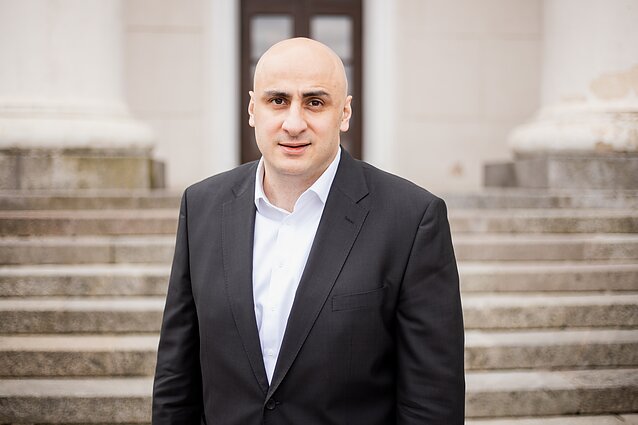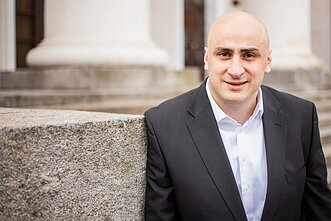








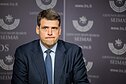


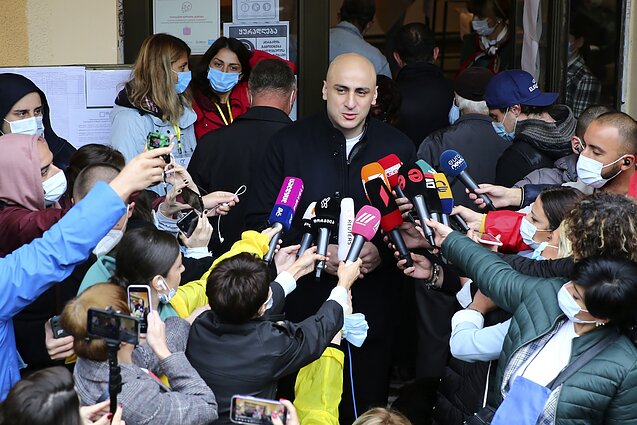
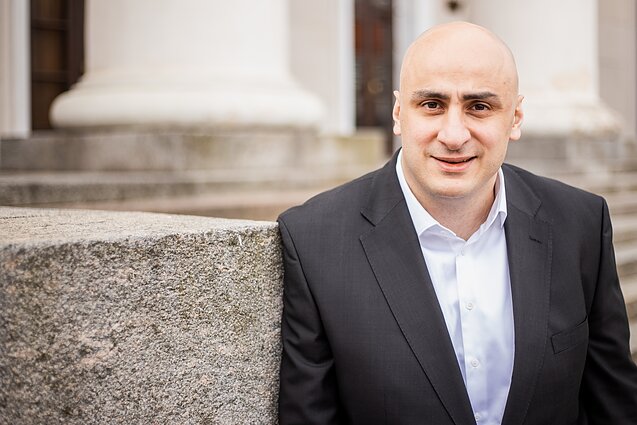
The Georgian government “has been captured by an oligarchic pro-Russian regime”, but the war in Ukraine gives hope that it will be defeated and the country will return to the Western path, says Nikanor 'Nika' Melia, the Georgian opposition leader, in an exclusive interview with LRT.lt.
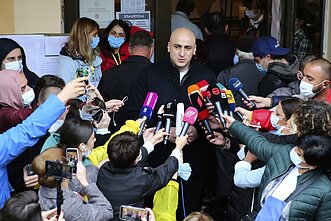
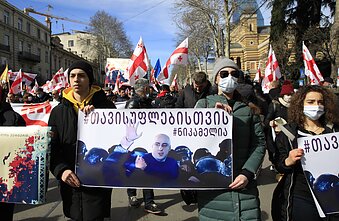
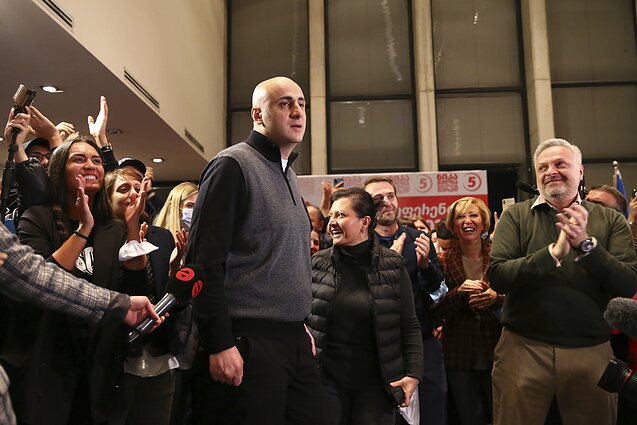
In February 2021, Melia, chairman of the United National Movement (UNM), the largest opposition party in Georgia, was accused of inciting anti-government protests and subsequently arrested.
Western leaders condemned Melia’s arrest as politically motivated and anti-democratic. Almost three months later, the opposition leader was released after the European Union posted his bail.
According to Melia, Georgia’s politics have turned to Russia after 2012, when the Georgian Dream party, founded by billionaire Bidzina Ivanishvili, came to power. Ivanishvili amassed his wealth by developing and selling businesses in Russia and remains sympathetic to the country.
The oligarch does not hold any formal position in the Georgian government, but the opposition considers him to be the de facto leader of the country, who is ruling from behind the scenes and pursuing pro-Russian policies. Since the Georgian Dream came to power, the country has slowed down the EU accession process and strengthened economic ties with Russia.
The country’s opposition has also accused Ivanishvili of rigging the results of the 2020 parliamentary elections, which his party won by a narrow margin. According to Melia, there is little democracy left in Georgia. However, if Ukraine wins the war against Russia, Georgia’s pro-Russian regime will be forced to retreat as well.
After regaining independence in 1991, Georgia turned to the West and became one of the most pro-Western countries in the region, which also did not hide its ambitions to join the EU. But in recent years, it took a different direction and elected a party that is linked to Russia and advocates for a better relationship with Moscow. Can you explain what happened in Georgian politics that it changed its course so drastically?
It’s painful for me to admit that these days, Georgia is walking toward Russia rather than striving to become a member of the big European family. The situation has changed dramatically since 2012, when, for the first time, the government was changed through peaceful means. And many people back in Georgia thought that the tradition was made to transfer the power peacefully to other winners. But they were deeply mistaken.
The pro-Russian oligarch who, up to now has the full control over all branches of power (at the same time, he is a shareholder of the biggest Russian gas company, Gazprom) did not think twice before taking the country back to the painful phantom called the Soviet Union and Russia.
From 2003 to 2012, the party I represented laid the foundation for the Atlantic integration of Georgia, and we took back from Russia our economic and political independence. We became, without an exaggeration, a frontrunner in Eastern Partnership and in striving towards the European family. But the situation is as it is. It doesn’t mean that we don’t have to fight further on.
All the population of Georgia, unlike its government, believes that the fate of the Georgians is being decided now in Ukraine. The surveys demonstrate that 91 percent of the Georgian population believe that the war in Ukraine is their own war.
At this very turning point for the world, you have only two choices. Either you take the right side of the history or you take the wrong side of the history. There is no third position you can take. But unfortunately, our government, because of the Russian infiltration in our governmental branches, managed to create for itself the third position. They didn’t really assist Ukrainians in any way. They declined to join the international sanctions. They did not adopt the resolution, which would have said that Russia is committing genocide in Ukraine. And the certain steps they made were not only not in favour of Ukraine but were against Ukraine.
To me, it’s very painful because I believe that, metaphorically speaking, Ukraine is a Christ who is being tormented for humanity today. The Ukrainians are tearing the masks off the hypocrites, including those Western bureaucrats, who used to hold on to formal rationalism and didn’t pay much attention to Ukrainians and Ukraine since 2014.
But what is a good point that I would like to mention is that many of those unmasked bureaucrats of Western countries are trying to take an honourable place in the Ukrainian boat, which is sailing toward the truth. So, as a Georgian, I would very much like for our people to have the chance to be in the same boat as Ukraine is. That is inevitable because the will of the Georgians cannot be prevailed by an oligarch, doesn’t matter how stinking rich he is, because our historical aspirations are to be a part of NATO and the European family.
So, do you think that the war in Ukraine could be a breaking point in Georgia as well?
Absolutely. There is no doubt about that.
We have many examples in the modern history of politics, where the ones, who had lots of money, had influence over the government and informally ruled certain countries. But they lost the battle against the people. I think Bidzina Ivanishvili realises that. In the not too distant future, the Georgian people will prevail over an oligarchic regime. That is why they are not supporting the Ukrainians. That is why on a daily basis, the government of Georgia is harshly criticising Ukrainian President Zelensky and his government in this crucially important time for the whole world.

And if they had a hidden desire, a couple of months ago, for the Ukrainians to lose the war against Russia, now, they revealed their intentions. Otherwise, I cannot explain why you should decline to join sanctions at any extent. You could draw the sanctions partially, you could join the international sanctions fully, or you could at least start a discussion about joining the sanctions or not. But from the very first minute, our government declined the possibility of joining the sanctions.
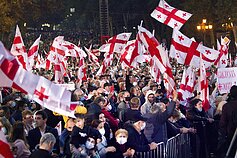
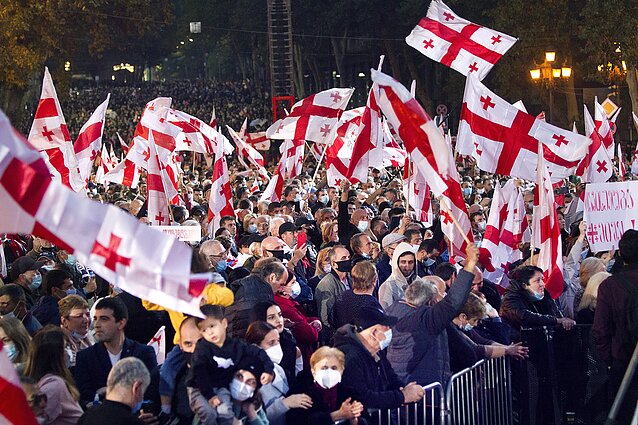
Then, the people of Georgia rallied many times on the main avenue of Rustaveli in Tbilisi. So, the Georgian Dream was forced to adopt a resolution on the Ukraine and Russia war. And a 'miracle' happened – they adapted their resolution on the war without mentioning Russia in it.
The head of the Georgian parliament also said he didn’t quite believe that the genocide happened in Bucha. After this statement, the head of the Ukrainian Rada Ruslan Stefanchuk invited the head of our parliament to go to Bucha and personally get convinced that the genocide happened. So, he had to go. But he came back to Georgia and he made the following statement: “Yes, I went to Bucha. There could some signs of a war crime.” He could not even dare to say that there were some signs of genocide.
So, these kinds of examples illustrate to me and to the population of Georgia the point that Georgia is not on the right track right now. But I’m already sure that it’s only a temporary occurrence.
You called your government an oligarchic regime. Do you think that there is no democracy left in Georgia?
It’s an important question. There are still some international partners of Georgia that could say up till now that Georgia is a democratic state with some signs of autocracy. But in fact, we can unfortunately freely say that Georgia is an autocratic state with some signs of democracy. We still have several TV stations that are not under the control of the government, as well as the public defender’s institution. If we remove these elements, we can say that we qualify as a typical and classical oligarchic and autocratic regime.
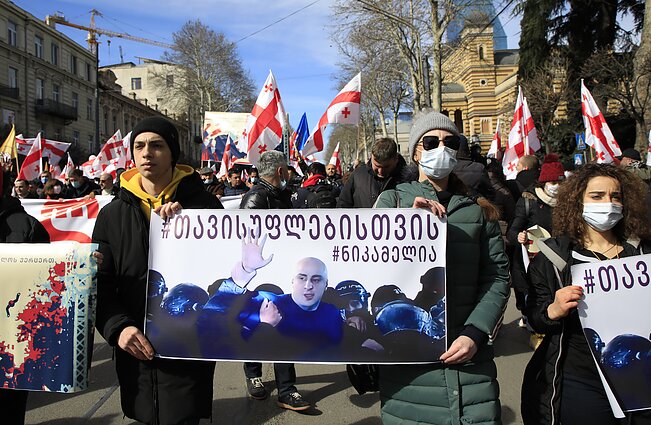
The state capture of Georgia is the case. And this is not me who is saying that. Our international partners in their reports, talking about this phenomenon, called it the state capture. But how could you assess otherwise when you know that the acting interior minister of Georgia is the former bodyguard of the oligarch [Ivanishvili] and when the acting prime minister of Georgia is the former cleric who worked in his bank.
So, that is why we need more intervention from our international partners. We should start seriously thinking about sanctioning Bidzina Ivanishvili, an oligarch who is financing the pro-Russian political system in Georgia. I’m happy to know that as days go by, more and more international partners of Georgia admit this. They also admit that they made a huge and dramatic mistake in 2008 when they did not support Georgia much.
Since the Russian invasion of Georgia in 2008, instead of cutting the economic and political relationship with Russia, the western part of the world did the exact opposite – they became more and more dependent on Russia. For example, they became more dependent on the energy supply from Russia.
After 2008, we had 2014, and the West didn’t react properly then either. Especially, I must say, the head of the German government Angela Merkel and French President François Hollande thought that they would appease Putin and he would calm down. But he had a rest for a few years and started another act of aggression in Ukraine.
History illustrates that you cannot appease the Russians, who have many times revealed their imperialistic intentions. If you appease them, they get more and more greedy. So, the best way to solve this problem is to be very fierce and very direct with Russian policy. I’m happy to know that the world is getting unified around Ukraine. And I’m very sorry that the government of Georgia is acting quite differently. But, in the not too distant future, we will change this situation because, as I already said, we feel obliged to be next to the Ukrainians with all of our heart.
How and when could this change in Georgia happen?
The fate of the Georgian statehood is being decided in Ukraine. And I’m sure that Ukraine will prevail over Putin. Ten days ago, I went to Ukraine myself. I was able to see the atmosphere in Ukraine, see the heroes. They are not even thinking about surrendering […].
So, I just cannot think that the Ukrainians wouldn’t win the war, which automatically means that Bidzina Ivanishvili’s oligarchic regime will be defeated. But we should not only rely on the Ukrainians’ heroic acts. We should also act in order to get rid of this oligarchic regime as soon as possible through peaceful means. There is huge readiness within the society to do so. And I think in the not too distant future, we will have the result which will make all the partners of our country happy.
Our citizens do not deserve to have an oligarch on their shoulders. We see that the number of Georgian emigrants is getting bigger and bigger. Last year, almost 100,000 people left Georgia. There is an expectation for another 100,000 people to leave Georgia this year. So, we are bleeding. The most active people in Georgia are leaving the country in search of a better quality of life. When people are happy, they’re not leaving the country. But since Ivanishvili came to power, more than one million Georgians have left the state. We should break through this vicious cycle at any cost.
Do Georgians also feel more insecure or threatened by Russia because of the war in Ukraine?
The Georgian government does everything in its capacity to make the Georgians feel afraid. They call the whole opposition and the civil society the “war party”. Whoever is against the policy of Ivanishvili, gets this label.
Don’t you think that it’s the same propaganda as the Russians have? The KGB methods work perfectly well within the Georgian government. It’s not surprising to know that nobody in his right mind likes to observe the war in Ukraine from the country which is occupied by Russia, and Russia took 20 percent [of territory] from us.
We have had this problem for 32 years. The Russians are all the time around the corner in Georgia. We have Russian tanks 40 minutes away from the very central part of Tbilisi, and we have this sword of Damocles hanging over our head anyway.
Under these tragic circumstances, when we have the Russian tanks just around the corner, nobody, for instance, would undertake large scale investments in Georgia. And when you don’t get investments, you don’t get development. So, anyway, we are in trouble. But because of the Ukrainians, the chance has now appeared to get rid of this evil power as Russia is.

Newsletter
Every Friday morning.