








LRT English presents a series of articles about seminal works by Lithuanian authors – all of them are available in English.
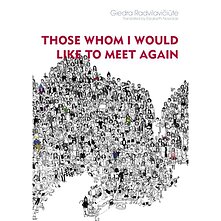
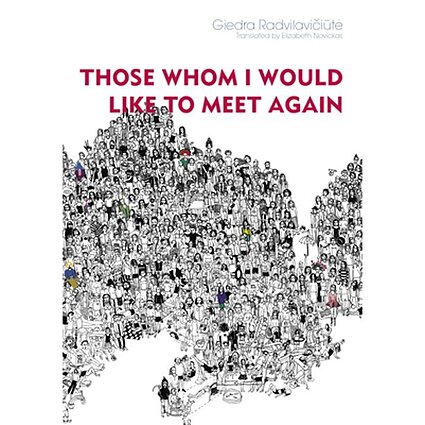
Those Whom I Would Like to Meet Again by Giedra Radvilavičiūtė
(Dalkey Archive Press, 2013; transl. by Elizabeth Novickas)
Against the background of the works discussed earlier in this series of reviews, one might perhaps arrive at the conclusion that all of Lithuanian literature is marked by doom and gloom – intimations of past and future apocalypses unfolding on both the personal and the societal level. So perhaps it is fitting, just for a change, to turn our attention to something a little different for this instalment.
Giedra Radvilavičiūtė’s Those Whom I Would Like to Meet Again is a lighter kind of book – physically, with its hundred-and-some pages, but more importantly as a reading experience, in the impression it makes on the reader. And yet, that lightness is also deceptive in a very deliberate way, acting as a stylistic cover for the work’s more delicate seriousness.
Those Whom I Would Like to Meet Again is a collection of short prose pieces – ten in total – of an ambiguous and indistinct genre: the texts are seemingly overtly autobiographical, covering subject matter such as scenes from the author’s family life, as well as her writerly (mis)adventures, but also carry a distinctly essayistic tone in their numerous philosophising tangents and ample metatextual references. The latter range from the highbrow canon – Nabokov appears more than once – to the pop culture of the day. As the title suggests, people and interpersonal relationships of all kinds lie at the heart of much, perhaps most, of the work: imagined dialogues with a departed parent, emergency visits to friends whose pickle jars have exploded, telephone chats with pushy know-it-all editors.

The dominant feature of the collection is its sharp-witted and breezily conversational tone, conveyed with ease by Elizabeth Novickas’s nimble translation. Radvilavičiūtė’s authorial voice never for a moment threatens to take itself seriously, even while the subject matter oscillates between the trivial and the profound. The effect is heightened by the form, the quick tempo of the short pieces keeping the reader on their toes, always half a pace behind the author’s weaving stream-of-consciousness turns. “Short stories don’t cut it – they don’t last long enough to really get into them,” an editor instructs the narrator in one story and recommends a switch to the – respectable, conventional, profitable – novel format for her next project. Instead, Radvilavičiūtė revels in the seeming triviality of her narrative form, crafting out of it a whole worldview with surprising depths.
The question of the worth of literature crops up more than once in the stories, and Radvilavičiūtė’s takes are suffused with a casual, playful cynicism. “I really do think great literature has died,” she confesses at the outset of the volume’s concluding story. And yet she shows little interest in trying to heroically resurrect the art form, rather preferring to pick at the corpse with her flurry of scattered, sarcastic observations. It is this necessity to try and the simultaneous, keenly felt impossibility of saying anything meaningful that characterises the work’s tone. Life can feel so full of meaning and yet, grasping for words to describe it, every utterance turns into a sad joke. It is “impossible to write about objectively, because love gets in the way,” as the narrator says of a friend.
There are times when Radvilavičiūtė’s literary reflections and the relentless satirisation of her own profession turn into a weakness, edging away from autobiographical authenticity and into the realm of writerly self-absorption. On the whole, however, her manifold ruminations on topics such as ageing, emigrant life and friendships are relatable and empathetic, and the stories are enlivened by her remarkable talent for sketching memorable and idiosyncratic characters in just a few sentences. This is especially apparent in the title story’s cavalcade of real and fictional personalities, but the whole collection acts on the reader almost like a series of delightful if bittersweet watercolour sketches that jump from the page.
The explicitly autobiographical stylings of the pieces give the collection a distinctly generational quality. The stories, originally published in various collections over the first decade of the twenty-first century, embody the voice of an educated forty-something (Radvilavičiūtė was born in 1960), someone who grew up in a world marked by the Cold War and witnessed its fall, and has since made a home for herself in the new configuration. This is evident, for example, in the recollections of the author’s expatriate life in the US in the 1990s, which differ markedly from the more obviously traumatic emigrant stories found in classic novels like White Shroud, although the ever-observant Radvilavičiūtė finds telling traces of those earlier generations and migrations as well.
Generations – and occasional intergenerational tensions – are also an important running theme in many of the relationships and scenes depicted throughout: mothers and daughters (and their daughters), childhood memories, lost landscapes. Echoes of Lithuania’s recent past regularly emerge from the web of reminiscences and soliloquies, yet the whole is filtered through the prism of a self-consciously post-modern, turn-of-the-millennium mindset and point-of-view. Of all the works considered in this series, Those Whom I Would Like to Meet Again is the only one firmly rooted in the present day – suffused with memories yet not overwhelmed by the past.
There is an affectionately depicted, yet melancholic, messiness to the world Radvilavičiūtė’s authorial persona inhabits, an imperfect and worn-out everyday clumsiness that makes it feel lived-in and familiar. This is in sharp contrast to the dictatorially artistic and hermetically self-contained aestheticism of novels like Vilnius Poker or Tūla, reviewed earlier in this series, and frankly, it’s a relief. Radvilavičiūtė very consciously writes against that cultural background tapestry – Tūla is referenced on the very first page of the first story – yet reclaims her city, her world, for the living, her Vilnius where “the streets are crooked. But in the spring, who knows, something could always happen.” What more is there to say? Something could – if you let it.
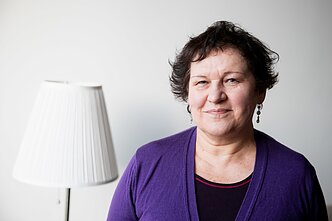
Mikko Toivanen (@aruinedmap) is a cultural historian with a lively interest in the literatures of the world and the craft of translation. He is also the co-author of a blog on fragmentary fiction.
Read more:
Lithuanian immigrant song from post-war New York. White Shroud by Antanas Škėma
Atrocities closely observed. Darkness and Company by Sigitas Parulskis
Identities in search of a city. Vilnius Wilno Vilna by Kristina Sabaliauskaitė
A game of chance you’re bound to lose. Vilnius Poker by Ričardas Gavelis
Invented woman, invented city. Tūla by Jurgis Kunčinas

Newsletter
Every Friday morning.