







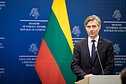


Lithuania’s Foreign Minister Gabrielius Landsbergis argues that “Putinist Russia” is not the same as the Russian Federation that the Europeans thought they were dealing with. The end goal of the war in Ukraine should be to achieve a systemic change in Moscow, he believes.
In an exclusive interview with LRT.lt, the Lithuanian foreign minister discusses the far-reaching implications of Russia’s aggression against Ukraine, how it is transforming Europe, the possible end of Putinism in Russia, and the readiness of Lithuania’s allies to defend the Baltic states.
In one interview, Mykhailo Podoliak, who is an adviser to President Zelensky’s chief of staff, when asked about the West’s reaction to Russia’s aggression, said that the West had not yet realised that the Russia with which they had been cooperating, with which they had had huge economic and cultural projects and strategies, was no more. Is he right?
I have said the same thing. Even today [interviewed on April 8], at a press conference, the question was asked: how do I see the continuation of the agreement between Russia and NATO on the establishment of permanent military units along the border? The answer is: the Russia with which the NATO-Russia Treaty was signed in 1997 no longer exists. What we have now is a Putinist Russia.
If we need to make a historical analogy again: the Germany of 1933, which was taken over by Nazis, was another Germany.
And perhaps political scientists would be better placed to pinpoint the exact point when Russia changed from the Russian Federation to Putinist Russia. Whether it was 2008 or the beginning of Putin’s career, the Chechen war, it is difficult for me to say, but history will describe that transformation. And now our only question is: how are we to live with Putinist Russia? How do we see our future existence? This is not to say that there won’t come a time when Russia is Russia in a common security area with Europe.

Putin is not just one man, Putin is a huge system, and it would be naive to expect that, if Putin were to be removed, something would suddenly change. We are now seeing that a very large part of the Russian public supports the slaughter in Ukraine. Meanwhile the West, I have the impression, was naive in believing that the Russians would see what was really going on and would take to the streets. Why this naivety? Does everyone judge Russia by their own countries?
There are many things that are judged in this way: “Russia would never attack Ukraine because it is irrational”, “Russia would not use bacteriological or chemical weapons because it is irrational”, “Russia would not attack NATO because it is afraid of the response”. Or the argument, which kind of throws me off, that Putin will rationally pursue a some sort of solution before May 9.
Maybe he will, but does that mean that he will not present whatever he has as a great achievement? This is a completely different information space, these are people living in an information bubble of their own making, a big Facebook bubble of 100 million people. So what is there to talk about? They will report what they want to report, they will present their “victory” however they want. I have no doubt that the scripts have already been prepared and all the i’s have been dotted.
There is no need to look at Putinist Russia through our own standards. It is a different state, operating according to different laws. [...]

So we should not expect a regime change to come from the Russian public, because they are not capable of it and do not see reality?
In the current circumstances, I do not believe that could happen. I believe that de-Putinisation will first take place first in Ukraine. This is Ukraine’s greatest gift to the world. The Putin regime is being dismantled there.
But this gift comes at a very high price.
The price is insanely high.
After World War Two, Europe kept saying “never again”. And suddenly we see a kind of re-run from Butcha. We see Europeans going to protest neat embassies. But their political leaders are hesitant. Are they hoping that the war will end and that we will go back to business as usual, or are there other reasons?
I think that strategically, we should ask ourselves – and I talk about it all the time in Europe, in NATO – […], what would be the end goal of this whole situation for us? And I sometimes think that for them [European leaders], for some of them, the goal is just ending the war, perhaps signing a peace treaty.
But on what terms?
Whatever, just a peace treaty: that’s it then, we’re done, we’ve ended the war. Some are thinking further, they are saying that perhaps the end should be replacing Putin. There certainly are those who think so in Western Europe.
But I keep reminding everyone that here, in Lithuania, we think that as long as there’s this regime, a regime of lies and propaganda, with its institutions and its intelligence services and so on, nothing will change. As you said: if we replace Putin, who knows if it won’t get worse. This is a systemic evil that has spread like a cancer throughout the country.

And until we have answered this question, we cannot have a strategic response: what is our ambition, what do we want? If we want an end to the war, then we need to put maximum pressure on the Ukrainians to sign a peace treaty under any conditions and that will be it. If we want to replace Putin, then we restrict his scope of action and hope that the dissatisfied elites will overthrow their leader. But if we want systemic change, we need to think in a different way. The country will have to be isolated, and perhaps for a long time, and for us this would be the real end of this war. It is regime change.
“For us” – you mean Lithuania?
Exactly, Lithuania. Because we are directly affected in terms of security. [...]
Russian propaganda is making threats that the Baltic States and Poland are the next targets. What are we to make of it? Is this just hate-mongering for domestic Russian consumption, or is it a message to our own people that, look, will you put pressure on your government to stay out and not help Ukraine?
I think it is a strategy of containment, a kind of deterrence, [a warning] that we are watching you.
Are you afraid?
No. We see that they are watching us, but they have been beaten in Ukraine. […] We have discussed that if Ukraine were in NATO, if the promises of 2008 were kept […] and if they had Western weapons now, rather than their Soviet ones, it would not even be an issue.
But it is very difficult to compare Ukraine with the Baltic countries. The size and some specific particularities, like the Suwalki corridor [the narrow gap of land between Poland and Lithuania]. There are people in Lithuania who are worried about that. George Bush gave a speech in Vilnius in 2002, saying that whoever chooses Lithuania as an enemy will be their enemy and that the Baltic states will no longer be alone in the face of aggression. Does that still stand today?
Absolutely. That is steel-tight tied and secure. The whole strength of the West rests on a small stone that is Lithuania or the Suwalki corridor. No one will test NATO’s resilience in the Netherlands, no one will test it on a the beaches of France. If anyone were to test the West, they would test it here. And that will show how strong the West is.

Do they in the West understand that?
I think so. And not without our efforts. We have chosen not to be silent, to be very outspoken. Even if it makes us seem presumptuous.
The political scientist Klaudijus Maniokas has criticised your foreign policy, saying that we should hold our horses, at least in terms of rhetoric, because we risk being isolated. In his view, we are essentially making ourselves a target. What would you say to this criticism?
I have read Mr Maniokas’ position, and I respect him as a specialist, an expert on European Union affairs, but I could not shake the feeling of 1940 [Lithuania was occupied by the USSR without even attempting military resistance]. At that time, too, there were also people saying: let’s agree, let’s not speak out, let’s not resist, and it will be fine.
Will we not have a repeat of 1940?
I do not see any reason why we should. Both because of the lessons learnt and because of the public's determination to defend themselves and their country. And today, what Mr Maniokas is criticizing, is perhaps this universal and empathic internalization of Ukraine’s struggle. [...]

In every crisis, real leaders emerge. At least among the Lithuanian public, there is a huge disappointment with Germany, which showed leadership in peacetime, when the economy was the number one priority, but not now. If not Germany, who is the leader of Europe today? A country or a person?
It is difficult to say, I would not be able to single out one. I see a drive for leadership and I appreciate it. I think that the French president, despite having been criticised for some of his actions and phone calls [with Vladimir Putin], is making an effort to carry the burden of leadership.
And it is rare that one is unanimously accepted as the leader, except perhaps President Zelensky, who is almost unanimously seen around the world as the leader of the free world, carrying all the burden and doing all the work. But if we look on the European side, I would say that President Macron has done that most clearly.
Germany is changing, and this is a difficult moment, given this country’s cultural and historical experience, its political dynamics. I have never been the first to criticise Germany, though I understand those who do, I understand what is expected of such a big country. […] I think they themselves understand that it will take time to regain the trust. And, importantly, they can start doing that in Lithuania, because they are very important here, both economically and in terms of defence, because of the battalion they lead [in Lithuania].

We are seeing a lot of interesting things in the European Union right now. For example, Poland used to be very friendly with Hungary, but now Jaroslaw Kaczynski said that if Orban cannot see the Bucha massacre, perhaps he should see an eye doctor. In other words, even ideological proximities no longer work in the time of Russian aggression. What kind of European Union will we see after this war?
I would start with Hungary. The isolation of Hungary is certainly palpable.
But they are still at the table and they still have a say.
Yes, they are at the table. One has to admit that, despite their rhetoric, they have not vetoed any decisions yet. That does not mean that we can reach very strong decisions, but I think that they are a significant part of the effort and some small steps can be made. It means that there is a difference between public statements, which are very strong, and the decisions that are agreed later.
The European Union is a very complex mechanism with many levels, and negotiations are almost never two-dimensional. One can always press or propose something that is important for a country, if you want to achieve a result. Being a very multifaceted union, it has much more dimensions than just, for example, defence.

NATO is a purely trust-based organisation whose sole purpose is to defend each other. That is all. There is no other lever with which we can negotiate. We will defend you – yes, we have to defend you, because of the promise in Article 5. That is why I have said that trust in NATO is something that has to be fought for and is extremely important, and if we were to lose it, it would be a great loss.
That is, if Russia attacked a NATO country and NATO did not react?
If they were unable to find a solution. That does not mean that NATO countries cannot help each other in other ways. There are ways. But it would be a huge loss for the Alliance. I hope that Budapest takes this seriously, because there are voices raising the question. [...]
Do you believe in Ukraine’s victory and do you believe that Russia can be a democratic country?
I absolutely believe that Ukraine will win.
Will it have won when it takes back Crimea, or in some other way?
I think that the real victory will be a complete victory. I would not put a deadline for when it will happen, I wish it as soon as possible, I will do everything to make it happen as soon as possible, as far as I and we as a country can help it. But there will be a victory.
Putinist Russia cannot be democratic. The Russian Federation can be democratic.