







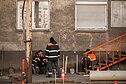

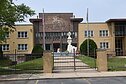



Poor food, no hot water, living in prison cells with no personal space. These are some of the complaints of migrants accommodated in Lithuania's Kybartai Foreigners Registration Centre.
In its recent report, the Parliament Ombudsmen's Office, called their living conditions inhuman and degrading. Meanwhile, the State Border Guard Service (VSAT) and the Interior Ministry say they are making every effort to improve things, which requires more time.
Read more: Report slams Lithuania’s treatment of asylum seekers as ‘inhuman and degrading’
A 19-year-old barber from Iraq is one of the residents of the Kybartai centre. In a makeshift barber shop he shaves about 20 people a week and does not take payment. Asked about the living conditions, he said: “It's like hell here, I'm in prison.”

The facility used to be a correctional home and was converted into a migrant centre just 4 months ago.
When LRT TV reporters visited it late in January, tea and soup were ready for lunch, as well as chicken with rice and salad. Meals here are served three times a day.
However, people in the centre had much to complain about.
“I'm vegan, so I can only eat rice and cabbage. Every day. For dinner, cheese, bread and one apple. That's not enough,” said one of them.

Living conditions are not satisfactory either, many said. They showed to reporters poor washrooms, with only cold water, and the cramped rooms, where they hang blankets in search of privacy from one another.
“There are 15-20 people in each room. No privacy, no space. We can only sleep, wash our faces and sleep again” said another man.
“Everything is very bad. I had only seen the prison in movies – and now here,” added another.
People accommodated in Kybartai have about 3 square metres of space per person. The minimal requirement is 4 square metres.

When the building was used as a penitentiary, the current living quarters were a disciplinary unit – prisoners would be sent to these cells as punishment for disciplinary offences.
There are some 550 migrants accommodated in the Kybartai Centre. Over 100 have already gone home – the Lithuanian government has been offering 1,000-euro payment to leave voluntarily.
“It is very difficult here. Tomorrow I'm going to the airport to fly home to Lebanon. I don't know if I will get the money I was promised, but I don't want to stay here anymore,” said one migrant.

When the migration crisis started last spring, the Lithuanian parliament passed a law allowing the authorities to lock up irregular migrants for up to six months. Detention-like conditions were singled out in the Ombudsmen's Office's report.
The migrants voice their hardships whenever someone would listen, even when seeing a doctor.
“They come to the doctor and say ‘I want freedom’. I say that I don't make prescriptions for freedom,” says family doctor Vilius Kočiūnaitis.
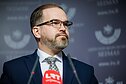
Ombusdwoman Erika Leonaitė says that the living conditions in Kybartai are inhuman and degrading.

“Some guards carry out checks several times a night - they turn on the lights or count how many people are present. In reality, such checks should only take place once. The overcrowding, the lack of hygiene, the lack of things to do, these are situations where people are not even free to leave the floor where they live, except in prescribed cases - they go to the shower, to the shops or to the canteen according to schedule,” Leonaitė said.
“The minister [of interior] must come up with a concrete plan of measures, otherwise she will have to take action and take individual responsibility. In general,” says opposition MP Vytautas Bakas, a member of the parliamentary Human Rights Committee. “The Prosecutor General's Office must react to this report, to assess if this is not criminal.”
Gintaras Klimavičius, the head of the Foreigners' Registration Centre in Kybartai, claimed that the cries for freedom can only be heard through the windows when reporters come.

He also said more space would be freed up, once some migrants were returned home.
“As for hot water, yes, it has not been installed yet, but as far as I know, procurement has been started, a tender will be launched and showers will be installed, toilets renovated, corridors painted,” Klimavičius said.
“We are facing shortages of specialists, medics, social workers, psychologists in this region. So it is objectively difficult to change the situation in the Foreigners' Registration Centre in a short period of time,” commented Rustamas Liubajevas, head of the Border Guard Service (VSAT) which is currently in charge of accommodating asylum seekers.

The Interior Ministry said that it was working on having a separate institution take care of it.
“Perhaps an agency could be set up to take care of the conditions, procedures, services and accommodation of irregular migrants and asylum seekers,” said Deputy Interior Minister Arnoldas Abramavičius.
According to Ombudswoman Leonaitė, if migrants were to take their complaints about living conditions to the European Court of Human Rights or the Strasbourg Court, Lithuania is very likely to lose the case.

Newsletter
Every Friday morning.