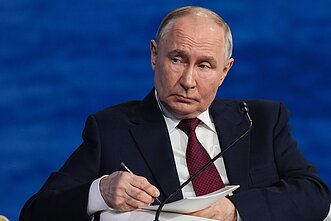




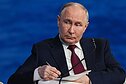





Last week, Russian President Vladimir Putin claimed Moscow was ready to cooperate with Lithuania based “on principles of mutual respect”. Did Putin signal any tangible intentions or was it just empty rhetoric?
During the accreditation ceremony of new foreign ambassadors to Russia, including Eitvydas Bajarūnas from Lithuania, Putin said that "our interaction with Lithuania could be more active and multifaceted".
"We stand ready for cooperation based on principles of neighbourliness and respect to each other and would like to see the same approach by our Lithuanian counterparts,” the Russian president was quoted by the Interfax news agency.
But his words were aimed at criticising Lithuania, according to Laurynas Jonavičius, a professor at the Institute of International Relations and Political Science (TSPMI) at Vilnius University.
“These words showed one thing – that Lithuania is to blame for the fact that bilateral relations have faltered,” Jonavičius said.
The TSPMI professor added that there were no indications that the situation on the part of Russia could change substantially. According to him, the new Lithuanian government was not capable of changing the relations with Russia until the Kremlin itself showed a willingness to do so.

Read more: Russia’s Putin says Soviets occupied Lithuania ‘with consent’
“We must evaluate relations with Russia by its deed," said Marius Laurinavičius, an analyst at Vilnius Institute for Policy Analysis. "We should not be fooled by the phrase that allegedly offered cooperation. This was not a new proposal to Lithuania."
“If Russia really wanted to improve its relations with Lithuania, it would do so in a different way or such statements would be accompanied by a formal invitation to negotiate,” he added.
'Terrorist state'
In the past decades, Lithuanian–Russian relations have remained tense, mainly due to the Kremlin’s military aggression in Ukraine and Georgia.
Russia has also imposed sanctions on Lithuania, including an embargo on dairy and meat products. Other Baltic states have also condemned Russia’s foreign policy that has resulted in unstable bilateral relations.
The strict rhetoric against the Kremlin by Lithuania’s former president, Dalia Grybauskaitė, was a symptom of the deteriorating relations between the two countries.
Read more: No need for radical foreign policy change in Lithuania, says foreign minister candidate

At the beginning of her first term, Grybauskaitė tried to establish contact with the country's eastern neighbours, including both the Belarusian leader Alexander Lukashenko and the Kremlin.
When Putin served as the Prime Minister of Russia, Grybauskaitė met with him in Finland in 2010 to discuss Gazprom, the behemoth Russian gas supplier that had maintained a near-monopoly in Lithuania.
But Grybauskaitė failed to negotiate favourable conditions and gas prices for Lithuania remained high. Later, she admitted that during the meeting, Putin listed his demands for Lithuania, including the closure of the Visaginas nuclear power plant.
Bilateral relations further deteriorated after Russia’s annexation of Crimea and the start of aggression in eastern Ukraine in 2014.
“This state has all the features of international terrorism. Those that send the army and armaments without any signs of identification can only be called [terrorists],” Grybauskaitė said six years ago.
The president had repeatedly called on the international alliances to act as a buffer to Russia.
Read more: As Baltic security 'deteriorates', Sweden turns to arms – interview

“Russia poses a threat not only to Lithuania or the Baltic region but also to the entire Europe,” Grybauskaitė said in an interview with Foreign Policy in 2017.
“It is important that countries like the United States do not leave the global political arena. If that happened, Russia would quickly take its place,” she added.
Her predecessor Valdas Adamkus was also critical of the aggressive Russian policy and said that Lithuanian–Russian relations could not improve for as long as Putin remained in power.
“We have been talking about the Russian and Belarusian regimes for a long time, but they have not changed over the decades. This poses no less of a threat to our security than Astravyets NPP” in Belarus, Adamkus said this year.
No improvement
Baltic states’ politicians and experts do not talk about a possible improvement of relations with Russia. The same is true for Russian diplomats.
“Looking at the whole history of the relations and their complete cooling down, it is not necessary to talk about improving cooperation now,” Russian daily Sevodnia quoted the Russian Ambassador to Latvia Yevgeny Lukyanov in October.
“We need to take today’s realities into account and think about the interests of the people of both countries. We do not see a friendly approach on the part of Latvia,” he added.
Read more: Baltics, Poland urge Russia to respect 'territorial integrity' of neighbours

During Gitanas Nausėda’s presidency, Lithuanian–Russian relations have not changed. This summer, the president criticised the Kremlin’s efforts to rewrite the history of the Second World War after the Russian parliament considered a bill to revoke the condemnation of the Molotov–Ribbentrop Pact.
Read more: Lithuania protests Russia's move to rehabilitate Molotov–Ribbentrop Pact
The Baltic states then accused Russia of falsifying the history of the Second World War. In response, Maria Zakharova, spokeswoman for the Russian Ministry of Foreign Affairs, said that Lithuania relied on old “phobias” that hindered the improvement of bilateral relations.
Dmitri Trenin, director of the Carnegie Moscow Centre think tank, told LRT.lt that Putin’s words last week were merely diplomatic and did not imply any greater ambition to establish closer relations with Lithuania.
“I have looked at the president’s statement and found it diplomatically bland and polite, but devoid of any special message. I don’t think that Putin worries that [...] Lithuanians don’t want to talk with him,” he told LRT.lt.
“He basically says that if Vilnius wants to start a meaningful dialogue, Moscow will not ignore that,” said Trenin.
Read more: Lithuanian president to rally EU support against Russia’s revisionism

Newsletter
Every Friday morning.