




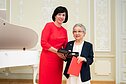


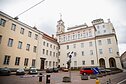

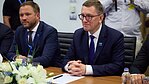




Sweden is set to dramatically raise its defence budget by 40 percent. In an interview with LRT.lt, the country’s Ambassador to Lithuania Inger Buxton talks regional security, coronavirus, Belarus, and "feminist foreign policy".
“We are living in a time when multilateral cooperation in the world is being challenged by some governments who no longer support the established rule-based world order and are undermining it with their actions," Buxton told LRT.lt in Vilnius.
"So it’s very important that countries like Sweden and Lithuania speak up to defend international cooperation that we have built up after the Second World War."
Do you have any concrete goals that you would be happy to achieve during your term in Vilnius?
We have been very supportive on gender equality. And I was very happy to see that there were more women nominated from the political parties in this parliamentary election. I think that is a good sign.
Another area is different types of human rights. You know that we are promoting it globally, but also in our own countries we have to continue to work on human rights issues, for example, when it comes to hate speech, hate crime, which is unfortunately increasing in society. Also with more extremist opinions, more nationalism and racism, we have an increasing challenge which we have to work on.
I think that we will also work with Lithuania to support the Belarusian population.
We are also very active from the Swedish side supporting LGBT rights, so working with organisations that are working with human rights, including LGBT rights, I see as a priority.
I think that we will also work with Lithuania to support the Belarusian population. Sweden and Lithuania have financed the EHU [the European Humanities University, an exiled Belarusian institution based in Vilnius] that we will continue to do.
Sweden will also take over the chairmanship of the OSCE from January, so we will work on Belarus, but also on the protracted conflicts in Nagorno Karabakh and Transnistria.

Sweden has proclaimed itself pursuing a feminist foreign policy. You are the fifth female ambassador to serve in Lithuania in a row, so is feminist foreign policy just about encouraging more women to go into diplomacy or is there a broader programme?
It’s six years now since we’ve launched the feminist foreign policy. And it is about women’s rights and ensuring we have equality between women and men, both in terms of social rights, democratic and economic rights. It’s a fact that countries that have more equality between men and women are also more prosperous economically, so there is the economic argument for it.
Read more: Lithuania's PM candidate: destroying 'world order' and why women-led parties won
Sometimes in the past it was seen as a one-side issue we dealt with and we provided financial support to organisations and so on. With the feminist foreign policy, [gender equality] was really integrated into the centre of our foreign policy. And that includes hard security policy issues, trade policy issues.
With the feminist foreign policy, [gender equality] was really integrated into the centre of our foreign policy.
Unfortunately, what we have seen for a number of years now is that in a number of countries gender equality has been backtracking, in terms of salary or employment of women and so on. There is also a number of countries that still have legislation that prevents women from having the same opportunities as men.
We also see the impact of Covid-19. Women often work in sectors that are harder hit and don’t have the same social security network as men do. And sometimes governments take the opportunity to reduce the rights in terms of freedom of movement, of speech and so on, using the pandemic as an excuse.
Today there are six countries that have adopted feminist foreign policy, not just Sweden.
How does Sweden see the gender equality and human rights situation in Lihuania? The country's government was criticised for not having any female members in the cabinet at one point.
There can be improvements both in Sweden and in Lithuania, definitely. The fact that there were more women running for seats in the Seimas is one important aspect. Of course, I believe a government that is more gender-balanced is better for a number of reasons.
You need to have different perspectives and if you are promoting gender equality in the society, as government you have to be representative. Young people need role models.
Then there are issues that need work. For example, when it comes to disability rights, women’s disability rights is one area where I think there’s room for improvement. Also, equal pay – that is something Sweden has to work on in our own country, too.

The Swedish government recently proposed to increase the defence budget and to restore the Northern Regiment. Does Sweden see the security situation as deteriorating in the Baltic region or globally?
We have seen for a number of years now that the security situation in the Baltic Sea in the High North has deteriorated. Not least with the Russian annexation of Crimea and [war with] Georgia in the past, military activities over and around the Baltic sea area. And that has meant that the Swedish government put a bill to the parliament for the biggest increase in defence expenditure in 70 years.
It means that, from 2014 to 2025, there would be an 86-percent increase in defence spending.
We have seen for a number of years now that the security situation in the Baltic Sea in the High North has deteriorated.
That includes reestablishing and reeponing some regiments that have been closed. Also, we are increasing the number of personnel in the war organisation from 60,000 to 90,000, so that is also quite a big increase. The annual basic military training will double.
We believe this is important for the security in the Baltic sea region. We have for a number of years strengthened cooperation between Sweden, Finland and the Allies.
This bill is not only about military defence, but also about civil defence. Increasing the resilience of society, not to be too dependent in terms of energy security, food supplies, training for civilian staff.
Read more: After US election, Lithuanian president hopes for attention to Baltic security

Sweden recently banned several Chinese manufacturers from developing 5G networks in Sweden. Why and how much is it connected to the agreement that Baltic nations signed with the US on network security?
In January, we introduced a new law that strengthened protection of communication so that when there is a bid – in this case, it is a question of an auction which will be held in November – [there are rules] who can compete in that auction.
5G network is very critical for the infrastructure of Sweden, this law means that the communication authorities have to consult with the Swedish armed forces and security services to have their assessments on companies that want to bid.
The Swedish armed forces and security services said that there were some companies that did not live up to the security requirements that we want to see.
Therefore, they have been excluded from the competition. We should emphasise that this wasn’t a decision on a specific country, it was really a decision on the companies biding to be part of this auction.

Sweden’s approach to the coronavirus pandemic has been different from that of many other countries. Has it been a success?
I think there was a realisation among health experts that this virus will not be a short threat, but a very long health issue that needs to be addressed over time. Therefore, Sweden took a decision not to have a lockdown, like many other countries did.
But when you look at what Sweden introduced, it is not that different from other countries. It was really based on citizens’ own responsibility, not tight laws or fines or anything like that.
There have been discussions in Sweden what measures are right or wrong. The level of people who died was relatively high in comparison to some other countries.
The big difference between Sweden and other countries is the masks – in no place are you required to wear a mask. And that is based on assessments by medical experts that the most important thing is keeping social distance. They say that there is a risk of masks giving a false feeling of safety. But of course some people wear masks in Sweden, it’s really up to you.
There have been discussions in Sweden what measures are right or wrong. The level of people who died was relatively high in comparison to some other countries. That has to do with nursing homes, unfortunately, many elderly people died. That has been discussed a lot in Sweden, how we could have prevented this.
Now that we see the numbers going up, there are some people that are fed up. It is a bit harder to get people to follow the advice and rules introduced by the authorities.

Your mentioned that Lithuania was your first choice – why did you pick Lithuania as your first ambassadorial posting and did you study any Lithuanian?
Yes, I did start learning some Lithuanian before I came here. I am now continuing to learn it.
Why I chose Lithuania? I heard many good things, I had been here twice, including when you held the OSCE chairmanship in 2011. It is sort of our common history, the development of our region both in terms of security cooperation, but also economic cooperation.
Its also nice to come here as a Swede because you feel very welcome, given that we have had very good relations after the 1990s . You meet a lot of people who speak Swedish, it is very nice to feel that there is an interest in Sweden.
Do you have any hobbies, any free time for them?
I am very interested in history, visiting places. I did actually go on Sunday for the fist time to the [Gediminas] castle to look at the exhibitions there, you have a fantastic historic heritage with churches, castles.
I like trekking, getting out in nature, you have very good restaurants, which is very nice.
I am also a skier, but we will see if there will be snow here.

Newsletter
Every Friday morning.