













Belarus' nuclear plant, Moscow, and political infighting – what is behind Lithuania's feud with the Baltic states over energy trade?
Since the collapse of the Soviet Union, Estonia, Latvia, and Lithuania have continued sharing the same Russian-controlled power grid with Belarus. By 2025, the three Baltic states plan to switch to a European network. Meanwhile, Lithuania has blocked electricity trade with Belarus after it launched its nuclear plant earlier in November.
Read more: Incident reported at Belarus nuclear plant days after launch
However, Lithuanian lawmakers say that power produced at Astravyets, just 50 kilometres from Vilnius and considered unsafe by the Lithuanian authorities, may be entering the Baltics via Latvia's connection with Russia.
Therefore, Lithuanian MPs called on the government to pressure Latvia against electricity trade with Russia.
The Committee on European Affairs suggested that the Lithuanian Foreign Ministry inform its Latvian counterpart that Riga “has violated the 2018 [...] tripartite agreement" on electricity trade with third countries.
Under the agreement, the Latvian–Russian border was closed to electricity trade with Russia. However, Riga announced it had started electricity trade with Moscow shortly after Lithuania blocked the Baltic states from trading with Belarus.
Read more: Moscow accuses Lithuania of discrimination, calls not to limit electricity trade

Lithuania is the only Baltic country that has a connection with Minsk. Despite blocking commercial trade, the physical flow of electricity continues due to the common energy grid.
Meanwhile, Latvia reasons that it is applying the new trilateral Baltic methodology for electricity trade with third countries – including Russia – which Lithuania has also accepted earlier this year.
The methodology allows importing a certain amount of electricity from Russia, provided that it has "a proof of origin that the imported electricity is originated from non-Belarusian producers".
But the new deal has been controversial. It has been approved by the Lithuania Energy Ministry, which represented Vilnius in the pan-Baltic negotiations, but has not been greenlighted by the National Energy Regulatory Council (VERT).
The Estonian and Latvian energy regulators have backed the deal and agreed to support Lithuania by boycotting the electricity produced at the Astravyets NPP.
However, Lithuania's regulator (VERT) insists that the amount of Russian electricity entering the Baltic market would simply double and power produced at Astravyets NPP would still enter the Baltics via Moscow and Latvia as the certificate system – cornerstone of the new deal – has not been created.
Read more: As sirens blare across Vilnius, authorities test nuclear response readiness

Read more: Baltics agree on methodology to boycott Belarusian nuclear energy
VERT, therefore, has called to further reduce the amount of electricity from Russia that could enter the Baltics.
In early November, Lithuanian Energy Minister Žygimantas Vaičiūnas claimed that VERT had been part of the negotiations and the disagreements arose “only before the [Lithuanian parliamentary] elections” in October.
He did say that “there may be objective reasons” for VERT refusing to sign the new deal, when the regulator “saw that it will have to actually implement this methodology, then maybe they looked at the [deal] more carefully”.
Meanwhile, VERT said it only found out in September that the negotiations had been concluded at the political level. Head of the regulator, Inga Žilienė, told LRT.lt that calculations regarding how the methodology will actually work once the Astravyets NPP becomes operational have not yet been done.
The conservative Homeland Union–Lithuanian Christian Democrats (TS-LKD), the winner of last month's parliamentary election, has also criticised the new methodology, saying it cannot prevent electricity produced at Astravyets from reaching Lithuania.
Lithuanian Energy Minister Žygimantas Vaičiūnas, however, says that the methodology prevents commercial electricity flow from Belarus from entering the Baltic electricity market.
According to Vaičiūnas, it would be naive for Lithuania to expect a methodology that would not only bar access for Belarusian electricity, but also would also prevent Latvia and Estonia from importing Russian electricity.
The conservatives say the methodology proposed by the minister does not have enough safeguards to ensure that Latvia does not buy Astravyets electricity through Russian intermediaries.
Both the conservatives and the parliamentary Committee on European Affairs have called on the Foreign Ministry to take over the negotiations.
They say electricity flows need to be more strictly restricted and the certificate system agreed in the deal – which is used to determine that the electricity has not been produced at Astravyets NPP – must be more reliable.

Read more: How Lithuania fought and failed to stop Belarusian nuclear project
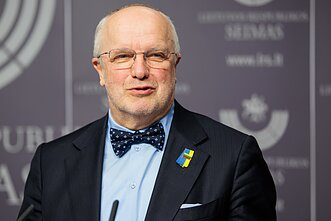
Gediminas Kirkilas, chairman of the outgoing Committee on European Affairs, told BNS that the committee had approved the position unanimously.
Kirkilas, the leader of the Lithuanian Social Democratic Labour Party (LSDDP), said that the position would help draw Brussels' attention to the matter and that the Foreign Ministry's taking charge of the talks would allow voicing a more coordinated position.
Lithuania's current foreign minister, Linas Linkevičius, is also member of the LSDDP.
MP Dainius Kreivys of the Homeland Union said that Latvia could be breaking its political promise not to buy energy produced at the Astravyets plant.
"Following the launch of the Belarusian nuclear power plant, an analysis of electricity flows shows that Latvia is successfully selling electricity entering Lithuania through the Lithuanian–Belarusian connection [...] in our market," Kreivys said.
"Lithuanian tax-payers' money is thus being used to finance the Astravyets nuclear power station's further development and, at the same time, Alexander Lukashenko's regime," he added.
The Seimas committee calls on VERT "to submit proposals on how to stop large electricity flows to Lithuania from Belarus in order to ensure that electricity produced by the Astravyets NPP does not enter the Lithuanian electricity market and that Lithuanian consumers do not pay for it through the Riga exchange".
The committee's position is not legally binding, but aims to send an important political signal.
Read more: Kremlin may threaten nuclear incidents in Belarus to blackmail Lithuania – MP

Newsletter
Every Friday morning.