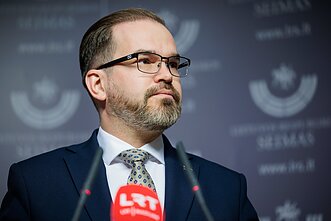










An institution owned by Prime Minister Inga Ruginienė’s public adviser and fellow Social Democrat Vigilijus Jukna received European Union funding for farmer training sessions that were often left without attendees, 15min.lt reported on Tuesday.
According to the investigation, Jukna’s organisation Mokslinės Paslaugos is currently implementing two major EU-funded projects covering 51 municipalities across Lithuania.
One project, focused on sustainable livestock farming and animal welfare, si about certifying 1,155 farmers and organising 77 training sessions. Another, covering sustainable livestock farming and plant protection, includes plans for 130 training sessions and 1,980 certificates. The institution is due to receive nearly 299,000 euros for the training programs.
Jukna, a former member of the Labour Party who now belongs to the ruling Social Democrats, also serves as chancellor of the Agriculture Academy at Vytautas Magnus University, which organises similar training sessions.
Although program rules require at least 12 participants per session, 15min.lt said it checked 13 training events over several months and did not find attendees at any of them.
“There was one lecturer, nobody else,” an employee of the Sela Museum in Biržai told the portal.
“They both happened and didn’t happen. They were supposed to take place, but there were no people there,” a representative of the Telšiai Education Centre said.
Journalists contacted nine institutions whose premises had been rented for training sessions last autumn. Staff at many of the venues reportedly gave similar answers, saying that participants who registered in advance often failed to appear.
“Sometimes they come for half an hour. How am I supposed to keep them there? [...] They already know everything,” lecturer Mindaugas Kuklierius of the Agriculture Academy told reporters after being approached in an empty museum hall in Biržai. He later acknowledged receiving 200 euros for each training session.
Jukna did not respond to 15min.lt’s questions about the institution or the empty training sessions.
Lithuania’s National Paying Agency, which oversees the EU-funded projects, said it had not identified serious violations. However, the agency’s inspections were carried out remotely and announced in advance.
After journalists described the situation without naming specific training dates, agency official Genovaitė Beniulienė said that if the suspicions were confirmed, it could constitute “a violation of funding conditions” and sanctions would likely apply.

Newsletter
Every Friday morning.