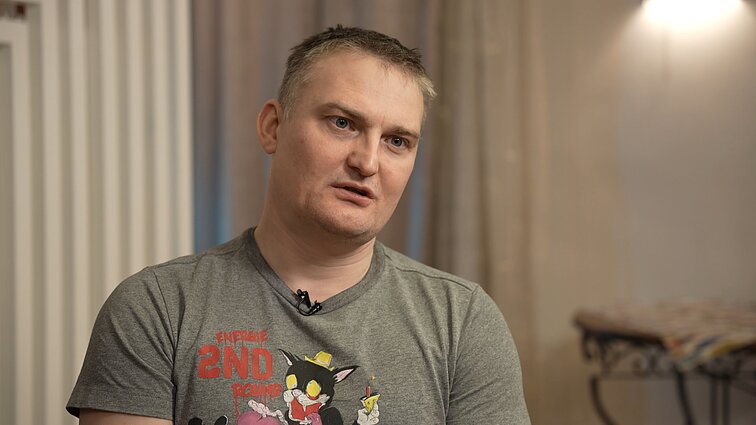















Mikhail Benyash, a renowned Russian lawyer and activist residing in Lithuania under a humanitarian visa, was nearly expelled from the country because he travelled to Minsk to see his son. He successfully challenged the decision in courts – but warns that bending law to political passions risks pushing Lithuania down the path of his home country.
Lithuania’s Supreme Administrative Court sided with Benyash and ordered the Migration Department to reinstate his residence permit.
The Migration Department had deemed his two trips to Minsk a violation of the new law that restricts travel by Russian residents of Lithuania to Russia and Belarus, and revoked the residence permit.
“I welcome the court’s decision. It shows that the judicial system in Lithuania is healthier than in Russia, more independent,” the lawyer said in an interview with LRT.lt.
The law came into effect last May and bars Russian residence permit holders from going to either Russia or Belarus more than once every three months. Lithuania’s security authorities argued it was necessary to limit the risk of them being recruited by hostile agencies.
The restriction is part of an expanding set of measures adopted in the wake of Russia’s attack on Ukraine in early 2022. Though temporary, the law gets extended every year and targets the citizens of Russia and, to a lesser extent, Belarus.
Under it, Russians cannot apply for visas or residence permits (unless they already have one), they are subject to additional security checks on the border and have to fill out a questionnaire about their personal opinions on the war in Ukraine. Non-resident Russians are not allowed to purchase real estate in Lithuania.
In an interview with LRT, Benyash argues that these rules put Russians in Lithuania under senseless pressure and fear, fomenting toxic environment that contributes very little to actual security.
He lost his residence permit last September because he went to Minsk two times, three weeks apart, in order to meet his seven-year-old child at the airport and then send him back to his mother in Russia.
When the Migration Department quoted these trips as grounds for designating Benyash a security risk, he went to court. The first instance court dismissed his complaint, but the Supreme Administrative Court sided with him and recognised that meeting and seeing off his son was an “objective reason” for an exception.
Benyash is a lawyer from Krasnodar who defended activists and protesters in Russian courts. After the Russia’s full-scale invasion of Ukraine in 2022, he came under pressure from Russian authorities: he was fined for “discrediting the army”, designated a “foreign agent”, and then disbarred from practising law. He ultimately left Russia and moved to Lithuania, where he received a humanitarian residence permit.
In Vilnius, Benyash worked as a plumber. However, the decision of the migration authorities to revoke his residence permit also made him lose his job.

What was your reaction when you learned of the Supreme Administrative Court’s ruling in your favour?
The usual: joy, restrained satisfaction.
Did you expect this outcome?
Yes.
How typical is your situation, how relevant is this issue for other Russians in this country?
People are frightened in Lithuania. Russians live here in fear. Those who live on humanitarian residence permits are all frightened. They’re afraid of the Migration Department, afraid of what it will do.
People are afraid that the State Security Department [Lithuania’s intelligence service] will comb through their social media and find a photo, for example, at the CSKA stadium from their youth or who knows when. Or they’ll find out that the person once worked at Gazprom or served in the army. Or they’ll come up with something else that would be enough to declare the person a threat to national security and their presence in Lithuania undesirable.
Almost everyone who lives under a temporary residence permit understands the threat. Sometimes, if you get into an argument with Lithuanians, they’ll tell you: “We’ll file a complaint against you with the Security Department. Let them check whether you’re a threat to national security.”
This recalls what I’ve heard in Russia: “You’ll be designated a foreign agent.” Well thank you very much, they already have. That’s what it looks like to me. People are intimidated.
So I welcome the court’s decision. It shows that the judicial system in Lithuania is healthier than in Russia, more independent. One can work with it. Most importantly, the judicial system isn’t susceptible to propaganda, which, in my opinion, was clearly evident in the ruling of the lower court and in some other decisions I’ve reviewed over the years.

Could you elaborate on the circumstances under which you had to travel to Belarus? You met your son there and then took him to his mother? Were those two trips?
Yes.
So the decision to revoke your residence permit was based on just those two trips?
Yes. What’s more, if I had spent the entire time between those trips – two and a half or three weeks – in Minsk, it wouldn’t have been considered a violation of the law. [...]
It seems to me, this contradicts the legislators’ intention. Because I could have spent ten times more time in Minsk than I actually did, and it would have been legal. This speaks to the poor quality of the law.
This isn’t just my opinion, it’s the opinion of Lithuanian lawyers, including the Seimas lawyers, who issued a negative opinion on this bill. It would be good to talk about this more often, so that the law doesn’t bend to propaganda.
I understand Lithuania’s situation, the country is in a state of hybrid war. But I’ve said it before and I’ll repeat it again: the most important thing Lithuania has – and this applies to any democratic state – is its legal system, its law. This is the key difference between Russia and Lithuania. We mustn’t allow the law to be bent to serve hate propaganda or short-term political slogans, be used by politicians to score political points.
I’ve observed this happening in Russia over the past twenty-odd years: the law has been distorted to serve populists, especially before elections. The harsher the politicians’ rhetoric – which they then tried to implement – the more the law suffered.
I try to look at this calmly, without emotion. My approach in this case is purely academic. This is important. I consider myself a friend of Lithuania and am trying to help it even with this case. I tried to reach out to Lithuanian politicians, I tried to be heard, but I failed.
Have you met with Lithuanian politicians?
No, although I would be happy to talk to any Lithuanian politician.
The problem is that there’s a wall between Russian citizens who fled the repressions and Lithuanian politicians or decision-makers. The communication is one-sided. We’d like to be heard too. We’re not saying anything shocking or hostile – these are perfectly reasonable things.
Besides this law, are there any other recent regulations that you find unreasonable?
I actually only recently returned to the legal profession, and not by choice. But there are some very simple examples.
Say, the Lithuanian Law on Advocacy. […] There’s a provision that allows lawyers from other countries to obtain a license in Lithuania without passing the Lithuanian language exam. So a French lawyer can do it, an English lawyer can do it, a Polish lawyer can do it. A Russian lawyer can’t – there’s a specific clause saying that Russians are not allowed to do it. It’s a direct ban.

Russian lawyers living in Lithuania are quite strong professionals and it would be useful for Lithuanian lawyers to communicate with them. I tried to reach out to Lithuanian lawyers, but everything is often viewed through the prism of fees, so the dialogue didn’t really work out.
There are other regulations that, in my opinion, are harmful to Lithuanians themselves. For example, restrictions on the purchase and sale of land. This impoverishes the Lithuanian market. Not only does this prevent Russian citizens from participating in the Lithuanian economy and thereby strengthening it, but it also simply reduces demand in the real estate market. At the same time, I don’t see any real security risks here.
There can be sensible solutions – for example, restrictions the size of land, zones where land cannot be purchased. Overall, [the current rules] look like populist decisions that are harmful to Lithuania itself. It’s a shame that this is happening, and the voice of reason that could be heard is going unheeded.
You’re a well-known, respected human rights activist. You’ve done a lot to protect activists in Russia. Your position and your situation are understandable. One can argue that the authorities are concerned about different Russians in Lithuania…
Of course, everyone’s interests must be taken into account and balanced. But I have a very simple approach to this. If Lithuania believes that Russian citizens don’t belong here, then revoke all their residence permits, declare martial law, send people to repatriation camps – as has been done historically.
What I see now is an atmosphere of toxicity in society, a covert incitement of hostility. This is terrible. Nations should be friends. I support friendship between nations.
I’ve been reproached for not resisting the war in Ukraine. I’ve sacrificed a lot while fighting that something like this would not happen.
But frankly, do you really think that friendship between peoples of Russia, Lithuania, Latvia, and Ukraine is possible?
Anything is possible. There are two examples, one positive, one negative. Nazi Germany killed over 50 million people during World War Two. Literally twenty years after its defeat, Israelis began travelling to Germany. A few more decades passed, and people of Poland and Ukraine began travelling there. The hatred gradually subsided.
The other example is the Armenian-Azerbaijani conflict. There, hatred is fuelled by politicians on both sides. As a result, there are practically no Armenians left in Azerbaijan, and no Azerbaijanis in Armenia. If any of them end up there, their lives will be in danger. I would really hate to see the history of our peoples unfold along these lines. It’s bad for everyone, for the people, the economy.
But Germany admitted responsibility after the war and paid reparations. Can Russia do the same?
When people say “Russia”, they often mean a single entity, personified by Vladimir Putin. After that, all people with Russian citizenship are automatically held responsible for his actions. But that’s not entirely fair.
Russia has 140 million people. Some of them were forced to leave the country. Many have a completely different opinion. I often see people in Europe citing Putin’s falsified statistics about the supposedly massive support he enjoys, but that’s not true. Objective research tells a different story, there is serious resistance to the regime in Russia. It’s in danger: these people are being jailed, some get killed. But there is resistance.
Talk about reparations is still premature – it’s like trying to divide the skin of a bear that’s still in the wild. What we need to focus on is regime change in Russia, with minimal bloodshed, preferably without any bloodshed at all.
Instead, discussions often boil down to the idea that every Russian is guilty, that Russia needs to be surrounded with barbed wire and split into many parts. I’ve heard this many times. […]
In your interview with Ksenia Larina, you said that talk of a possible Russian attack on the Baltics and Europe is somewhat overblown. You believe that Vladimir Putin won’t attack this region. Why are you so confident?
I’m looking at the real situation. Russia doesn’t have the strength to break through the Ukrainian front. Opening a second front is impossible now, it would simply destroy the budget and resources.
I’m following discussions in pro-government public groups. Many there already want it all to end quickly so they can go home. People are exhausted by this war.
Yes, propagandists sometimes gleefully talk about an attack on Lithuania. But here’s the real deal: entering into a conflict with NATO now, even given all the internal disagreements within the alliance, is impossible. I don’t believe it will happen. While Putin is a madman and his generals are corrupt, they’re not that crazy. They haven’t been able to conquer the Donetsk region for four years.
Surely, this shouldn’t stop Lithuania from thinking about defence. But defence and territorial defence is first and foremost about the economy. The stronger Lithuania’s economy, the greater its defence capabilities.
If 12,000 Russians and 50,000 Belarusians who fled the authoritarian regimes live in Lithuania, then it makes sense to involve them as much as possible in the country’s economy. This strengthens the country.
Let’s return to your personal story. After those two meetings with your son, were you able to see him again?
No. His visa expired. I was planning to renew it in December so he could come visit me for Christmas. But because of this whole situation, my child’s vacation was ruined. Of course, these are my problems, I’ll deal with them on my own.
You haven’t been able to work for the last six months?
Not exactly. The court decision came in December. It was announced in early January. I wasn’t fired right away, and I had some savings. We’re used to it, it’s not the first time.
You previously worked as a plumber in Lithuania. What are your future plans?
I can’t be a lawyer in Lithuania, it’s expressly prohibited by law because I’m Russian.
But now a lot of people are asking me for help with similar cases. Honestly, the last thing I wanted was to become an immigration lawyer. I’m a criminologist. But people ask that I help them and I do. For example, right now I’m writing an appeal for a colleague.
So, you’re still going to work in this area?
We’ll see. I’ve always said that what I really want is to build houses. When the war is over, I’d like to get a visa to Ukraine and go help rebuild the infrastructure.
I generally believe that Russian activists should learn to work with their hands. That’s what I’d like to do.
The interview is also available in Russian

Newsletter
Every Friday morning.