
















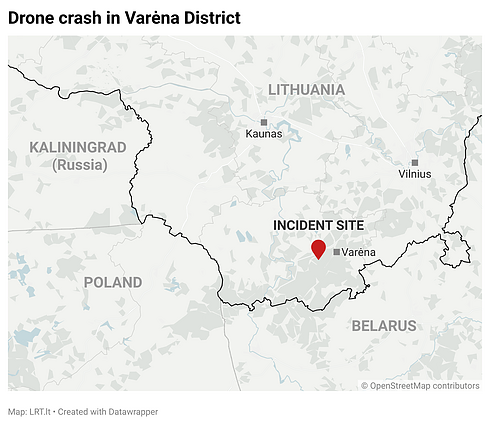
A drone crashed in Lithuania’s Varėna district near the country’s border with Belarus in the early hours of Monday. Here’s what we know so far.
Was it even a drone?
A video sent to LRT by a local resident showed an explosion preceded by a loud engine noise typically associated with drones. Many compared it to the sound of a Shahed-type drone used by Russia.
The authorities would not confirm the type of drone or aircraft, saying they had to wait until the investigation was finished. However, army reps confirmed they had found an engine typically used in such drones.
Whose drone was it?
Initially, the military said it likely came from Belarus, adding that it was impossible to tell until the investigation was finished.
On Tuesday, however, the Lithuanian authorities confirmed it was a stray Ukrainian drone on its way (via Belarus) to strike Russia’s Baltic port of Primorsk.
“It was related to an operation that Ukrainians were carrying out that night targeting Russia, and we can already say that it was a stray drone,” Prime Minister Inga Ruginienė told reporters on Tuesday.

Why was it not detected?
Lithuania deployed air defence assets near Vilnius after two Gerbera-type drones used by Russia crashed in the country in July last year. However, Varėna is some distance from the capital, the military said, and there were no air defence assets in the sparsely populated region at the time of the incident.
The military radars did not see it coming, and the authorities only found out about the crash after a local resident called them in the afternoon.
Detecting such types of drones is a headache, military experts previously said. For example, Iran has caused millions in damages to American assets in the Gulf using cheaply-produced drones.
Is Lithuania blind and deaf to drone threats?
Yes and no.
The country is able to detect flying objects, but there’s a glaring capability gap across the board – again, look at the war with Iran.
"I want to mention that neither Belarus nor Lithuania, unfortunately, detected it, because the drone was flying below what appears to be 300 metres. The services are still establishing the details," Defence Minister Robertas Kaunas said.
This rang hollow to many experts.
“No one has air defence against drones except Ukrainians,” Arūnas Kumpis, a former volunteer soldier in Ukraine and a drone expert, told LRT RADIO. “The essential question, during the fifth year of war in Ukraine, is whether we will finally take measures and find people who will solve this problem?”
What now?
The investigation will likely take some time; the conclusions following the July 2025 incidents took several months.
Meanwhile, Defence Minister Kaunas warned that such incidents could happen again because the war is continuing, adding that “air defence is one of the greatest challenges across NATO”.
Posting on Facebook, he said he would travel to Ukraine to learn more about air defence.
Additionally, Kaunas said the country has not yet received all the additional radars it had ordered following the previous incidents.
According to Prime Minister Inga Ruginienė, some of the deliveries were delayed due to the war with Iran.

Newsletter
Every Friday morning.