








In recent months, Lithuanian officials have intensified contacts with various groups within the Belarusian opposition, including those that advocate for lifting sanctions in exchange for prisoner release. Who are these people, what ideas are they promoting, and could this shift Lithuania’s approach toward the Minsk regime?
“This time, Vilnius received us better than ever before,” says Valery Kavaleuski, a former Belarusian diplomat, later a member of Tsikhanouskaya’s team and now her critic, as well as a participant in the Coalition for the Release of Political Prisoners.
The coalition was founded in 2024 by Kavaleuski himself, Tatiana Khomich, the sister of Maria Kalesnikava, and Olga Gorbunova, who had also previously worked with Tsikhanouskaya.
Kavaleuski and Gorbunova joined the so-called United Transitional Cabinet of the Belarusian opposition in 2022 – a body created by Tsikhanouskaya two years after what were widely seen as rigged elections in Belarus. It was intended to represent the country’s national interests abroad and act as a kind of government-in-exile. However, its composition changed repeatedly, with some members leaving.
By 2024, Gorbunova and Kavaleuski had left the cabinet, set up the coalition and begun promoting the idea of dialogue with the regime of Alexander Lukashenko – an approach that diverges sharply from that of Tsikhanouskaya and her allies.
Representatives of this wing of the Belarusian opposition argue that the current crisis should be addressed through de-escalation and a change in approach. Their main priority, they say, is securing the release of prisoners.
“Five years ago, when this movement began, we were convinced we would soon return home and open the prison gates ourselves. But more than five years have passed, and we understand we may not return any time soon, if at all. And today, the keys to the prison gates are in Lukashenko’s hands,” Kavaleuski told LRT.lt.
The coalition’s work focuses on contacts with European governments. Its aim is to persuade European capitals to resume dialogue with Minsk, which Kavaleuski believes could lead to the release of political prisoners.
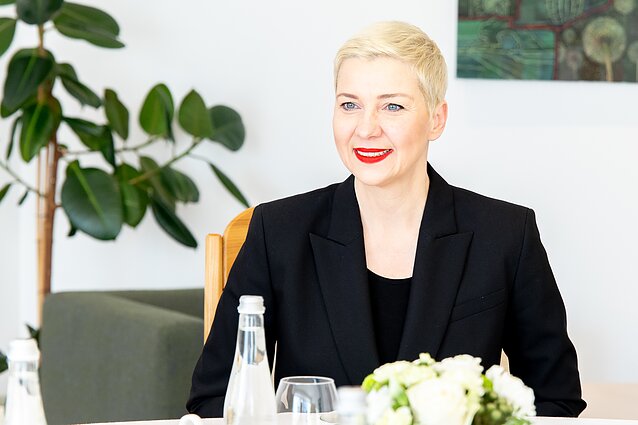
A similar position has been voiced by Kalesnikava since her release. In her first public statements, including an interview with Russian blogger Yuri Dud, she called on Europe to engage in dialogue with Lukashenko. “I am here because someone started talking to someone,” she said.
Kavaleuski stresses, however, that the coalition does not coordinate its work with Kalesnikava.
“We are not coordinating. Maria Kalesnikava is a communicator in the public space, while we are practitioners. We cannot say we act as a single front – the coalition is a separate initiative and remains strictly humanitarian,” he said.
According to Kavaleuski, dialogue implies de-escalation, which is why the coalition supports lifting sanctions on Minsk – but only as a tool.
“We are not advocating negotiations with the regime as an end in themselves, nor lifting sanctions as an end. These are tools to achieve the release of political prisoners,” he said.
Supporters of this approach argue that sanctions are not bringing Belarus closer to democratisation, which remains the goal of both the opposition and the European community.
“Perhaps European countries should not claim that sanctions will lead to democratisation. They do not. They isolate the country and affect ordinary people. Sanctions are hitting people hard. They are increasing Belarus’ dependence on Russia, but they are not leading to democratisation,” Khomich previously told LRT.lt.
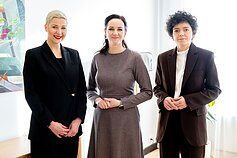
The issue of Belarus’ isolation was also raised during a visit by Kalesnikava and Khomich to Vilnius in early February, when they met Prime Minister Inga Ruginienė and Social Democratic leader Mindaugas Sinkevičius.
Kalesnikava, in particular, raised the possibility of restoring passenger rail services between Minsk and Vilnius. Shortly afterwards, however, the prime minister said she saw no prospect of warming relations with Minsk.
It is unclear whether sanctions and the transit of Belarusian potash fertilisers were discussed at those meetings. Kavaleuski says the issue was raised during a November meeting between the coalition and Lithuanian politicians.
“One important topic was the ban on Belarusian potash transit through Lithuania,” he said. “Belarus has not stopped supplying potash – it is simply using other routes, now exporting via Russia.”
He argues that Belarus has lost export capacity, Lithuania has lost up to €300m a year in revenue, and “Russia is the main beneficiary”.
Statements by Lithuania’s governing parties on potash transit have been mixed, with some politicians suggesting it could resume.
However, neither the presidential administration nor the foreign ministry has confirmed any such shift. Moreover, Lithuania cannot act alone, as EU sanctions apply collectively and were recently extended for another year.
Signals from Brussels
Lithuania’s stance broadly aligns with that of the EU. Sinkevičius has said any discussion of political dialogue with Minsk could only follow the extension of EU sanctions.
The Council of the European Union extended sanctions against Belarus on February 26 until February 28, 2027. The measures were imposed over domestic repression, support for Russia’s war in Ukraine and hybrid attacks against EU states. They target 312 individuals and 57 entities, including major state enterprises such as Belaruskali.
According to Lithuanian MP Ruslanas Baranovas, there is little appetite in the EU for dialogue with Lukashenko.
“From what I have seen, no one considers Lukashenko a partner with whom you can ‘cook anything up’. I have not met European parliamentarians who think this policy should change,” he said.
Kavaleuski says his team has been engaging with Brussels for the past year and that a new discussion on Belarus has begun, partly driven by contacts between Washington and Minsk.
“These contacts may indicate that Lukashenko’s political isolation has cracked. The positive side is that people are being released from prison,” he said.
However, he argues the EU risks lagging behind the US, which has taken an approach centred on freeing political prisoners.
Baranovas notes that when the new US administration began engaging with Minsk and securing prisoner releases, the European Parliament largely refrained from interfering. But tensions between Washington and Brussels have since deepened, leaving their approaches to Belarus diverging.
Time for a change?
Kavaleuski believes the current context calls for a shift in Western policy, citing what he sees as the ineffectiveness of opposition structures.
“There is a sense these structures have been going round in circles for years,” he said, criticising organisations linked to Tsikhanouskaya and figures such as Pavel Latushko.
“The democratic movement in exile must have an end point. We did not come into exile to stay forever – our goal is to return to a safe Belarus,” he said.
Baranovas says a similar sense of stagnation exists among some opposition figures abroad.
“Recently in Paris, many opposition representatives I met supported the idea of dialogue with Lukashenko,” he said.
He cautions, however, that not all proponents of dialogue are linked to the coalition, nor are they motivated solely by the goal of freeing prisoners.
“Off the record, it becomes clear that they feel they can no longer influence events from abroad. The regime is stable, and they are tired and see few prospects,” he said.
Some believe easing restrictions could allow them to return to Belarus and exert real influence, rather than waiting indefinitely for political change.
Divisions within the opposition
The main divide within Belarus’ democratic movement today is between pressure and engagement.
Tsikhanouskaya illustrated this during the Munich Security Conference, telling Politico that Europe should remain the “bad cop” while the US acts as the “good cop”.
“We ask Europe not to copy President Trump’s policy. American sanctions are to free people; European sanctions are to free the country,” she said, noting that repression continues despite some prisoner releases.
According to the human rights group Viasna Human Rights Centre, 16 people were recognised as political prisoners in February alone, with 65 cases of politically motivated persecution. A total of 1,138 political prisoners remain in Belarusian jails.
Kavaleuski acknowledges ongoing repression but says expecting its immediate end is unrealistic.
“Over five years, around 50 legal acts have effectively legalised repression. They cannot be reversed overnight,” he said.
He argues that only sustained dialogue can gradually reduce repressions.
A repeat of the past?
The current situation is often compared with 2015–2016, when the EU and US lifted sanctions after Lukashenko released political prisoners, leading to a period of relative thaw.
At the time, Belarus pursued a more balanced foreign policy and limited its integration with Russia. Civil society and cultural initiatives also saw some revival.
However, analysts argue this model cannot simply be repeated. Artyom Shraibman of the Carnegie Russia Eurasia Center in Berlin previously Radio Free Europe/Radio Liberty (RFE/RL) that Western demands are now broader, including an end to Belarus’ role in Russia’s war against Ukraine and hybrid actions against EU states.
He also says Minsk is unlikely to risk another “thaw”, which it believes contributed to the 2020 protests.
Is Lithuania changing course?
Within the opposition, there is growing recognition that change is needed. The release of protest leaders has added momentum.
After the release of Kalesnikava and Viktor Babariko, Tsikhanouskaya said new opposition leaders shoul emerge.
Her comments came shortly before her departure from Lithuania, amid speculation about a shift in Vilnius’s approach. Changes in her security arrangements and official rhetoric were seen by some as signals of a policy rethink.
Baranovas rejects this.
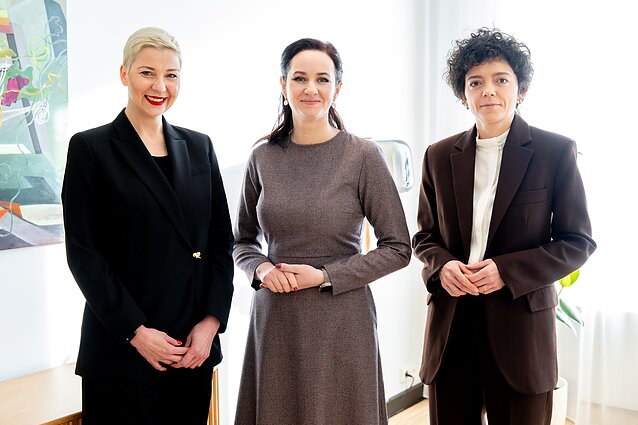
“I would not say we are in a transition period – rather, space has opened for discussion about what to do next,” he said.
Kavaleuski agrees, saying Lithuanian politicians are increasingly questioning the direction and effectiveness of their support.
Meanwhile, new actors are entering the political arena. Babariko has announced the creation of a new party, Razam (Together), backed by his supporters and allies of Kalesnikava. The party says its formation reflects the evolution, not division, of the democratic movement.
Dozens of other political and humanitarian initiatives also remain active.
At the same time, contacts between Minsk and Washington continue. On March 18, US presidential envoy John Cole is expected to visit Minsk, with another group of political prisoners potentially set to be released.

Newsletter
Every Friday morning.