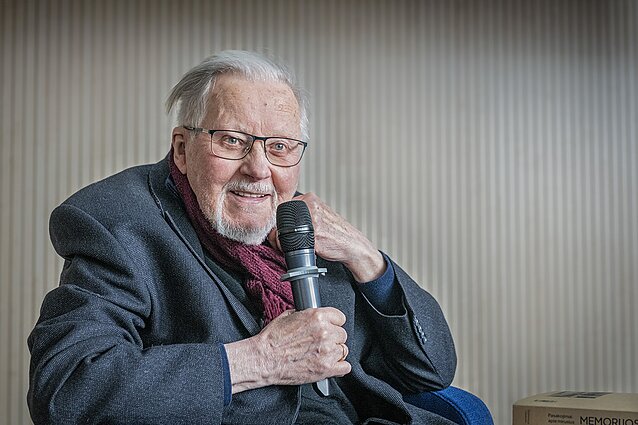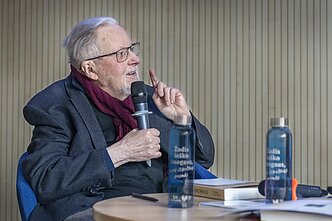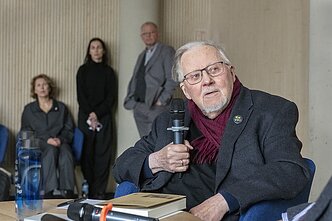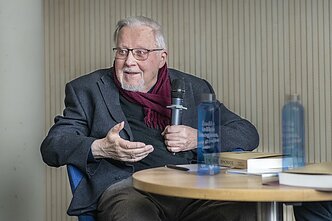








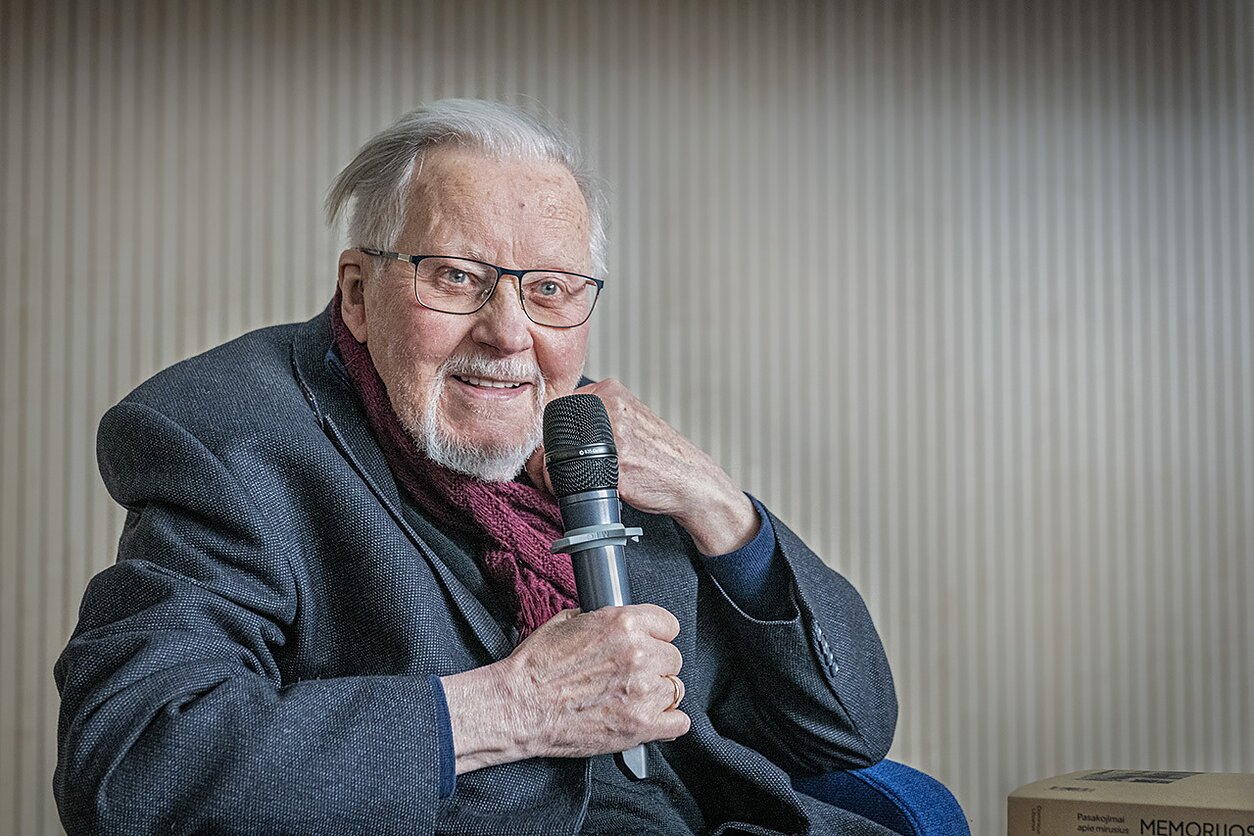
In his new book, Pasakojimai apie mirusius. Memorijos (Stories about the Dead: Memoirs), Vytautas Landsbergis – one of the primary architects of the restored Lithuanian state – examines the nearly 50 years of illegal Russian occupation through the intimate prism of personal relations.
The numerous figures in the book, from his fellow Sąjūdis comrades to his late wife, Gražina Ručytė-Landsbergienė, are not treated as historical subjects, but as “living” inspirations. For Landsbergis, the past is not a closed chapter, but a vibrant, ongoing dialogue that provided the political clarity necessary to build a modern state. This intersection of personal memory and nation-building serves as the essential context for his complex dealings with the leaders of the Soviet Union.
During your conversation at the Vilnius Book Fair, it was made clear that your new book is about a number of people who marked your life and of whom you have particular memories.
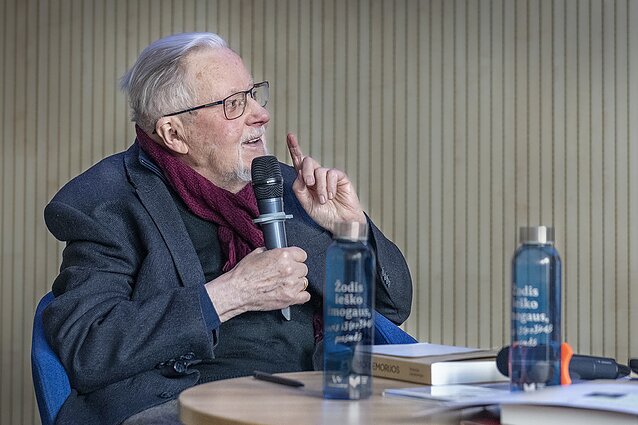
Yes, it is about those people who have passed – those who were around me and together with me throughout my life. In part, it looks like a book of memories because it concerns people who are no longer living. Therefore, it appears to be about the past, but I tried to explain to our audience that it is not really about the past. It is about the present, because all those persons of whom I am speaking are still alive in my mind.
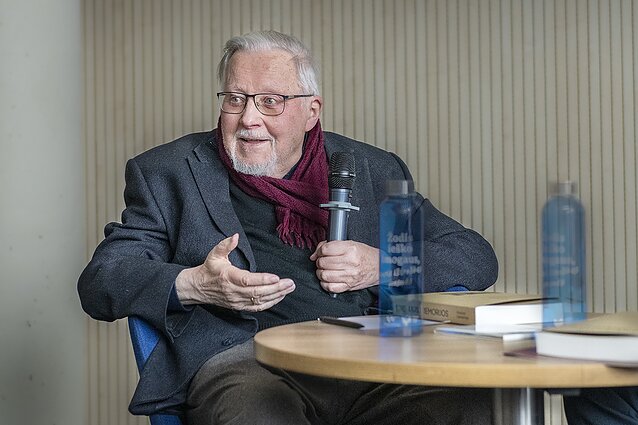
They live in my consciousness, and in everyone’s consciousness, so long as they are commemorated. Spiritually, they are alive. Initially, the idea was simply that some necrologies or memories were worth collecting. But after some time, I realised that this would be a book not about the past, but about these figures as if they were living today – with us and among us.
In a collection of this scale, some figures inevitably carry more weight than others. How did you balance the prominence of these different people – were there some whose stories felt more essential to tell in full, while others remained as brief, vivid memories?
No. As it happened, the purpose was to write about those people who have allegedly passed, but who have not passed away completely. Sometimes the impulse to write arises just as they are passing through my mind. I feel I must say something about him or her. It would not be right of me to take what I know and release it forever into the depths. It is more reasonable to acknowledge that while this is my heritage, it is also a collective heritage.
Are these “mysteries” in the sense of being unsolvable, or are they simply thresholds we haven’t yet crossed?
Mysteries, perhaps, or an area we have approached but not yet stepped beyond. We are still standing there, preparing ourselves to be ready for that step.
Aside from Čiurlionis, who stands as a pillar of your artistic life, could you name others whose presence in the book is equally significant?
One significant part concerns my conversations with his sister, Jadvyga Čiurlionytė. She was my professor of musicology. Often, these talks were extended because she was very old and lived alone. I was frequently captured by these endless conversations. Sometimes she would say something entirely new that I had never heard before.
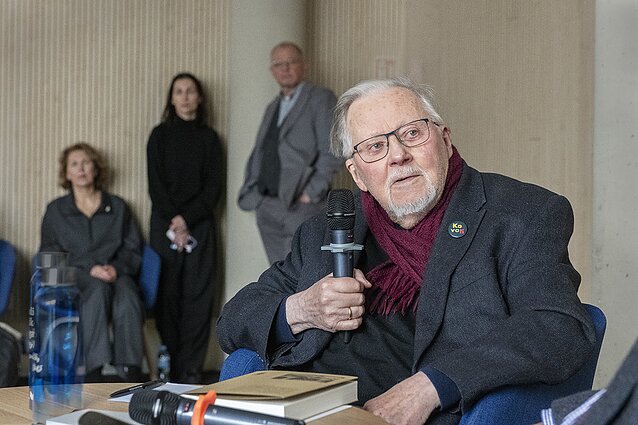
I even appointed one of my former students to visit her often and record what she said about her life, about her brother, and about society. I do not know where those notes are now. But if they still exist somewhere, they would be a very interesting and valuable piece of history.
If we look beyond the world of music and musicology, which other figures were vital to your thinking – those with whom you discussed the pressing actualities of the day?
These memories stay with me now, but they will not go to the grave with me; they will continue to live. That was the encouragement to do this work. If I had lived ten years less, this book would be smaller. But as long as I am living here and carrying these contents with me, I feel it is my responsibility, my duty, to fix them. I must not bring them with me to the “depths”.
Which figures from the political world left the most significant mark on you—those whose influence demanded a place in your memoirs?
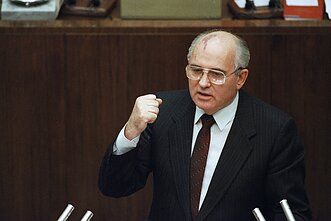
I could write a quite interesting essay about Gorbachev. I met him several times and engaged in all kinds of negotiations regarding our political confrontation within the Soviet Union. I remember something interesting: for him, it was also an adventure to meet a seemingly unimportant person like me. He moved in a circle of “great personalities”. I am not sure if he realised anything about me, but I realised quite a lot about him.
When you look back at those encounters, what was it about his perspective that made a true mutual understanding impossible?
I saw that he was personally limited by his Soviet communist education and heritage. His world was carved in stone – inflexible and immobile. I was happy that my world was mobile; I could catch something new, a new idea or a new angle of vision. He was not able to do that. To have given him a new idea – that would have been my victory. Sometimes it was just a little point, but it was a point!
Could you describe that psychological “turning point” moment where the personal power dynamic became clear?
He was trying to convince me to change Lithuania’s political line regarding independence. As I left, he said to me, “Okay, Vytautas” – trying to be familiar, calling me by my first name as a master speaks to a subordinate. He insisted that I go home to Lithuania to rest and think about what we had discussed. I remember that feeling. If I were to agree to go home and “think” about his ideas, I would be admitting that he was the master of the situation. I did not like that. I turned back and said one word more: “And you, Mikhail Sergeyevich, please rethink as well.”

You actually said that to him? You told the then General Secretary of the USSR to “rethink as well”?
Yes. In that moment, we were on an equal level. I do not feel he was uniquely wise. To me, he was a normal person with whom one could exchange ideas. That is the essence of all communication – whether you are in a high position or a “little” position. Gorbachev stood only for order – for the obedience of implementation.
Was there any continuation of this dialogue after Gorbachev left power, or did the dynamic change entirely when Boris Yeltsin emerged?
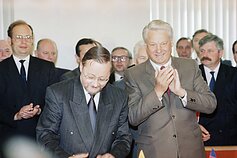
When Yeltsin was in power, we had very good, friendly conversations. Yeltsin was different. He was not a “stone-minded” person. I remember our negotiations vis-à-vis in his cabinet, with plenty of vodka. If we reached a point of agreement, he made sure it stayed agreed. Even if his advisors tried to change his mind later, I could simply say: “Boris Nikolayevich, we agreed.” And he would tell his advisors to stay out of it. That is unimaginable for Russian leaders, except for Yeltsin.
Watching Sergei Loznitsa’s film, Mr. Landsbergis, I was struck by the footage of Mikhail Gorbachev. He appeared profoundly arrogant, particularly in his dismissive attitude toward you when you addressed the Supreme Soviet regarding the Molotov-Ribbentrop Pact and confronting them with the fact that the proof of an illegal occupation was sitting right there in their own archives.
It was not quite so direct. But that was the conclusion drawn by the wiser, more conscious Soviet politicians. Alexander Yakovlev was a good politician and an advisor to Gorbachev. Later, he was pushed aside, but for a time, he was appointed by Gorbachev to work with the Baltics – to convince us not to revolt and to reach an agreement that would keep us within the Soviet Union.
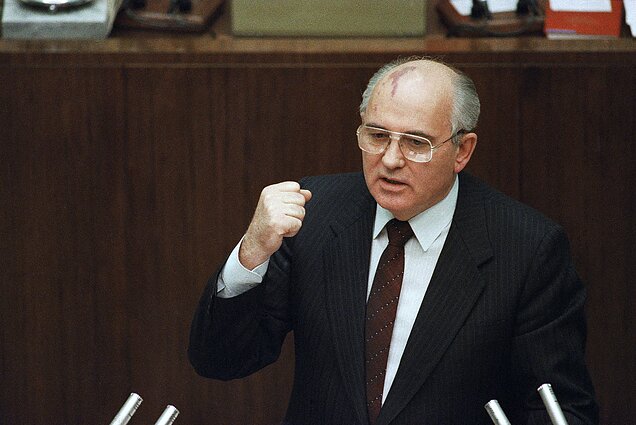
By then, the truth was already understood by everyone because of the course of events. The real events followed exactly what was described in the Molotov-Ribbentrop Pact – how it would be in the future and how it was to be done. It could not have been an accident. History happened exactly as it was conceived and agreed between them. Therefore, some record had to exist.
It turned out that in the archives, they had the microfilms of those secret protocols. The hardline liars tried to claim that a microfilm is not “true”, not an argument, or not a fact. But nobody can create a fake microfilm that matches, point-to-point, exactly what actually occurred in history.
How did the hardliners react when the existence of these protocols moved from allegation to documented fact?
That was sufficient argumentation. At that time, some colleagues from the Congress of People's Deputies had been appointed to a group – our group – to work on the question of the secret protocols. The hardliners tried and tried to convince everyone that there were no protocols and nothing to discuss because “they do not exist”. They said it was not proof, only allegations.
But even Gorbachev was not so stupid as to stay on that point; he said, “Let them look, let them work, let them analyse.” And so, we continued toward a resolution with the conclusion that the protocols did exist. That document was prepared for a vote in the Supreme Soviet by the Congress.
It was something miraculous. Hardliners protested that the Congress could not adopt such a document because it contained words about secret protocols which “did not exist” – they hadn’t “found” them yet! To them, it was nonsense that should not be mentioned. But Yakovlev and the others were reasonable people; they understood it was a fact. And so, the document was prepared for a vote. But in the first vote, it failed.
The hardliners won. They protested that it was impossible to adopt such a Congress conclusion. And while they were happy that they had won this vote, we were laughing.
I was sitting in the front row of the Congress. I do not know for what sake, but they had organised it so that we were in the front row. The television cameras were showing us all the time. Academician Sakharov was there, too, trying to convince those hardliners of the necessity of democracy and reforms. And now, after a vote where we should have looked like losers – because we had “lost” – we were laughing.
We were laughing because we saw this Congress of hardliners as a stupid, incompetent crowd of unreasonable people. And Gorbachev was surprised. They looked and they looked at us, wondering: “Why are they laughing after they lost?”
And then came the moment when that bubble popped?
Yes. They had said the case was closed – the vote was done, and the Congress would not adopt a position on protocols that “did not exist”. There was a brief pause – tormoz (stalemate) – before the parliamentarians could leave and then a little old man went to the tribune. He was not a deputy; perhaps he was organised by some secret hand.
He came to the microphone and, without even asking for the floor, he said: “I am an archivist. I have seen the documents regarding these protocols. You must look in the most secret archive of Molotov. They are there.”
The great bubble of Gorbachev and his people just popped. Gorbachev realised he was in an absurd situation. He asked Yakovlev to find new formulas or compromises, but Yakovlev said: “No. I did what I understood. My job is finished.” Then this “Archivarius” entered the stage again to say: “I know where the documents are!”
The next day, the Congress adopted the resolution condemning the secret deal and the occupation of the Baltic states. I remember hardliners in the hall shouting: “Don’t vote! The Baltics will leave!” They didn’t care about justice; they only cared about the territory they were losing. But the Congress voted. They adopted it. Those were moments of high-level political drama.
While the world saw a grand historical drama, for you, was it merely the formal acknowledgement of a truth that was already clear?
For us, it did not look so important, because everything was already clear. Facts are facts. But for them, the procedure was the most important thing. The procedure was everything. Regardless, we went home with a feeling of victory.
A hypothetical question: If the current occupant of the Kremlin had been in power in 1989 or 1991, I suspect the situation would have been far more lethal. Given your experience with the “stone-minded” leaders of the past, how do you view the Putinism of today?
Of course, there would be no problem for Putin to take us out – with poison, or perhaps an “open window”. Out of the stage. Times have changed.

Today’s Putinism emerges from the depths of Stalinist and post-Stalinist traditions. Back then, they still hesitated; they still tried to find a balance between the lie and the truth. Today, they may say that Ukraine belongs to Russia, that Ukraine is guilty of the war, and that Zelensky should be sentenced. It is “bad luck”. They seem happy with their own bad luck.
Since we began by discussing your new book, is Gorbachev a central figure in these memoirs?
There are many people in my life with whom I had to deal to achieve our goals. This Gorbachev point – this destiny of the Lithuanian state – is just one of many. But it was vital because I was placed in an advanced position. I was responsible. I had to fight.
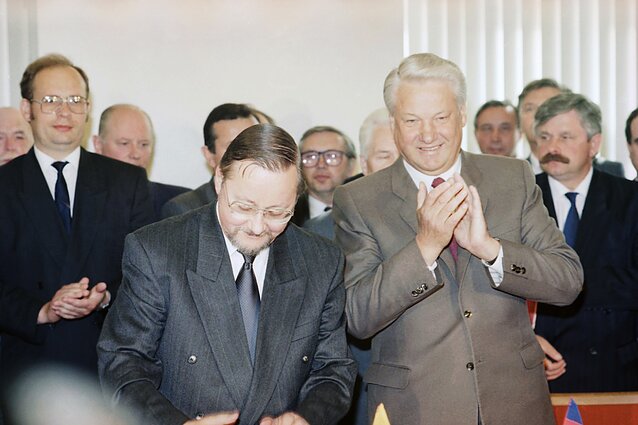
However, with Yeltsin, there was a truly remarkable, unforgettable moment. We met in Moscow with the Lithuanian and Russian delegations. We had reached the point regarding the protocols, but Yeltsin’s advisors tried at the last moment to convince him to “take out” that section. It was spontaneous; I was not prepared for such a turn.
I said to him: “But you are garbingas – you are an honourable, honest person. We agreed on this. Why are they coming back to this question?” And he dismissed his advisors. He said: “Yes, we agreed. It is finished. This point is closed.”
That was a great moment for Yeltsin. Otherwise, my situation would have been very difficult. We had documents prepared to sign, and suddenly it might have looked as if Landsbergis was the one blocking the business. But Yeltsin did not choose to humiliate me or send me home with nothing. He had dignity. He was not so reasonable later, particularly in the case of the Chechen War, but in this moment, he had dignity.
Looking back at the first formal presidential elections in 1993, do you ever regret not standing for the office yourself?
Well, how could I present myself as a candidate for president when the president of the United States and other world leaders were already calling me “President”? I received telegrams, letters, and correspondence addressed to the “President of Lithuania”. I did not protest.
Regarding those first formal elections with Stasys Lozoraitis and Algirdas Brazauskas – the situation was complicated. It was a period of immense difficulty for the Lithuanian people; we were in the middle of a total systemic reform to reach a free-market economy. We were building a new state that was a world apart from Russia.
The reality was that the Soviet Union was punishing us with economic blockades and political pressure. They succeeded in fostering internal criticism. The “Gorbachevists” would always say: “I could agree to everything, but Landsbergis is too hard.” Gorbachev himself used to say: “With Mrs Prunskienė, we could find a solution. But with Landsbergis, it is impossible. He is too... hard.”

Newsletter
Every Friday morning.