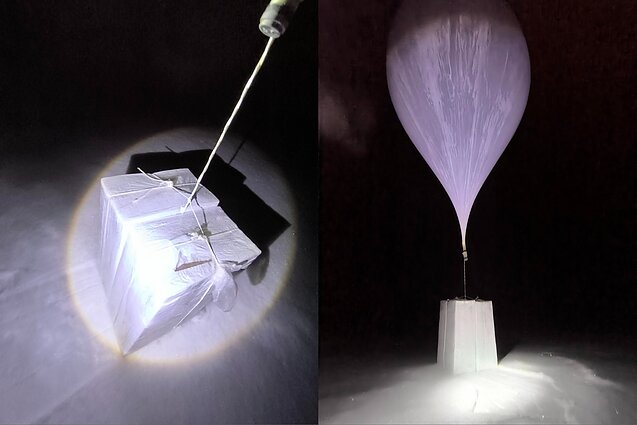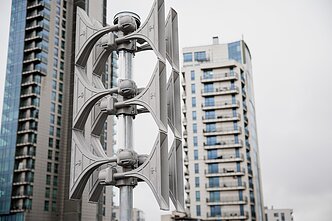
















Lithuania's airspace could soon be patrolled by flying zeppelins – lighter-than-air craft designed to intercept the smuggling balloons that have become an increasingly serious security concern.
The solution comes from a consortium called Dobis, which won a competition seeking innovative approaches to the problem. Investor Dominykas Milašius spoke to LRT Radio about how the idea came about, how the system was adapted to Lithuanian conditions, and what commercial opportunities it might open up.

Fighting fire with fire
The name, Milašius explains, was chosen deliberately. "We chose the name Dobis from Harry Potter, because we want Vilnius Airport to become a free elf – no longer tormented by its problems."
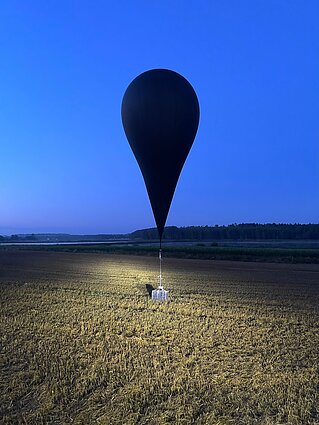
The smuggling balloons in question are gas-filled meteorological balloons capable of reaching very high altitudes. They fall into the category of lighter-than-air vehicles – and that, says Milašius, is precisely the point.
"We thought: fight fire with fire. Other balloons and airships, carried by the same wind, can reach exactly the same altitude at exactly the same speed."
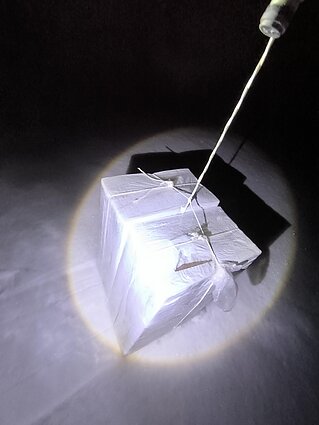
"Our task is to lift an airship of sufficient size to the same altitude as the smuggling balloon and attach a payload capable of doing something with it – whether that means observing it and tracking its trajectory, attaching something to it, or bringing it down," he explained.

How does it work?
The system has three distinct functions. The first is a tethered aerostat – an airship suspended on a cable – which performs a surveillance and communications role. "You can deploy such a system near the border or other strategically important sites and keep observation equipment airborne for a long time at relatively low cost," he said.
The second function involves what Milašius calls a mothership: a gas-filled balloon capable of reaching altitudes of five kilometres or more, carrying payloads such as surveillance equipment, drones, or other craft. Milašius said these could operate cheaply and efficiently, rising to altitude without expending energy.
"Or we can attach more complex cargo – robotic arms, for instance, or nets to capture meteorological balloons. We haven't started doing that yet. That is our engineering challenge for the future," he said.
Inspired by South Korea and the United States
The team initially considered using drones to intercept the smuggling balloons, but concluded that the energy cost was prohibitive. The airship concept emerged after studying approaches taken abroad.
"We looked at cases in South Korea and the United States and noticed growing interest in lighter-than-air vehicles. We asked ourselves: what if we built our own airship – our own zeppelin? We could create an autonomous system to control it, manoeuvre it into the same orbit as the meteorological balloons, and carry out rendezvous and proximity operations. We decided to try," Milašius explained.
One of the greatest challenges, he acknowledged, has been adapting the system to Lithuanian weather.

"It is genuinely difficult to control them in winter during a blizzard. On one of the army-organised test days it was snowing. We had to change a great many demonstration plans at the last minute," the investor said.
Built for extreme conditions
The equipment must function reliably in storms, frost, high winds, and at the altitudes where the smuggling balloons operate – conditions that place considerable demands on the technology.
"The climate here is not favourable for visibility during approach or docking operations. So you have to build things that can communicate even in cold conditions – heating systems must be installed so the airships can withstand the low temperatures at altitude and cope with all the extreme scenarios you encounter up there," he said.
Cameras, lidars and radar systems can help identify objects in difficult conditions – including within cloud.
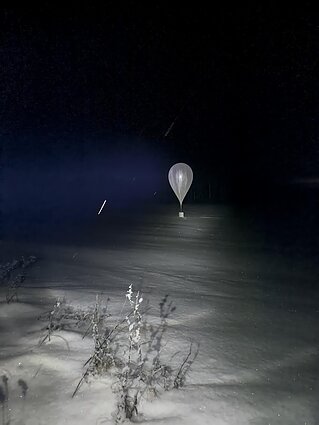
"You can hang one balloon below the clouds and another above them, and monitor what emerges between them and what trajectory it follows. You have to think carefully about the extreme conditions in which we operate and design systems to work as long and as reliably as possible," Milašius said.
Three options once contact is made
To manoeuvre in the air, the airship uses rotor motors arranged as a navigation system, mounted to make the craft as streamlined as possible – shaped, he says, like a bullet.
"The core task is to lift the airship to the same altitude as the target balloons – which costs nothing, because the gas does the lifting. Then you release it in the same direction the smuggling balloons are travelling. At that point the airship is at the same altitude, using almost no energy. Then we need to close the distance – two objects in the same orbit, brought gradually together," he explained.
What happens next depends on the instructions of the end user. Several Lithuanian institutions are interested in the system for different purposes.

"The simplest task is observation. With current methods, the balloons are not always detectable. Having an object that can see an entire swarm of balloons and track their trajectories is already part of the solution.
The second option is a rendezvous operation – attaching something to the smuggling balloon's payload.
The third is destruction or interception: either a kinetic intercept, where we destroy it and bring everything down, or a controlled descent – using a parachute, for example," Milašius said.
He acknowledged that opinion is divided on the question of shooting balloons down, given that falling cargo could injure people or damage property.
"We understand that concern, which is why one of our engineering goals is to try attaching parachutes to payloads. We are receiving a great deal of feedback from the Lithuanian military and the State Border Guard Service, and we will see which function we ultimately pursue. But one of the core ideas from the beginning was non-kinetic interception – a controlled landing."
'Airships are experiencing a renaissance'
Although the Dobis concept emerged as a response to a national security challenge, Milašius says the team has begun to recognise its broader commercial potential.
"We started by trying to solve a Lithuanian problem, and along the way we realised that airships – zeppelins – are experiencing something of a renaissance. It turns out there are many companies in the United States considering a return to cargo transport: not passenger flight, but aerial tankers that could cross the Pacific and bring large volumes of goods from Asia," he said.
In Europe, too, the team has encountered start-ups working with intelligence data.
"An airship can remain airborne for a long time, surveying and scanning a large area of territory, then return with that data or transmit it back in real time," he added.

Newsletter
Every Friday morning.