













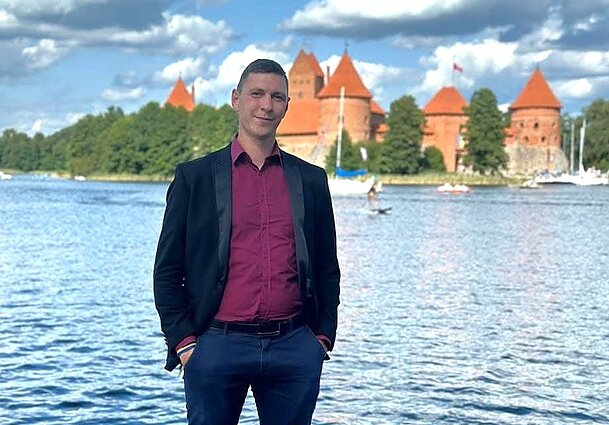
“I came to ask for help, and I left as an illegal.” That is how Ruslan Kutishchev recalls a visit to the migration office at age 19, a moment that crystallised years of uncertainty in a life spent without official documents.
Kutishchev was born in 1994 in independent Lithuania, but because of decisions by government agencies he was left for more than a decade without a passport, unable to work legally, pursue education or fully access basic services. His case, shaped by the complex citizenship issues that followed the collapse of the Soviet Union, highlights how decisions made in the early 1990s can still affect people today.
For Kutishchev, the transition period lasted 16 years.
A childhood caught between countries
Kutishchev says his story began before he was born. His mother moved to Lithuania from Belarus during the Soviet era with her parents. There she met his father, a Ukrainian serving in the Soviet army. The couple separated before Ruslan’s birth.
After the Soviet Union collapsed, citizenship rules across the region changed abruptly, leaving many families uncertain about their legal status.
“When the Soviet Union collapsed, my mother was told she was not eligible for Lithuanian citizenship because she came from Belarus and had not always lived in Lithuania,” Kutishchev said in an interview with LRT. “She was only given permanent residence.”
His father, who returned to Ukraine, also struggled with documentation.
“He waited five years to receive a Ukrainian passport even though he was born there,” Kutishchev said.
Kutishchev himself was born in a village near Visaginas and attended a Lithuanian school. Despite that, he says authorities refused to issue him a passport.
“I was entitled to citizenship. But no one ever accepted my documents. Never,” he said.
He said attempts to get recognised began when he was still a teenager.
“When I was 16, we tried to apply [for a passport]. But they simply refused to accept the application,” he said.
Three years later he travelled to Vilnius to seek answers at the Migration Department, the agency under the Ministry of the Interior that handles passport issuance.
“I came asking for help,” he recalled. “And they told me I was an illegal person living in Lithuania.”
“I came to ask for help – and left as an illegal.”
Years without rights
Without identification documents, Kutishchev says everyday life became a constant struggle.
From his teenage years onward he was unable to work officially, enrol in further education or receive normal access to health care.
“From the age of 14, I essentially couldn’t study properly, couldn’t get a job, couldn’t go to a doctor,” he said. “These were 18 years of restrictions. You can’t really call that a life.”
He relied on occasional informal work through acquaintances to survive.
At times, he said, people did not believe his story.
“People would say: ‘That can’t happen.’ They didn’t believe the migration service could do its job incompetently,” he said. “They pointed fingers at me, called me a loser.”
Court ruling turns the case
The turning point came years later. In September 2024, with the help of a lawyer, Kutishchev submitted an application through an online system to the Migration Department.
The agency issued a formal refusal, arguing that at the time of his birth his father might have been a citizen of Ukraine.
Kutishchev’s lawyer, Andrey Melkov, challenged the decision in court.
In February 2025, the Regional Administrative Court ruled that the Migration Department’s refusal was unlawful and ordered the case to be reconsidered.
In its decision, the court referred to a precedent from the Constitutional Court, stating that citizenship represents a stable legal bond between a person and the state and must take into account the individual’s real social and legal ties.
Judges noted that Kutishchev was born in Lithuania, completed schooling there and lived in the country with his mother and two brothers.
“Taking these circumstances into account, the panel concludes that the applicant’s complaint is justified,” the ruling said.
After the court decision, the Migration Department requested additional information about Kutishchev’s father’s citizenship.
Melkov argued that such demands were unfair.
“The burden of proof cannot be placed on a person who is already in a vulnerable situation,” the lawyer said. “State institutions must cooperate with one another and request the necessary data themselves.”
The defence also filed a complaint with the Seimas Ombudsperson’s Office, which found that the complaint about the actions of the Migration Department and the Visaginas municipality was justified and identified violations by state institutions.
Finally receiving a passport
Eventually, citing the Convention on the Reduction of Statelessness and the ombudsperson’s recommendations, the Migration Department entered Kutishchev’s Lithuanian citizenship into the national population register.
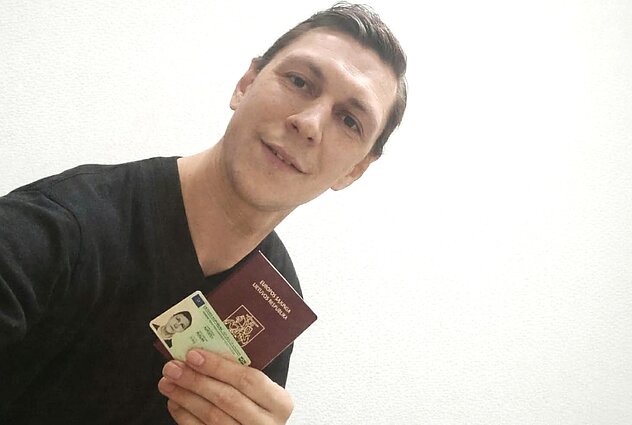
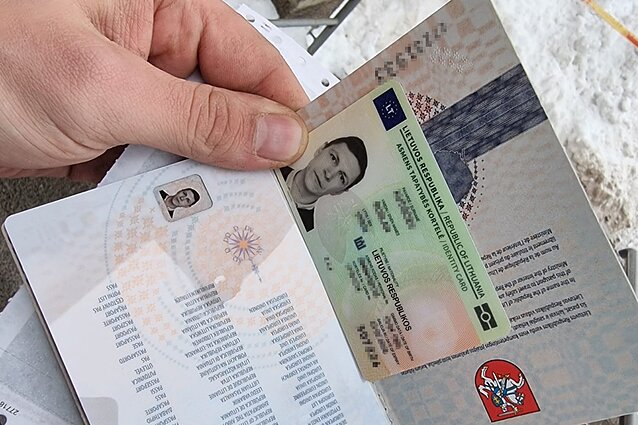
On February 27 this year, at the age of 32, he finally received his first Lithuanian passport.
“Ruslan burst into tears of joy,” Melkov recalled.
Kutishchev describes his own reaction as more restrained.
“I partially won,” he said. “But how many other people like me are there? No one knows. And someone should answer for what happened to me.”
He is now considering seeking compensation for the years he lived without documents.
“Years without the possibility to study, build a career, live normally. These are huge losses,” he said.
Authorities respond
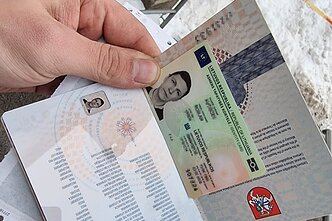
The Migration Department confirmed to LRT that Kutishchev’s passport and identity card were issued February 23, 2026, and delivered four days later.
However, the agency says the decision does not mean it recognises that he had Lithuanian citizenship from birth and insists the outcome was not connected to any legislative changes.
Officials argued the problem originated earlier.

“The person’s mother, for reasons unknown to the Migration Department, did not carry out all the actions necessary to obtain an identity document when the person was a minor,” the agency said in a written response.
According to the department, the passport application could not be accepted previously because Kutishchev’s citizenship status had not been resolved.
The agency also said its request for information about the father’s citizenship was consistent with legal practice.
“If a person proves citizenship based on their parents’ data, they must provide the relevant documents,” the department said.
The agency says it sees no procedural or systemic violations in the case and described the final decision as one taken in favour of the individual under conditions of legal uncertainty.
It also said it does not keep statistics on how many people might be in a similar situation.
Such cases usually come to light only when individuals are detained by law enforcement or approach government institutions themselves, the agency said.
LRT.lt contacted the Visaginas municipality for comment regarding Ruslan Kutishchev’s case. The municipal administration stated that it has not reviewed any requests to change or remove records about his nationality, including claims that he is Lithuanian.
The municipality also noted that it does not keep separate statistics on stateless persons. Data about residents, including stateless individuals, is used only as needed for administrative functions and comes from sources such as the Residents’ Register, the Migration Department, and documents provided by individuals. Therefore, the municipality cannot specify how many stateless people live in the city.

Newsletter
Every Friday morning.