


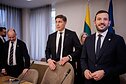







Lithuania’s constitution assigns the president primary responsibility for shaping foreign policy, which is implemented together with the government. In practice, that means the country’s external agenda should be led by President Gitanas Nausėda and Foreign Minister Kęstutis Budrys.
But political sources and analysts say a quiet rivalry has emerged in recent months between Prime Minister Inga Ruginienė and Budrys, with the prime minister seeking a more active role in foreign affairs. She has found backing in Mindaugas Sinkevičius, chairman of the ruling Social Democratic Party, while Nausėda has so far largely stayed above the fray.
“The prime minister truly believes she is doing quite well in foreign policy,” one politician familiar with the situation told LRT.lt. “She has said she would like to be more active internationally once domestic issues are more settled. Kęstutis [Budrys, the foreign minister] is certainly not a favourite within the government. But the main problem is that no one really talks to each other.”
Tensions within the coalition
Relations between Ruginienė and Budrys are described by several officials as chilly, though neither has publicly criticised the other. One politician assessed the likelihood of Budrys’ dismissal from the cabinet at “50-50”, though such a move would require presidential approval.
Under the constitution, ministers are appointed and dismissed by the president on the prime minister’s nomination. Budrys, a former presidential adviser, was appointed upon Nausėda’s insistence, making it unlikely the president would agree to his removal. An impeachment-style interpellation in parliament would require serious grounds and is viewed as improbable.
At the same time, Sinkevičius – who serves as mayor of Jonava and formally has no foreign policy portfolio – has periodically entered the foreign policy debate. Observers say he often acts as a political ally for Ruginienė.
“They are clearly thinking about the future and how to strengthen themselves,” one official said, suggesting Budrys is viewed as a potential rival. Few in Vilnius doubt that the foreign minister could run in the 2029 presidential election, and many of his actions are interpreted through that lens.

As a result, some analysts warn, foreign policy risks becoming a tool of domestic political competition, even though senior officials are expected to speak with one voice internationally.
“It doesn’t look like they are all coordinating among themselves,” one Social Democrat said privately.
Taiwan and China: tactical misstep?
Differences have been most visible in debates over Lithuania’s relationship with Taiwan and China.
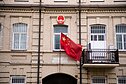
In 2021, Lithuania allowed the opening of a Taiwanese Representative Office in Vilnius under the name “Taiwanese”, prompting strong backlash from Beijing. China downgraded diplomatic ties and imposed trade restrictions, while Taiwan pledged significant investment funds for Lithuania that have yet to materialise.

Recently, Ruginienė publicly floated the idea of changing the office’s name to “Taipei Representative Office”, a move intended to ease tensions with China.
Professor Tomas Janeliūnas of Vilnius University said the prime minister appeared to underestimate the broader geopolitical context.
“Her statement that she sees no problem in changing the name shows she may not fully grasp the context of why the name was chosen and why it angered China,” Janeliūnas said. “It risks signalling that Lithuania can be pressured into more radical concessions.”
According to Janeliūnas, even a name change could undermine Lithuania’s credibility without guaranteeing improved ties with Beijing. China’s ultimate goal, he argued, has been closure of the office rather than a cosmetic change.

Budrys has avoided direct comment on the naming issue but has said Lithuania seeks normalised diplomatic representation with China and that efforts are ongoing. The Foreign Ministry has stressed that restoring relations requires time and mutual respect.
Social Democratic lawmaker Ruslanas Baranovas, a member of parliament’s Foreign Affairs Committee, has publicly opposed renaming the office, arguing that Lithuania would lose more than it would gain.
“If you make one mistake and then try to fix it by making another mistake, you end up with two mistakes,” Baranovas said.
Ruginienė’s advisers, however, say her comments were intended to prod Taiwan into delivering on promised investment funds, including a $200 million industrial investment fund and a $1 billion joint projects fund. So far, critics say, tangible results have fallen short of expectations.
Some politicians argue the debate is less about geopolitics and more about domestic political optics, especially given that former Foreign Minister Gabrielius Landsbergis had faced criticism over the China policy.

Belarus: sanctions and strategy
Belarus has also reemerged as a source of internal debate.
Lithuania has maintained a tough line against the government of Alexander Lukashenko, citing its role in Russia’s invasion of Ukraine, political repression and actions affecting Lithuanian security, including alleged intentions to disrupt Lithuania’s civil aviation with smuggling balloons.
But shifts in US policy under President Donald Trump, including dialogue with Minsk and selective sanctions relief, have prompted discussion in Lithuania about future strategy, since current measures have so far failed to achieve stated objectives.
When Belarusian opposition figure Maria Kalesnikava was released from prison and met Ruginienė and Sinkevičius in Vilnius, Sinkevičius voiced support for a US approach focused on encouraging Belarusian sovereignty and autonomy from Russia.
“Sanctions are not an end in themselves,” Sinkevičius wrote on social media, arguing they should be used strategically to achieve security and humanitarian goals.
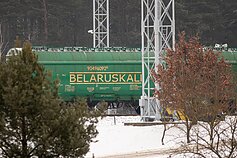
The comments raised questions about whether Lithuania might reconsider its stance on Belarusian fertiliser transit through Klaipėda port, particularly after the US eased certain restrictions, though EU sanctions remain in place.
Budrys responded indirectly in a video message, emphasising that Lukashenko’s government has not fundamentally changed its behaviour and that Lithuania continues to push for stronger EU-level sanctions.
Janeliūnas warned that easing restrictions could damage Lithuania’s credibility within the European Union.
“Fertilisers mean money for the Lukashenko regime,” he said. “We have long argued for maximum pressure. A reversal would undermine our reputation.”
Baranovas said Lithuania has reached a point where it must reassess its long-term approach to Belarus.
“We once believed sanctions could help bring change. That has not happened,” he said. “Now we must decide whether to maintain the same course indefinitely […] or consider alternatives.”
Tsikhanouskaya’s relocation
Tensions have also surfaced over Lithuania’s treatment of Belarusian opposition leader Sviatlana Tsikhanouskaya.
Recently, Lithuania downgraded her security detail. While officials described the change as technical, it prompted Tsikhanouskaya to move her main office from Vilnius to Warsaw, though her representation in Lithuania remains accredited.
Ruginienė has reportedly questioned the scale of resources devoted to Tsikhanouskaya’s office, while Budrys and Nausėda have sought to maintain high-level engagement. The Foreign Ministry preserved her official guest status, allowing access to VIP facilities at Lithuanian airports.
Baranovas downplayed the differences, saying the relocation reflected practical considerations rather than a fundamental policy shift.
Still, observers say the episode illustrates broader undercurrents in Lithuania’s foreign policy debate, including questions about priorities, resources and long-term strategy.
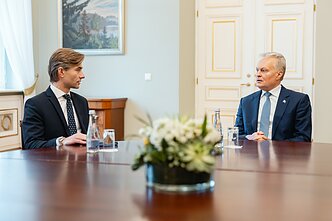
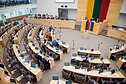
For now, Nausėda has convened a meeting with Ruginienė, Budrys, parliamentary speaker Juozas Olekas and Foreign Affairs Committee Chairman Remigijus Motuzas to discuss key foreign policy issues.
Whether that meeting will smooth over differences or merely manage them remains to be seen.

Newsletter
Every Friday morning.