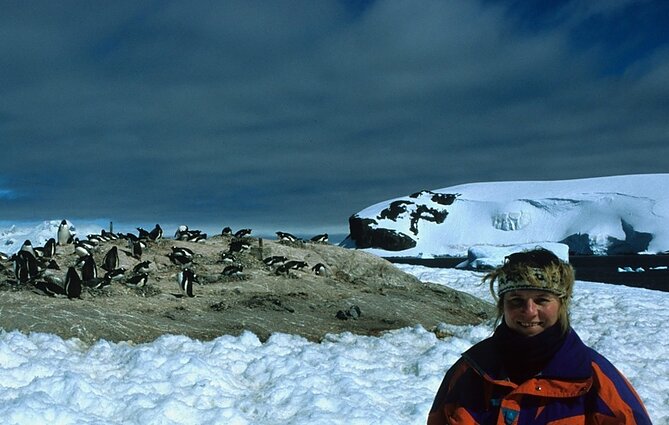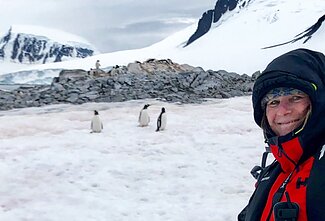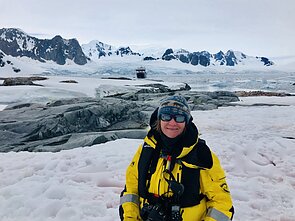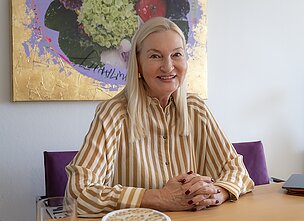











“At that time, it was easier to fly to the Moon than to travel to Antarctica as an all-female group,” says physician and researcher Dr med Monika Puskeppeleit MPH, who has visited some of the most remote places on Earth.
On the occasion of the International Day of Women and Girls in Science, Puskeppeleit told LRT.lt about the world’s first all-female Antarctic overwintering expedition, which she led from 1989 until 1991.
The German physician of Lithuanian descent says her interest in exotic travel began in childhood while reading adventure books and stories of old polar explorers. However, the spark that ultimately ignited her own desire to go on an expedition was a 1979 documentary about Archibald William McMurdo. The film described the social isolation experienced by a polar overwintering team that spent for more than a year at an American base near the South Pole.
“And then I had this thought. I walked out of my room and knocked on my good friend’s door – she was studying geography at the time. I said, ‘Give me your big atlas, your big map. I know it – I’m going to overwinter in Antarctica.’ That was the spark in 1979 from which everything began,” Puskeppeleit recalls.
Two days after completing her medical studies in 1984, Puskeppeleit went to the German Alfred Wegener Institute for Polar and Marine Research to meet its director, Prof Gotthilf Hempel. He referred her to the founder of the German Society of Polar Medicine and Related Fields, Prof Horst Smolka.
“I am Monika Puskeppeleit, a German doctor and I plan to overwinter in Antarctica,” she would introduce herself. But the answer was always the same: “Alright, but that’s impossible in this century for a woman.”
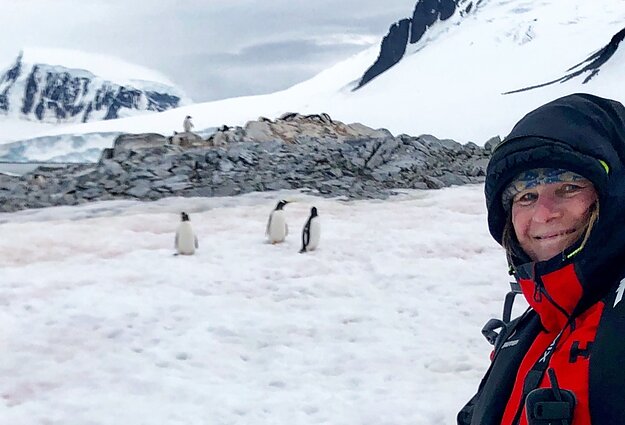
The first German overwintering base in Antarctica was established in 1981, Puskeppeleit explains, and several expeditions had already stayed there, spending 14 months at a time, including nine months in complete isolation. These were always male groups.
Mixed-gender groups were also viewed with suspicion, the Polar Research Institute said this would be psychologically difficult because of potential conflicts deriving from social and psychological dynamics.
“I already knew that there were mixed teams at the Australian and US stations such as the South Pole station, but in Germany this was completely impossible,” Puskeppeleit says. “At that time, it was easier to fly to the Moon than to travel to Antarctica as an all-female group.”
Since mixed teams were not allowed, Puskeppeleit told Hempel that there should be an all-female team.
In 1986, Puskeppeleit delivered her first international lecture on the immunity of people overwintering in Antarctica – it was so well-attended that some listeners were practically sitting on the floor. It was clear she would not give up.
In 1988, nine years after she first had the idea of going to Antarctica, there began what she calls a “snowball effect”.
“I received letters from several young female scientists. They had just completed their geophysics studies and were also interested in an Antarctic expedition. They wrote to me because they had obtained my address from the director of the Alfred Wegener Institute. In the end, we submitted an application for an all-female team.”
The authorities liked the idea that Germany could become the first nation in the world to send an all-female research group to the South Pole.
Like landing on the Moon
Back then, preparations were not as extensive as today for spending winter at the German Neumayer III research station. In particular, mental training for isolated work on ice has improved significantly.
The only survival course that the nine women completed at that time took place in the Austrian Alps. Puskeppeleit was on her own at the time as she prepared herself medically and psychologically for her 14-month stay in Antarctica.
As an assistant doctor in surgery, she deepened her multidisciplinary medical knowledge in many specialist areas, ranging from dentistry and gynaecology to emergency medicine and neurosurgery.
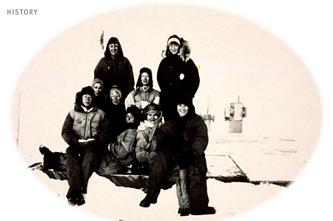
In November 1989, shortly after the fall of the Berlin Wall, nine women – two meteorologists, two geophysicists, two engineers, a cook, a radio operator, a physician and Puskeppeleit herself as the team leader – set off for Antarctica.
The group split into two teams. The first one, which included Puskeppeleit, reached Antarctica aboard the South African icebreaker S.A. Agulhas.
Its modern successor today can break ice about one meter thick. However, near Antarctica in the Southern Ocean, the S.A. Agulhas became trapped in pack ice.
“I said, ‘oh, this is where the adventure begins’,” she recalls. The problem was resolved in about a day, but it served as an important lesson: they had entered a dangerous zone where anything could happen.
The women reached the Antarctic coast of Dronning Maud Land by the South African icebreaker and then their final destination, the German Georg-von-Neumayer Station, by helicopter.
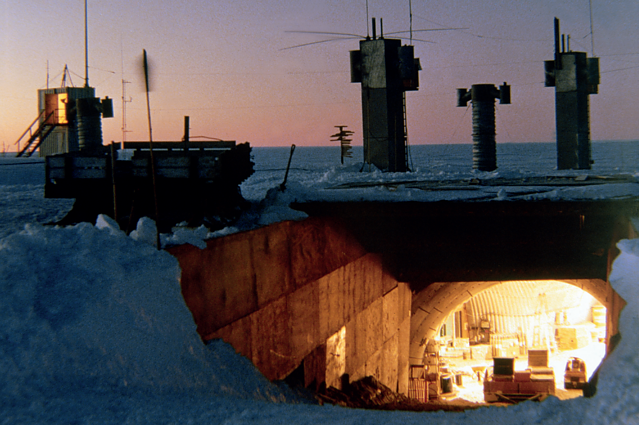
“I’ll tell you: the moment I stepped out of the helicopter, that first step onto the ice shelf at the Georg von Neumayer base – something that was only a dream in 1979 and became reality in 1989, ten years later – felt like landing on the Moon.”
Two seasons
Unlike Europe, the Antarctic continent has only two seasons, winter and summer. Antarctic summer begins in October and ends in March, while winter begins in March and lasts until October.
In summer, the sun shines all day and does not set until winter. Even at midnight, the sun at the South Pole is bright enough to read a newspaper. In winter, it is dark and cold all day, the period is known as polar night.
The average winter temperature in Antarctica is −34.4°C, while in summer it rarely rises above 0°C, except in coastal areas.
The two teams of Puskeppeleit’s expedition met on the ice continent in midsummer, December 1989.
“In summer, up to 150 people can be at the station. Summer guests arrive, expedition participants, people from various countries – so there are many people here. The first six to eight weeks are dedicated to newcomers taking over information from those who previously overwintered here. Meteorologists and geophysicists receive all information from colleagues who had overwintered before them and work together for a certain period. For me, the former station leader – of course, a male colleague – explained all organisational and logistical matters during the first two months,” Puskeppeleit recalls.
At the end of February–beginning of March, the previous overwintering team and visiting personnel leave Antarctica, no new ships arrive, and a nine-month overwintering period begins – the period of isolation.
Life eight metres under ice
Today, the Georg von Neumayer Station is completely different from what it was in 1989: at least twice bigger and built on stilts above the ice, allowing it to have windows.
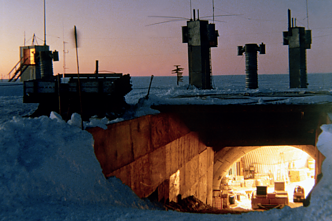
Puskeppeleit and her team lived in two steel tubes connected in the middle, resembling the letter H. The base was built on ice but due to snowfall it was singing deeper every year.
“When we arrived, the base was already about eight meters under the ice, and for 14 months we had no windows. The Georg von Neumayer station operated using central diesel generators as power supply. The waste heat from the diesel engines was used to heat the living and working containers in the steel tubes and to melt snow for drinking water,” she explains.
Unlike other international overwintering stations, the German base provided a separate room of about nine square metres for each member of the expedition. “We had some private space,” Puskeppeleit says.
Depending on weather conditions, the team would start their day at 6 or 7 in the morning. Team members all had their own duties. First, the meteorologists would record weather data. Puskeppeleit is pleased that the team carried out several projects that had not been attempted in Antarctica before.
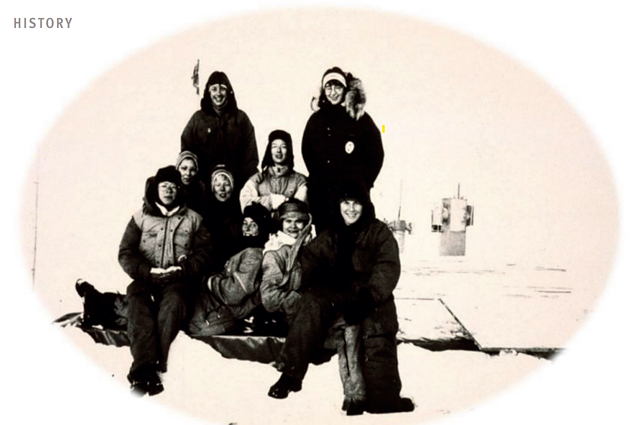
“This was the first time wind energy was tested in Antarctica. One of my engineers, Susanna, presented it as a pilot project, and we installed wind-power generation equipment to reduce diesel consumption. We also changed the waste-disposal system. We compressed the waste using a press and stored it until German research vessel FS Polarstern returned in December 1990. It was a great deal of work, but it was worth it, because the system was later adopted by other overwintering teams.”
Until the 1980s–1990s, waste from most Antarctic stations would simply be dumped at nearby landfill sites or into the sea, and also burned. Today, an increasing amount of waste is removed from Antarctica, and wastewater is treated before being discharged into the sea – a process strictly regulated by the Madrid Protocol.
Scientific experiments
Puskeppeleit’s expedition also stood out for conducting scientific experiments in polar science and biomedicine.
“The doctors who worked before me were station leaders, top-level medical specialists, and so on. They sometimes acted as liberos, as in a soccer game. The wintering doctors supported their colleagues in scientific outdoor activities. However, they did not conduct their own scientific research. Today, of course, doctors do conduct research,” she explains.
One of her scientific interests is climate change. At the turn of the 1990s, a big ozone hole over Antarctica was continuing to expand, Puskeppeleit decided to investigate how intense ultraviolet radiation affects UV-B-sensitive Bacillus subtilis bacteria.
Ultraviolet radiation is divided into UV-A, UV-B, and UV-C. The ozone layer absorbs 100% of UV-C rays, about 90% of UV-B, and only a minimal amount of UV-A. High levels of UV-A and UV-B primarily cause skin burns, but under prolonged exposure to sunlight, UV-B rays can damage DNA and cause cancer.
UV radiation in Antarctica is particularly intense in summer. Scientists found that in October, at the beginning of winter, bacteria kept outdoors in October later formed colonies just as poorly as those kept outdoors in summer. This indicates that the thinned ozone layer allowed significantly more harmful UV-B radiation to reach Earth than usual.
Special evenings are important for mental health
Although the team spent a great deal of time working together outdoors, during whiteouts (periods of strong winds) and dark periods they had to stay inside the base. To maintain mental and physical well-being, the nine women regularly attended aerobics classes or watched movies on Friday evenings, Puskeppeleit recalls.
The expedition brought only a limited supply of food, so they could not eat whatever they wanted every day. However, there were exceptions.
“My birthday in April was the first one,” Puskeppeleit says. “I decided I wanted to have a birthday party at the edge of the ice shelf near Atka Bay. Our cook baked me a very colourful birthday cake with 35 lit candles on top, and we had a wonderful birthday party inside [a tracked snow vehicle].”
Such memorable moments helped prevent isolation problems during the polar night.
“During the polar night, when it was very stormy outside, we made mini-skirts out of our old sweaters and if you were to look through the old diaries of the first Antarctic explorers like Shackleton, Nansen or Amundsen, you would see that they also had such evenings – special evenings.”
Returning from such journeys where one survives on minimal resources makes one more modest.
“When I returned to civilisation, it took me more than a year to buy new things, because I said that I already had everything. I had lived in a room of nine square meters 14 month, that says it all.”
Even one’s senses change.
“When I smelled flowers and the red soil of South Africa, it was something incredible. Your smell perception becomes sharper – I’ll write a bit about that in my autobiography as well.”
Just like Rogozov
When it comes to historic Antarctic expeditions, one of the most memorable stories involves Leonid Rogozov, a Soviet surgeon who in 1961 performed an appendectomy on himself.
Puskeppeleit said that during her overwintering, she did not have to perform any major surgical procedures. Most of the medical issues she encountered were minor, such as knee injuries or carpal tunnel syndrome caused by prolonged repetitive hand movements compressing the median nerve.
However, like Rogozov, Puskeppeleit once had to stitch a wound on herself – though not on her abdomen but on her head. Unlike Rogozov, she did not use a mirror, but enlisted the help of her team members who had received basic first-aid training beforehand.
“I was my own first patient; I sustained a superficial head wound while working outside in the station area. I then asked my radio operator and meteorologist for help. I said: You have to help me stitch this wound on my head, and we did a great job. I don’t even remember exactly where the wound was anymore,” she laughs.
In early 2026, the first-ever astronaut medical evacuation from the International Space Station took place. Puskeppeleit notes that similar evacuations are sometimes conducted from Antarctica as well.
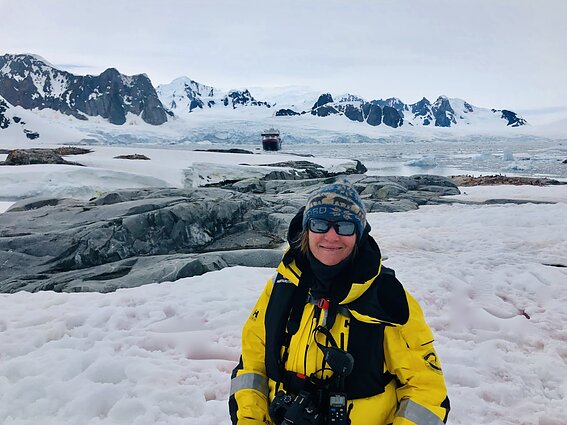
“I’ll tell you a story from an overwintering expedition before ours. I know this person very well, he is one of my colleagues. He developed appendicitis. Can you imagine that the base leader and station doctor, responsible for overwintering, got appendicitis? The team spent a long time considering what could be done, because winter is the isolation period.
“They discussed that maybe the Americans could send a Hercules [a US military aircraft] and a few people could parachute in to help, but the risk was very high. So my colleague said he didn’t want to risk anyone else’s life. Instead, he tried to manage it with antibiotics, and honestly, he did quite well. Later, in summer, he was transported by ship to Cape Town and operated on there. This happened in the 1980s.”
According to Puskeppeleit, it is easier to evacuate people during the Antarctic summer period, when there are more expedition ships in the area. Patients can also receive necessary medical care or surgery on board some research vessels until they are transported further.
The reunification of Germany in Antarctica
Puskeppeleit explains that overwintering in Antarctica used to be completely different from today, as there were far fewer ways to communicate with the outside world.
According to her, initially the expedition team could use satellite communications to make phone calls and send fax messages back home to Germany. However, during her expedition, in the middle of winter, satellite connections failed, making the isolation even more intense.
For communication between bases on the southernmost continent, radio was used. So women sent radio messages to family and friends via former East German base located 800 km away (before Germany’s reunification, there were two German bases in Antarctica), and their colleagues would forward the messages to the Northern Hemisphere.
To prevent wear on the equipment, messages were sent only once per week and the number of sentences was limited.
Interestingly, these contacts between the two bases coincided with the 1990 reunification of Germany. So in a sense, reunification happened not only in Europe but also in Antarctica.
“In 1990, we began establishing a regular radio contact with the East German overwintering team. It was, so to speak, German reunification in the ice of Antarctica,” Puskeppeleit recalls. “So, on October 3, an important day for us Germans, we had a rather interesting radio meeting. I, as the German station leader, and my colleague, the former East German base leader Gerhard Schlosser, conducted a symbolic reunification, including the exchange of scientific data.”
Puskeppeleit notes that today scientists traveling to Antarctica have 24/7 access in emergency situations to hospitals in their homeland, social media platforms and much more. Thus, this may no longer be the kind of adventure experienced by early explorers or by her and her team.
“Nowadays, I can talk to friends in Australia just as we are talking now. Isn’t that amazing? But you lose some excitement, you lose that venturing.
“During solar storms, southern lights are intensive, so there were times when we had no communication for one or two days, and sometimes the systems would brake down. So you have moments where you’re really alone at the end of the world. At those times, you felt like you were on another planet,” she smiles.
Conspiracy theories are still there
Puskeppeleit recalls that before her all-female expedition to Antarctica, many people doubted that they would succeed. People wondered why she, a doctor, was not pursuing a conventional medical career, but instead wanted to travel to the end of the world.
“Some people said, what is she doing? Can’t she just be a normal doctor and work in a hospital? But I didn’t give in,” says Puskeppeleit.
It might seem that after the expedition, attitudes would have changed. However, this is not entirely the case, she admits. Even today, there are conspiracy theories about the women’s overwintering expedition from 1989–1991.
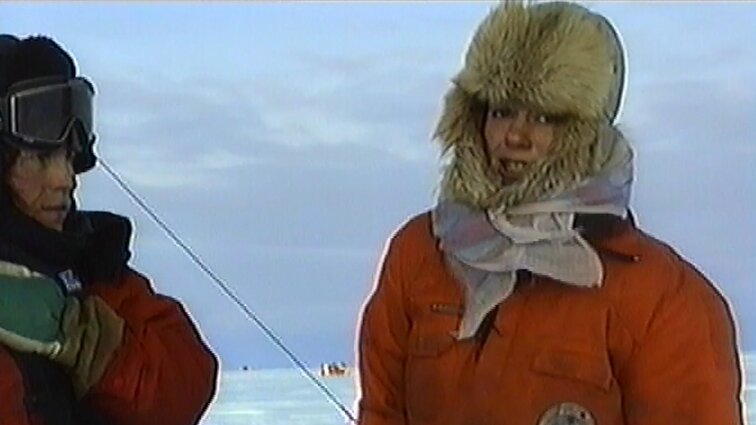
Video courtesy of Monika Puskeppeleit
“We had many obstacles to overcome before, during, and after our Antarctic overwintering.”
Last year, as a keynote speaker at the British Antarctic Survey, she encountered questions reflecting doubts about the expedition conducted more than 30 years ago. She was asked whether there had been any team difficulties during their winter stay, as it had been reported that her team members had returned on two different research vessels.
“However, the reason for this was that there was an urgent emergency on site at the time, affecting another nation. We, Germans, assisted in this rescue operation with our helicopters. For this reason, we had to change the entire logistics plan for the 1991 summer campaign, and our women’s wintering team was divided into two groups for the journey home to Germany,” Puskeppeleit says.
Her new dream is to have her own research vessel and to provide opportunities for young scientists and citizen scientists – non-professional researchers who care about nature – to conduct research expeditions in Antarctica.
“We’ve been working on this project for five years and we don’t give up. It’s my little new Antarctic dream from another perspective. I hope that soon we will reach our goal,” says the scientist.
Greenland
Although her first Antarctic expedition will always hold a special place in her heart, Puskeppeleit has had fascinating experiences traveling to the remotest parts of the Northern Hemisphere, from Siberia, Alaska, and Svalbard to Greenland.
“I feel a close connection with the people of the Arctic, and this is a big difference between Antarctica and the Arctic. In Antarctica, the residents are scientists – they come, spend a little time, and leave. In the Arctic, people live there; it’s their home, it’s their nature and their history. This is an important difference between the two polar regions and the opportunities for collaboration there,” Puskeppeleit explains.
She notes that Greenlandic people struggle with issues of identity, which she believes may relate to the high rate of youth suicide there. She stresses that it is important for other countries to help Greenland achieve not only economic but also internal independence.
“You can see their generations-old knowledge of the polar region shining in their eyes. When I travelled with them on dog sleds across the Greenland glaciers for several days, I felt very safe. Many of them are very special people. They are very strong people, and I love them.”
In 2025, Puskeppeleit became a fellow of the Explorers Club. This is a prestigious international association dedicated to promoting field research, scientific expeditions, and the conservation of natural resources.
Among the members of this club are Lithuanian seal researcher Laura Stukonytė and Lithuanian-born anthropologist Birutė Galdikas; it has also included the first people to reach the South and North Poles, those who climbed Everest, and those who flew to the Moon.
Since early 2026, Puskeppeleit has been serving as IAATO Antarctic Ambassador for environmental issues in Antarctica.
In Germany, her and her team’s achievements during their Antarctic expedition have not yet been officially recognised.
“Antarctica and my polar dream have been a part of my life for more than 35 years, and they are a wonderful enrichment of my life. To this day, I am very happy and grateful that I was able to experience this together with eight other amazing Polar women,” says the German polar pioneer.

Newsletter
Every Friday morning.