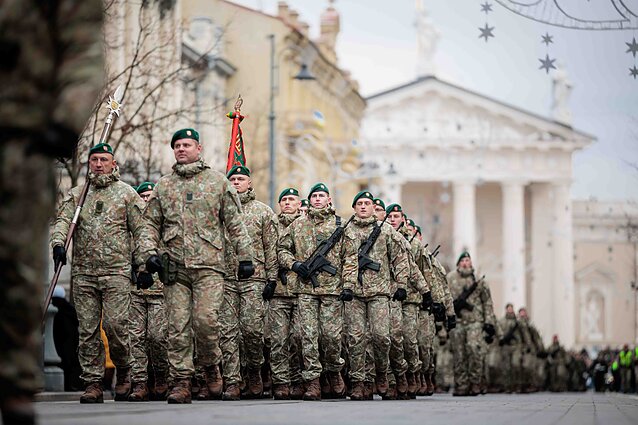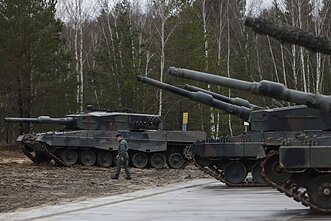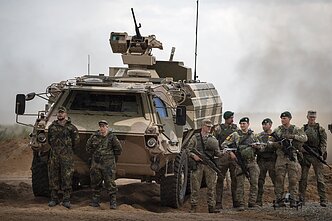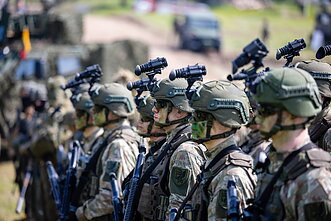















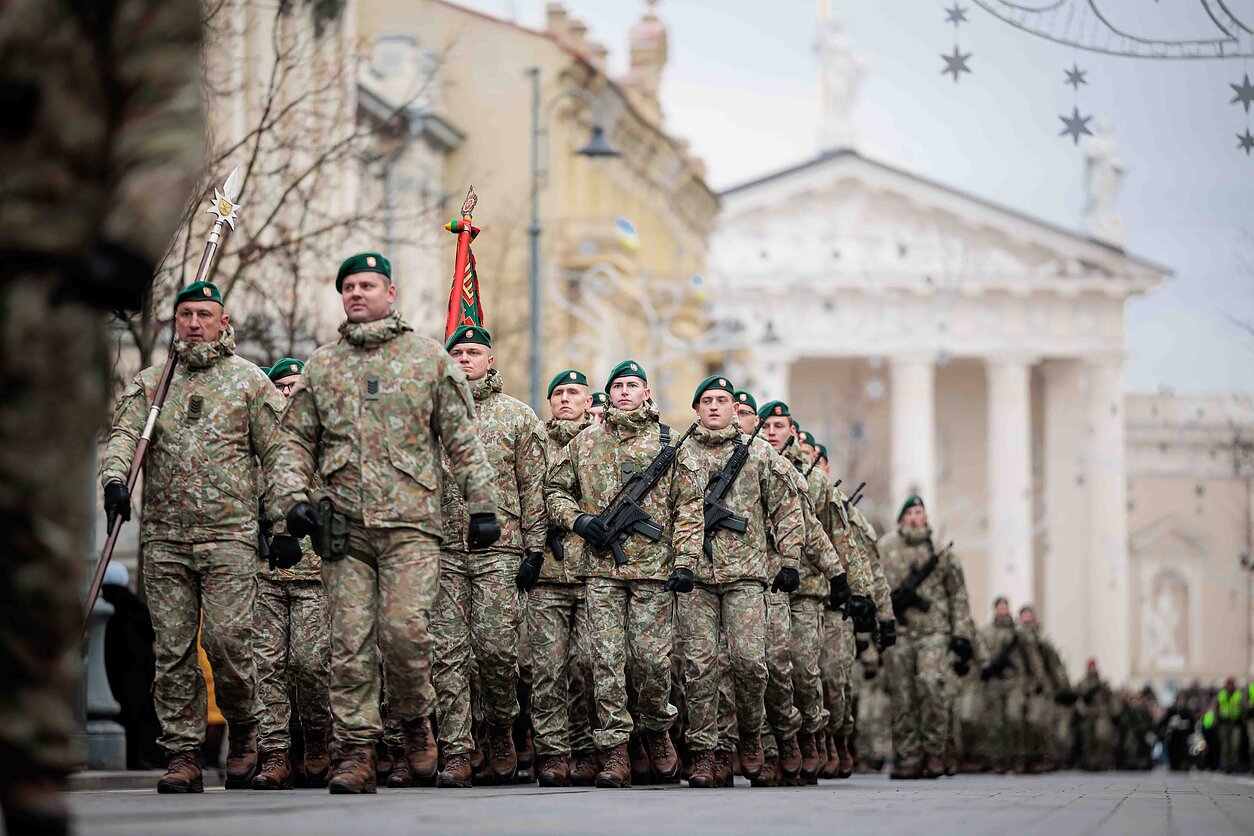
A military simulation published this week by the German newspaper Die Welt depicts a scenario in which Russia manages to seize the Lithuanian city of Marijampolė and take control of the Suwałki Corridor with just a few brigades. As with several earlier high-profile simulations conducted abroad, Lithuania’s armed forces and society are largely ignored.
“What is written there is nonsense. I do not know the objectives of that war game – perhaps they are overly political, intended to show a threat or to educate their own public, German or other European citizens,” retired colonel Gintaras Bagdonas, a former intelligence director at the EU Military Staff, told LRT.lt.
The scenario describes Moscow sending a “humanitarian convoy” to Kaliningrad later this year to address a fabricated humanitarian crisis. The convoy travels through the so-called Suwałki Gap, followed by Russian troops. A German brigade stationed in Lithuania is portrayed as ineffective, while US and NATO forces hesitate, unwilling to risk a Third World War.
Further reading
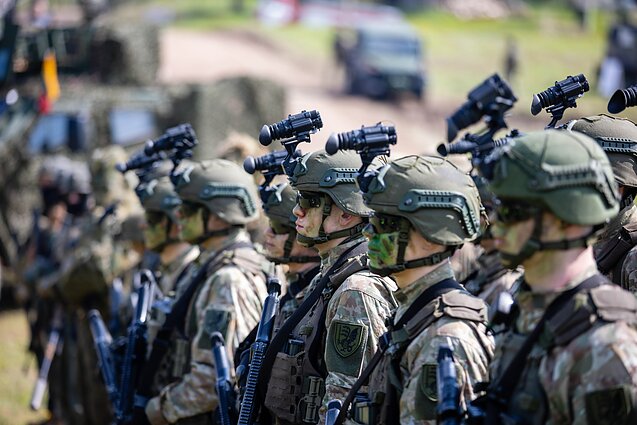
In essence, the participants allow Russia to capture one of Lithuania’s key cities with just 12,000 troops, despite the Lithuanian armed forces – even without counting reservists, volunteers, local defence units or the Riflemen’s Union – being several times larger.
The war game, conducted by Die Welt in collaboration with the Bundeswehr University in Hamburg, involved current and former German military officers, politicians, and decision-makers.
Such simulations are routinely conducted behind closed doors by most armed forces and institutions. This time, however, the media chose to publicise it in order, as Die Welt put it, to spark a debate about whether Germany and Europe are prepared for war. For that reason, the results should be treated with caution.
“In those exercises, they probably wanted to make conditions as bad as possible for themselves and test political decision-making mechanisms,” Bagdonas said.
A similar portrayal of impotence sparked debate in Latvia in 2016, when the BBC aired the documentary World War Three: Inside the War Room. Around the same time, the influential think tank RAND Corporation also published a widely circulated paper suggesting Russia could overrun the Baltic states in just a few days.
In the BBC project, as in the German simulation, former military officers, politicians and diplomats sat around a table and role-played escalation scenarios. In Latvia’s case, these mirrored Russia’s seizure of Crimea and parts of Donbas. Using special forces, regular troops and alleged separatists in eastern Latvia, Russian forces occupied a large part of the country.
Reflecting the mood of the time, the US deployed forces and, together with the UK, sought to form a so-called coalition of the willing. Much of Europe hesitated, and NATO’s Article Five was not triggered because of the fog of war and, as at the start of the conflict in Donbas, widespread information chaos.
Latvian officials, along with European and Baltic commentators, criticised the narrative that deterrence does not work, local forces are powerless, and there’s no unity.
In retrospect, the situation at the time was arguably more fragile. NATO had not yet deployed forces to the region, and the Baltic states’ militaries were only beginning to recover following long years of post-financial crisis cuts.
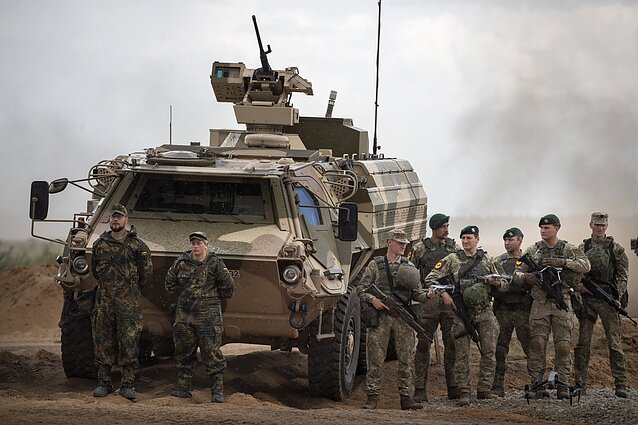
At the time, everything rested on NATO’s collective defence clause. Today, however, that guarantee has begun to look less certain after Donald Trump was elected US president for a second term.
This has already prompted Lithuania’s Prime Minister Inga Ruginienė to speak about a contingency plan should NATO collapse. Discussions about spheres of influence and European defence without Washington are also taking place in political corridors in Vilnius.
Further reading
These anxieties were also reflected in last year’s internationally bestselling book, “What If Russia Wins?” Its author, Carlo Masala, a professor at the Bundeswehr University in Munich, outlines a potential war in the Baltic states in which the US is absent.
Once again, local voices – and local forces – are barely visible.
“The author does not discuss how Estonia and allies present in the Baltic region would react, even though the attack takes place on their territory,” Marielle Vitureau, a French journalist based in Lithuania, wrote on Facebook.
“That an author of this stature, invited to high-level conferences in the Baltic region, simply forgets to write about this is incomprehensible. Once again, the Baltic states are discussed while being ignored,” she added.
The German war game simulating a Russian attack on Lithuania has drawn similar criticism from international security experts.
“I'm deeply sceptical of these wargame scenarios because they seem to imagine NATO has no early warning, is asleep at the wheel as Russia masses forces at the border and lays mines, and that local [Lithuanian] & multinational forces in situ wouldn't move into forward positions in a crisis,” Shashank Joshi, The Economist’s defence editor, wrote on X.
He was backed by Decker Eveleth, a nuclear weapons and deterrence expert at the CNA think tank.
“Wargame was organised for a newspaper to prove a point. Some of its conclusions may be valuable depending on design, but broad conclusions about the level of threat Russia presents cannot be drawn from a scenario planned under these circumstances,” Eveleth wrote on X.
An almost identical scenario – in which a Russian “humanitarian convoy” to Kaliningrad is used as a pretext to attack Lithuania – also appears in the popular strategy video game Broken Arrow, released last year by Russian developers and Western publishers. The project reportedly involved a controversial Russian author, Sergei Chekmayev, who has promoted separatism in Donbas.
As in the real war in Ukraine and in simulated scenarios by the BBC, Die Welt, and Broken Arrow, the trajectory repeatedly points toward Russia’s threat of nuclear escalation. In other words, the West is conditioned to do everything it can to avoid a Russian nuclear response.
“Russia has successfully deterred the West from taking more radical steps in support of Ukraine. Its deterrence works and is largely based on the fact that Russia is a nuclear power – and it works,” Anton Shekhovtsov, a Ukrainian professor at the Central European University in Vienna, told LRT.lt.
He said such war-game scenarios are primarily aimed at Western elites and societies, in an effort to jolt them awake, which may explain the limited role assigned to the Baltic states.
The scenario itself, he added, is not entirely implausible.
“Russia would most likely refrain from aggression against NATO on the scale seen in Ukraine, but would instead build up tools below the threshold of conventional war,” he said. “The core idea of how Russia could undermine NATO is conveyed fairly accurately.”
One participant who played the Russian side, Alexander Gabuev, director of the Carnegie Russia Eurasia Centre in Berlin, told Meduza that European countries would, in reality, have reacted more quickly.
He said the simulation was designed to test how Germany might respond to a chaotic and fast-changing situation. “We found that their reaction would not be sufficient to defend the North Atlantic Alliance,” said Gabuev, who played the role of Russian President Vladimir Putin.
Military: We do not see this as a trend
The Lithuanian armed forces said they did not see a broader trend in Western war games of excluding Baltic militaries or societal factors.
“In this case, since the war game was organised not by military structures planning an operation, but by various organisations using personnel with differing levels of expertise and pursuing different goals, it is likely that the planners either do not have accurate information, rely on unverified or open sources, or exclude certain factors for other reasons,” the military said in a written response to LRT.lt.
The armed forces also directed LRT to a statement it posted on Facebook on Friday. In it, the military said that “even without reinforcement, our current capabilities consist of more than 20,000 active-duty personnel and more than twice that number in reserve, which can be activated in a very short time”.
“Neither Article Five nor decision-making in other countries affects the start of actions by the Lithuanian armed forces,” the statement said.

Newsletter
Every Friday morning.