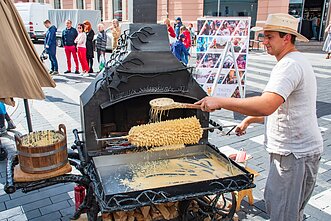












Lithuania’s iconic spit cake, šakotis, is not only familiar to Lithuanians but also well known in France – though under a different name and with its own regional twists.
In France, the cake is called gâteau à la broche, which translates as “cake on a spit”, according to Goda Klimavičiūtė, a contributor to LRT RADIO based in France. Like šakotis, it is made by layering batter onto a rotating spit over an open flame.
French cuisine is renowned for its breadth and variety, Klimavičiūtė said, with countless regional desserts ranging from cakes and creams to biscuits. Many recipes, she noted, have been adapted from abroad.
“The croissant, which we all know, was brought to France by Austrian bakers,” she said. “The French refined it and turned it into a national symbol.”
While visiting a gastronomic market in Paris, Klimavičiūtė said she was surprised to see a cake that looked strikingly similar to Lithuania’s šakotis.
“I thought Lithuanians had arrived,” she said. “But I was surprised to learn the bakers were from the Pyrenees. They had brought their own culinary heritage – gâteau à la broche.”
The origins of the cake are debated. One theory traces šakotis to confectioners working for Prussian kings, while the recipe reached France with Napoleon’s army returning from the Caucasus.
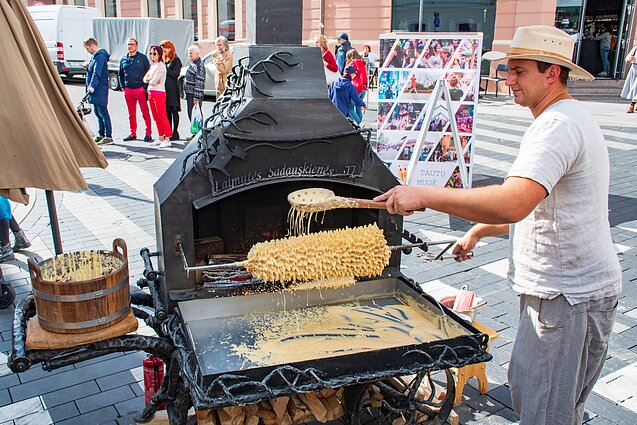
“There is a legend that Napoleon thought the cake resembled the king’s guard,” Klimavičiūtė said. “He borrowed the recipe and brought it back to France, where it took root.”
Traditionally baked over an open fire, the French version of the cake has become a source of regional pride in two French departments – Hautes-Pyrénées and Aveyron. A brotherhood dedicated to the cake operates there and organises an annual festival each July.
Klimavičiūtė said the Lithuanian and French versions of the cake are made using the same technique and are typically served on special occasions. Still, each has distinct flavours and characteristics.
“The French version is scented with lemon, orange blossom and a splash of rum, and it uses fewer eggs than the Lithuanian šakotis,” she said.
Despite the similarities, Klimavičiūtė said she always introduces šakotis as a Lithuanian cake.
“We don’t take offense, and neither do they,” she said. “We just look for similarities and differences. It’s actually quite nice that both of us have such similar cakes.”

Newsletter
Every Friday morning.