










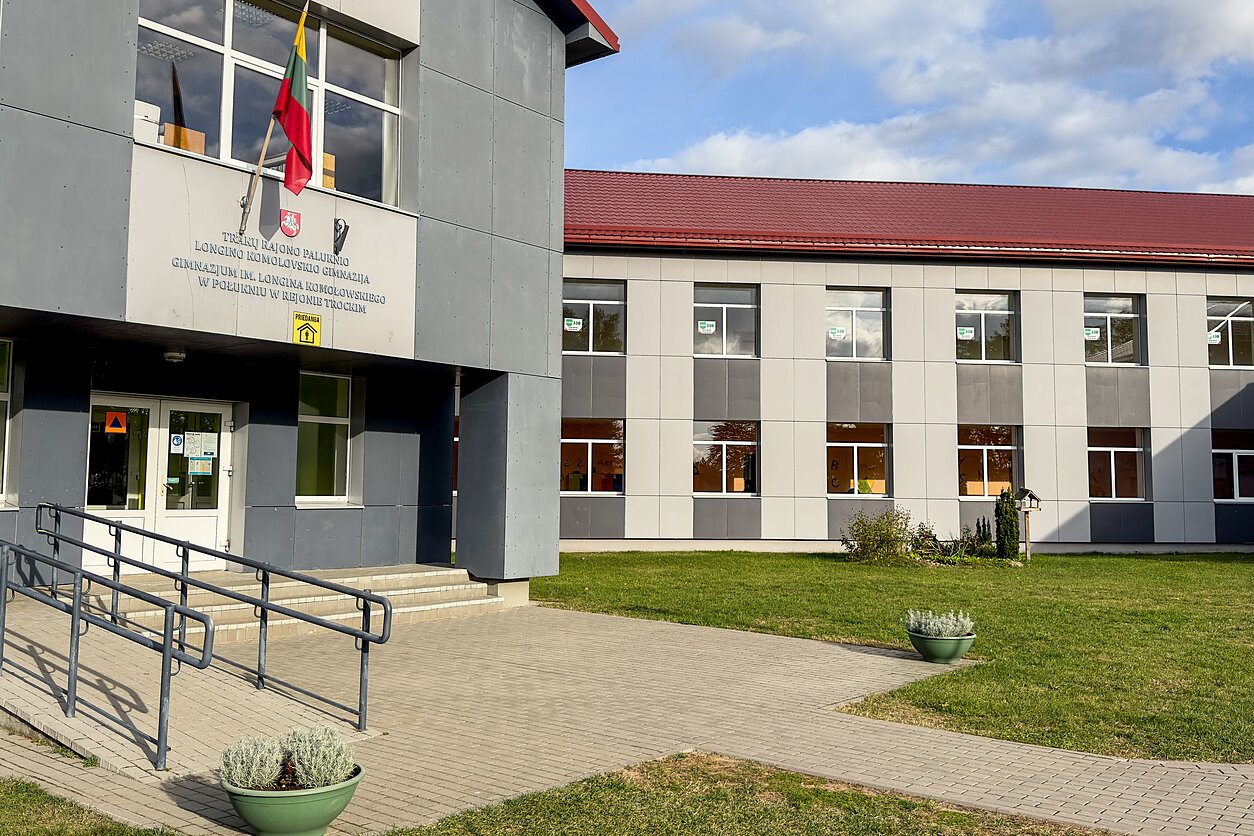
Representatives of the Electoral Action of Poles in Lithuania–Christian Families Alliance (LLRA-KŠS) are questioning whether Polish-language schools in Trakai District are being discriminated against following a municipal decision to reorganise two such schools into branches of larger institutions.
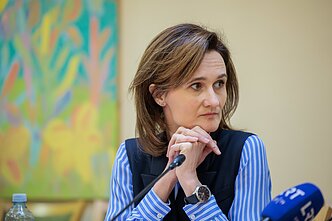
“This is not an isolated dispute. It is a systematic process by the ruling majority of liberals and the conservative Homeland Union–Lithuanian Christian Democrats in Trakai that raises serious questions about equality and possible discrimination,” Agnieszka Rynkiewicz, a member of the Trakai District Municipal Council, told a news conference at the Seimas on Wednesday.
Rynkiewicz said Polish-speakers make up about 30% of Trakai District’s population and argued that its educational needs are being ignored.
“This is not a marginal group. It is a significant part of society that is inseparable from the identity of this region – historically, culturally and socially,” she said. “Do the state and local government have the right to ignore the educational needs of such a large part of the population?”
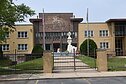
Over the past several years, two Polish-language schools in the district have lost their independent legal status. Since September last year, the Andrzej Stelmachowski Primary School in Senieji Trakai has operated as a branch of Trakai Gymnasium. The Longin Komołowski Gymnasium in Paluknys is set to become a branch of the Polish Henryk Sienkiewicz Gymnasium in Lentvaris in September.
“I want to emphasise that no other school in Trakai District has lost its independent legal status – only these two Polish schools,” Rynkiewicz said. “In our opinion, this is no coincidence. This is selective decision-making.”
One of the schools has about 100 students, the other around 120.
Česlav Olševski, another LLRA-KŠS representative, said experience shows that “if a school loses its independent status, after two or three years it simply ceases to exist”.
Rynkiewicz said the reorganisation of the Senieji Trakai school has already created administrative and organisational problems, including delays in information, difficulty contacting management and limited access to projects and competitions.
“This creates an unwritten conflict,” she said. “Either the Trakai Gymnasium administration applies for projects itself and gets the funding, or the school in Senieji Trakai is left with nothing.”
Olševski said the situation of Polish-language schools in Lithuania was also raised at a meeting of the European Parliament’s Intergroup on Traditional Minorities, National Communities and Languages at the initiative of LLRA-KŠS leader and MEP Waldemar Tomaszewski.
“MEPs paid particular attention to the situation in Trakai District, where, under the guise of reorganization, Polish schools are losing their independent status and are effectively being destroyed,” Olševski said, adding that the decisions were negatively affecting Lithuanian-Polish relations.
Lithuanian Foreign Minister Kęstutis Budrys said last week that one of his deputy ministers had been tasked with looking into the situation.
“This is not only a local issue for Trakai District, but a matter on the national agenda,” Budrys said. “We should find a solution that suits parents and students, is good for the community, complies with the law and causes as few problems as possible in our relations, especially with our strategic allies.”
Trakai District Municipality rejected allegations of discrimination, saying the decisions were based on objective criteria such as student numbers, educational opportunities and the need to ensure sustainable, high-quality education, not on ethnicity or language.
“Over the past few years, the municipality has consistently invested in the infrastructure and educational conditions of ethnic minority schools, allocating almost 5 million euros for this purpose,” it told BNS on Wednesday.
The municipality said the reorganisations were envisaged in a 2022–2026 plan for restructuring the district’s school network, approved in 2022 after assessing demographic trends, declining student numbers and legal requirements.
In the case of the Paluknys gymnasium, the municipality cited persistently small class sizes, particularly in grades nine and 10, which required additional funding to maintain incomplete classes and infrastructure.
Merging the school with the Henryk Sienkiewicz Gymnasium in Lentvaris would allow for more stable organisation of education and broader opportunities for students, it said.
The reorganisation of the Senieji Trakai primary school was also part of the same plan, the municipality said, noting that the process resumed after courts rejected legal challenges.
“The most important thing is that reorganising schools into branches will allow children to continue studying in their native language in Paluknys and Senieji Trakai,” the municipality said, adding that larger schools are better positioned to participate in EU-funded projects and attract investment.
Trakai District Municipality said it is guided by Lithuanian law and government-approved rules for school networks and remains open to dialogue with state institutions.
There are 63 schools in Lithuania where Polish is the language of instruction.

Newsletter
Every Friday morning.