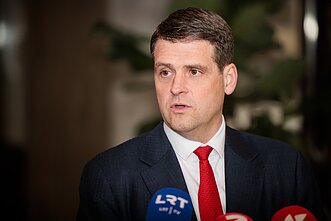



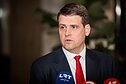









Lithuanian President Gitanas Nausėda said Tuesday he will push firmly for the European Union to extend sanctions on Belarus, citing Minsk’s continued alignment with Russia, repression of political opponents and what he described as escalating hybrid attacks against Lithuania.
“With the European Union set to decide in late February, I will be among those who most firmly demand the extension of these sanctions,” Nausėda told the radio Žinių Radijas.
Nausėda insisted the Belarusian government remains a close ally of Russia, continues to hold political prisoners and is responsible for repeated security incidents along Lithuania’s border, including the use of smuggling balloons.
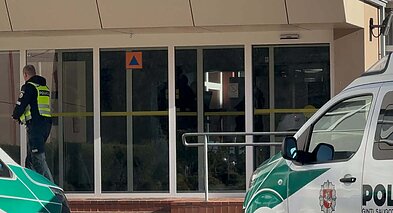
The most recent balloon incursion occurred last week, when Vilnius Airport was forced to suspend operations three times in one evening. Nausėda said the incident prompted a strong response from the United States, which warned Minsk that such actions could undermine any effort to improve bilateral relations.
“The response was marked by very tough rhetoric and firm wording,” Nausėda said. “If the Belarusian regime is seeking at least some normalisation of relations – if not with the European Union, then at least with the United States – it should clearly avoid such signs of escalation.”
In mid-December, US President Donald Trump’s envoy, John Coale, reached an agreement with the administration of Belarusian leader Alexander Lukashenko on the release of some political prisoners and the easing of sanctions on Belarusian potash fertilisers.
The move fuelled speculation that Washington might pressure Lithuania to allow the resumption of Belarusian fertiliser transit through the port of Klaipėda. Nausėda dismissed such claims, saying there have been no discussions with the United States about easing sanctions.
“There have been no such talks, and Washington has never made such a request under any pretext,” he said.
Nausėda also urged politicians to avoid speculation about possible negotiations with Minsk, responding to remarks by Remigijus Motuzas, chairman of parliament’s Committee on Foreign Affairs.
“As for Mr Motuzas’ statement, it was probably a what-if reflection,” Nausėda said. “Speculating today about hypothetical scenarios is not very responsible. We have the situation we have, and it is not acceptable to us.”
Motuzas said last week that discussions were underway in Vilnius about the possible content of talks with Belarus and a potential neutral venue.
Belarus has sought a meeting with Lithuania’s foreign minister or deputy minister since last year, following repeated balloon incidents that forced temporary suspensions at Vilnius Airport and led Lithuania to briefly close its border with Belarus.
Although border checkpoints have since reopened, Belarus has continued to block Lithuanian companies’ trucks from leaving the country.
Foreign Minister Kęstutis Budrys has said Minsk is attempting to legitimise itself internationally by pressuring Lithuania but stressed that talks with the Belarusian authorities are not under consideration.

Newsletter
Every Friday morning.