











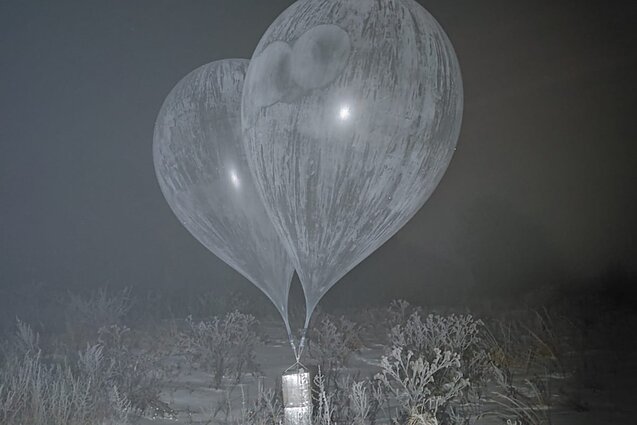
Lithuania is asking the European Union for financial assistance and political pressure on Belarus to help address a surge in smuggling balloons crossing its border and disrupting critical infrastructure, Lithuanian officials said. But would that help?
The EU has pledged support but acknowledges that the crisis Lithuania is facing represent a new type of threat for the bloc.
According to information presented to the European Parliament by visiting Lithuanian ministers, contraband balloons forced airport closures 15 times between October and December last year alone, disrupting nearly 350 flights and affecting more than 50,000 passengers. The longest closure lasted 11 hours.
Transport Minister Juras Taminskas said Tuesday in Brussels that the situation was under control following changes to response procedures.
“Algorithms have been changed for how we respond when contraband balloons are detected, so that airports are not closed or are closed for as short a time as possible without compromising civil aviation,” Taminskas said. “At this point, it is working.”
However, Vilnius Airport was closed again later that day, and balloons prevented Taminskas himself from returning to the Lithuanian capital.
The European Public Prosecutor’s Office has opened a preliminary investigation into what Lithuania describes as hybrid attacks against the country. Interior Minister Vladislav Kondratovič said broader involvement by law enforcement agencies could help curb the incidents.
“The goal is to make life as difficult as possible for the facilitators and participants in these schemes,” Kondratovič said. “We see that services using criminal networks are one of the main foundations of hybrid attacks.”
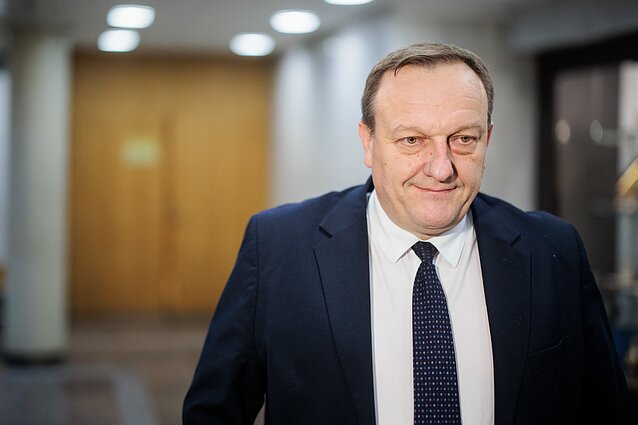
Lithuania’s main request to Brussels is additional funding. Officials estimate losses linked to the balloon incidents totalled nearly 2.5 million euros last year.
Taminskas said Lithuania is seeking extra financing to protect critical transport infrastructure, including airports, the Klaipėda State Seaport and road networks.
The European Commission has promised assistance but said the technology involved presents new challenges.
“We have never seen equipment of this level – balloons capable of reaching altitudes of 10 kilometres and traveling at high speed,” said Henrik Nielsen, a European Commission official. “Previously, we saw simple drones flying a few hundred metres with very limited payloads. More advanced balloons or drones are something new.”

Lithuania has so far been unable to request EU support for specific countermeasures because it has not identified the most effective way to neutralise the balloons.
“At this stage, we have not yet determined the most effective method to deal with them,” said Rustamas Liubajevas, head of Lithuania’s State Border Guard Service. “That is why a comprehensive approach is needed, including criminal intelligence and the fight against organised crime.”
Beyond funding, Lithuanian officials are also calling for political pressure on the government of Belarus, including possible sanctions.
In mid-December, EU foreign ministers agreed that “hybrid attacks” against Lithuania could qualify as grounds for sanctions. That decision opens the door for potential EU action against Belarus over the balloon incidents, provided Lithuania or another member state formally requests it.

Newsletter
Every Friday morning.