















Foreign nationals moving to Lithuania continue to face significant obstacles in the rental housing market, from initial contact with landlords to day-to-day living, according to a study by the Office of the Equal Opportunities Ombudsperson.
The research, conducted last year, found that foreigners frequently encounter unexplained refusals, ignored messages, inflated financial demands and pressure to rent without formal contracts. In some cases, discrimination is explicit, with landlords openly stating they do not rent to foreigners.
“Problems arise at every stage – when trying to arrange a viewing, when negotiating lease terms and even after moving in,” said Eva Laugalytė, a senior adviser at the Ombudsperson’s Office. “Landlords may share information reluctantly, arrive late to meetings or stop responding altogether.”
The findings are echoed by an experiment conducted by LRT.lt and interviews with real estate professionals who work with foreign clients. While overt discrimination is not universal, informal barriers and unwritten rules continue to shape foreigners’ access to housing.

An experiment in Vilnius
To assess real-world responses, an LRT journalist contacted landlords advertising apartments and rooms for rent in Vilnius, posing as a foreign citizen. In five calls, the journalist spoke either English or Russian and identified herself as a citizen of the Czech Republic, Russia, Ukraine, or Belarus.
Responses varied. When calling in English and identifying as a Czech citizen, one landlord readily agreed to arrange a viewing for an apartment on Tauro Street, offered several time options and confirmed that an official lease would be signed.
In another call, conducted in Russian, the journalist identified as a Russian citizen. The landlord responded positively, asking about the length of stay and number of tenants, confirming that the apartment could be rented for at least a year and that all documents would be issued officially. She noted that the property was registered as a guesthouse but said it would still allow legal residence registration.
When the journalist identified as a Ukrainian citizen, the landlord immediately replied, “Very good”, and proposed arranging a viewing. He confirmed that the lease would be official and include residence declaration, and said he was available to show the apartment on the weekend.

A similar reaction followed when the journalist posed as a Belarusian citizen. The landlord said nationality was not important as long as the tenant lived and worked legally in Lithuania. She offered a one-year contract with official registration and later had a relative follow up to discuss viewing an apartment in the Naujamiestis district.
The only conversation that took a political turn occurred during a call in English, when the journalist identified as a Russian citizen while inquiring about an apartment on Skroblų Street. After routine questions, the landlord asked: “And if I ask you whose Crimea is, what would you answer?” When the journalist replied “Ukraine’s”, his tone softened. “Then we can continue talking,” he said, later confirming willingness to rent and sign an official contract.
Realtor: Refusals exist, but are often indirect
As of August 2025, more than 200,000 foreign nationals lived in Lithuania. Ukrainians accounted for about 75,900 residents, Belarusians 51,900, Russians 14,200, Indians 5,500, Kyrgyz nationals 4,700, Azerbaijanis 4,100 and Kazakh nationals about 3,000.
According to real estate agent Aliona Loboda, a Ukrainian national who has worked for several years in Vilnius helping foreign clients find rental housing, outright discrimination is relatively rare, but barriers remain.
“I don’t see major problems just because people speak Russian,” Loboda told LRT. “I often start conversations with landlords in Russian, and no one has ever simply hung up the phone.”

She said landlords usually ask to switch to Lithuanian or English, or continue in Russian if comfortable. Still, she estimates that about 20% of landlords refuse to rent to foreigners.
“Often it’s phrased politely: ‘We want to rent only to Lithuanian citizens,’” she said. “About 10% may say directly that they don’t rent to Ukrainians, Africans or other nationalities, but that’s a small share.”
According to Loboda, foreign tenants are more likely to face additional requirements related not to nationality but to legal status. About 80% of landlords first ask whether the tenant has a Lithuanian residence permit or other legal documentation.
“If they don’t, landlords say they lack guarantees and ask them to come back once documents are in order,” she said.
A similar proportion ask about employment, while only about 10% request proof of income, such as a work contract or bank statement. Security deposits are often higher for foreigners – commonly two months’ rent plus advance payment – though Loboda said deposits can also increase for families with pets or other perceived risks.

More caution after 2022
Loboda said attitudes have shifted since the first years of Russia’s full-scale invasion of Ukraine.
“In 2022–2023, landlords were more accommodating toward Ukrainians. Now people are more cautious,” she said, adding that the increase in refusals reflects accumulated experiences rather than nationality alone.
Some landlords, however, view foreigners as more responsible tenants. “I’ve heard landlords say foreigners worry more about legal status and therefore take better care of apartments,” she said.
She also pointed to incentives offered by the Vilnius municipality. Landlords renting to Ukrainian refugees can obtain an annual rental patent for just 7 euros, though many are unaware of the benefit.
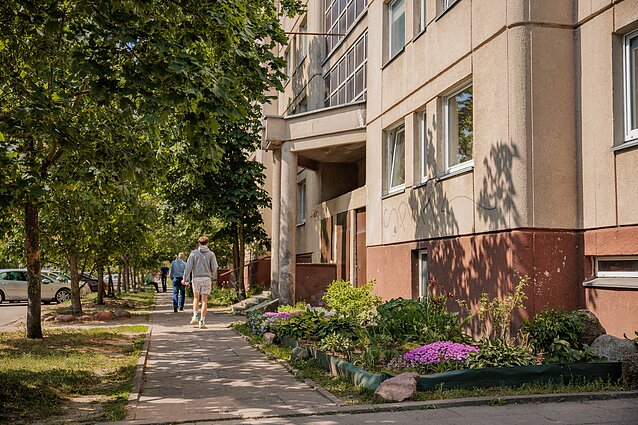
Most foreign tenants choose districts based on affordability and family needs, Loboda said, with Karoliniškės, Pilaitė, Pašilaičiai and Fabijoniškės among the most popular due to lower rents.
Race and origin matter
In a second phase of its experiment, LRT tested responses to prospective tenants from Africa and South Asia. Speaking Lithuanian, the journalist called landlords on behalf of acquaintances – a Black man from Cameroon and an Indian citizen.
One landlord in Naujamiestis asked detailed questions but did not refuse outright, emphasising the importance of cleanliness, single occupancy and personal trust.
“The most important thing is that the person lives alone and is tidy. How long have you known them? Can you guarantee everything will be fine? Because it happens that they say they live alone but then five end up staying,” the landlord complained.
Another landlord in Pašilaičiai declined, citing inability to communicate in English and concerns about managing the lease.
“We’re elderly and we don’t speak English. How will we communicate?” he reasoned, declining the journalist’s offers to mediate.
The most categorical refusal came from an agent for a flat in Užupis, who said the owners would not rent to Indians or any foreigners, citing a negative past experience that necessitated renovations. Moreover, the owners live abroad, they said, and would not be able to monitor the state of the property.

The Ombudsperson’s study found that black foreigners face the harshest discrimination. The research surveyed 144 non-EU nationals who had searched for or rented housing in Lithuania over the past five years.
“Black respondents’ experiences stood out for the level of distrust and rejection,” Laugalytė said. “Some were refused immediately after a face-to-face meeting, with landlords saying they had not expected the tenant to be black.”
The study found discrimination often is not concealed. Foreigners reported being told directly that apartments are not rented to non-Lithuanians, or being asked to pay disproportionately large deposits. Some described openly offensive remarks related to their race or origin.
Researchers said access to housing depends not only on citizenship or appearance but also on landlords’ stereotypes of an “ideal tenant” – typically white, Lithuanian-speaking, childless and middle-class. Those who do not fit this image face greater scepticism.
As a result, many foreigners accept higher rents or informal arrangements without contracts, limiting their ability to declare residence and access social services.
“People prioritise finding housing over challenging discrimination,” Laugalytė said, noting that complaints are rare due to lack of information, fear of legal consequences or scepticism that reporting will help.
She urged those experiencing discrimination to seek advice from the Ombudsperson’s Office, while stressing that broader state involvement is needed.
“Without stronger regulation of the rental market, dignified and accessible housing will remain out of reach for many,” she said.

Newsletter
Every Friday morning.