













Argentina, Brazil, Uruguay and Paraguay, which belong to the Mercosur bloc, are not major trading partners for Lithuania. Jonė Kalendienė, chief economist at the national development bank ILTE, says the European Union’s trade agreement is unlikely to have a major effect – at least not in the near future.
“There will definitely be no sudden growth. We won’t suddenly be flooded with their meat, nor will we suddenly export a great deal,” she told LRT.lt.
EU and Mercosur representatives signed agreements in mid-January after 25 years of negotiations, creating a single market of around 700 million consumers. Mercosur is an abbreviation of the Spanish term Mercado Común del Sur, meaning the Southern Common Market of Latin America.
The European Commission forecasts that the agreement will open up many new trade opportunities for companies across the EU. Annual exports to Mercosur are estimated to rise by about 39% (around €49bn), supporting hundreds of thousands of jobs. Mercosur exports to the EU could increase by about €9bn.
However, the agreement still has to be ratified by the European Parliament. At a session on Wednesday, MEPs decided to refer the signed document to the EU’s Court of Justice. This means politicians will not be able to vote on it until the court delivers its opinion, a process that could take up to two years.
Trade with Lithuania
According to the Ministry of Foreign Affairs, in 2024 Argentina was Lithuania’s 73rd-largest trading partner, Brazil 65th, while Uruguay and Paraguay were not even listed separately.
Lithuania’s trade turnover with Argentina that year totalled €47.21m, and with Brazil €64.63m. Eurostat data show that trade with Paraguay and Uruguay was extremely limited.
Lithuania’s imports from Paraguay amounted to €884,000, and from Uruguay €1.48m. Exports to Paraguay totalled €2.04m, and to Uruguay €4.55m.
According to the State Data Agency, Lithuania mainly exported nitrogen fertilisers to Argentina, technical plastics to Brazil, petroleum oils to Paraguay and cocoa paste to Uruguay.
Meanwhile, Lithuania most often imported unprocessed tobacco from Argentina and Brazil, oilseed crops and fruit from Paraguay, and wool from Uruguay.

Winners and losers
By comparison, overall EU trade with Mercosur was far larger. In 2024, it totalled €111bn, of which €55.2bn was exports and €56bn imports.
The Commission says the new agreement will cut tariffs and open up new markets for a range of goods and services.
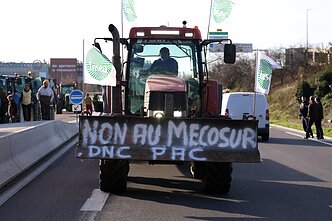
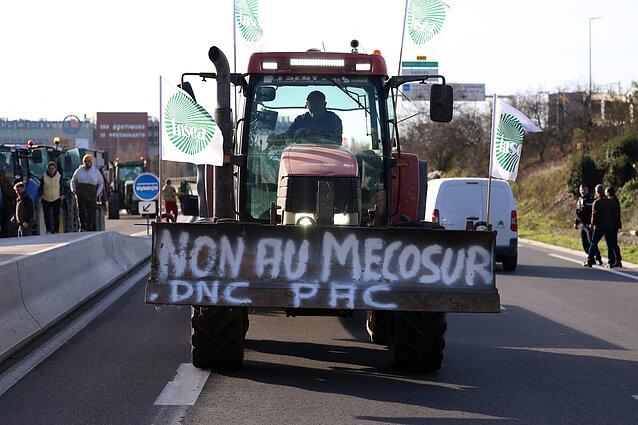
Even so, these promises have not convinced everyone in Europe, with farmers being the most critical. They fear that lower standards on pesticides, animal welfare and workers’ rights will allow South American countries to flood Europe with cheaper meat imports.
The strongest supporters of the agreement are Germany’s and Spain’s automotive and pharmaceutical industries, which hope to gain a foothold in the vast Mercosur markets.
According to Commission figures, 60,000 European companies already export to Mercosur, and the new agreement would allow them to save about €4bn a year in customs duties.
Kalendienė, the economist at ILTE, said the main risks for Lithuanian businesses are linked to livestock imports.
“Latin American countries primarily export agricultural produce. In the case of crop farming, we are in different natural zones, so there is no strong competition. In livestock farming, however, it is natural that our producers would face greater supply from those countries.
That said, looking at Lithuania as a whole, crop farming dominates – cereals, grains and rapeseed. Meat-based livestock farming makes up a relatively small share of overall agriculture,” she said.
In her view, the agreement could be attractive for Lithuanian consumers because of lower prices.
“The agreement is about tariffs, which means some goods should become cheaper and more competitively priced. If consumers can buy good-quality meat at lower prices, I think we would benefit. Although, for example, chicken is already very cheap here. The question is whether it would even be worth importing it. But in the case of high-quality beef, consumers would probably gain,” Kalendienė said.
Speaking about car and pharmaceutical manufacturers, the ILTE economist said that if Europe benefits, Lithuania would benefit too.
“Especially if the car industry benefits. It is no secret that it is not going through its best times in Europe right now, and our industrial companies are closely linked to it. There is a lot of servicing and parts manufacturing for European carmakers. If conditions improve for them, it will automatically become easier for us as well.
From a direct perspective, new markets that are easier to access are always good for Lithuania. The question is how much potential we have. What can we actually offer? We do not produce many final products, but rather intermediate ones that are later used in industry,” Kalendienė said
She agreed that Lithuania’s trade with Mercosur countries has so far been limited. She also doubted that the situation could change quickly.
“There are veterinary authorities and permits that need to be obtained. Nothing is that simple or fast. Even if countries sign an agreement, it does not mean there is a buyer – contacts still have to be found.
Of course, there may be special programmes in Lithuania to help businesses enter those markets. But usually this is something that requires at least five years of groundwork,” she said.
Farmers’ concerns
Farmers in Lithuania have also expressed concern about the EU agreement with Mercosur. For example, the chairman of the Chamber of Agriculture, Arūnas Svitojus, believes difficult times lie ahead for European agriculture. On the other hand, local dairy processors say lower tariffs could have a positive effect on exports to South America.
The Agriculture Ministry also told LRT.lt that producers of higher value-added food products tend to view the agreement positively or neutrally.
“When forming its position, the Ministry of Agriculture was guided by the principle of cumulative impact, assessing the overall and long-term effect on agriculture and the food industry. The analysis showed that even in this area opinions differed: the poultry, bioethanol and beef sectors reacted most sensitively to the proposed provisions, while producers of dairy products, beverages and higher value-added food products assessed the agreement positively or neutrally, as broader export opportunities would open up,” the ministry said in a statement.
As there were no major comments from other sectors of the economy, it was the specific nature of agriculture and the food industry that generated most of the debate.
“Taking this into account, the position prepared by the Ministry of Agriculture formed the basis for shaping Lithuania’s overall position at EU level, and it was incorporated into the final document in a way that sought to balance the interests of different subsectors as much as possible and protect the most sensitive segments,” the statement said.
Ministry representatives stressed that specific agricultural products would continue to be protected under the agreement.
Hints at compensation
The Ministry of Agriculture also stressed that the European Commission’s proposal for the new multiannual financial framework after 2027 foresees an agricultural reserve of €6.3bn to manage potential market disruptions.
“However, there are concerns about whether the allocated amount will be sufficient to finance potential market disruptions over the financial perspective period. In addition, it is unclear what the situation will be after 2034 and what future funding will look like.
After consultations with social partners, we propose that Lithuanian institutions approach the European Commission with a proposal to consider obliging sectors that will gain the greatest economic benefit from the implementation of the Mercosur agreement to make an additional contribution to the financing of the agricultural reserve, from which losses incurred by agriculture and the food industry would be compensated,” the ministry said.

Newsletter
Every Friday morning.