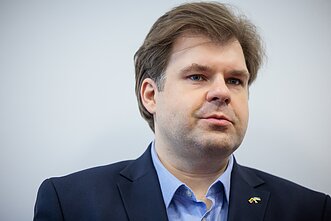















Valdemaras Klumbys, senior researcher at the Lithuanian History Institute, writes a three-part opinion article about the growing polarisation in society. In this installment, he writes about how patriotism is being used to justify propaganda narratives. The original article (in Lithuanian) is available here.
In the previous article, I discussed the most visible effect of propaganda on society – its fragmentation and polarisation. However, in order to delve into this topic, it is necessary to address one essential element of any propaganda – patriotism.
It is very easy to silence dissenters with it, which is why cases where propaganda does not use the patriotism card are rare.
One of the more striking such cases was the USSR, which attempted to replace it with proletarian internationalism. However, when Germany attacked the USSR in 1941, it very quickly became clear that internationalism did not work. Meanwhile, state and even national patriotism was the best tool to unite the people.
Patriotism is a rather difficult thing to define. Probably everyone would agree that it is important and, in difficult times for a state, perhaps even necessary, but only as long as it is limited to love of one’s homeland.
However, patriotism can very easily acquire elements of fanaticism, chauvinism, or xenophobia. One thing is simply the distinction between one’s own and others – one can ignore others, since the other is not necessarily an enemy. But another thing is to define who is an anti-patriot – a threat, an enemy that must be uprooted.
Such propaganda forms a patriotic unison: if only our opinion is correct, then only one version of patriotism is possible. Patriotism affected by propaganda seems to grant a moral right to judge everyone around, to divide them into patriots and non-patriots (in fact, enemies).
By usurping patriotism, the possibility for dissenters to be patriots is denied, as is the very possibility of a different patriotism. As soon as such usurping patriotism takes hold in the public space, a patriotic unison is formed.
The usurpation of patriotism is illustrated by the fact that for a long time (to this day?) the combination of left-wing views and patriotism in Lithuania has seemed unusual.
After the restoration of independence, the left-wing Democratic Labour Party of Lithuania(LDDP) and later the Social Democratic Party, due to their communist past, nomenklatura ties, and distrust escalated by opponents, seemed to automatically lose the possibility of being patriotic.
Yet, in any country with longer democratic traditions, dividing people into patriots and non-patriots according to right-wing or left-wing criteria is impossible.
Patriots are all those who care about their state; they simply understand differently what is best for the country and how best to achieve it.
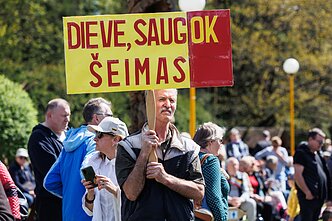
Participants in the anti-LGBT protests in Lithuania were also, without any analysis, written off in advance in the public space as anti-patriots. However, Ainė Ramonaitė’s research showed that the protest attracted very diverse people, including quite a few with patriotic attitudes.

Examples from Hungary, Germany, or France show that value-based conservatism and declared ultra-patriotism can fully coexist with friendliness toward Russia. However, who said that Lithuanian patriotism must necessarily be anti-Russian or pro-European?
An important element of patriotism is concern for the survival of the nation. If people believe that life in the EU erodes the nation, no Russian influence is needed for it to be perceived as a threat.
Kremlin propaganda simply exploits such fears for its own interests, just like populists of various kinds do. Therefore, those participating in controversial protests or voting for populists should not be made equal with pro-Russian radicals.
Writing off everyone who professes a different kind of patriotism as enemies only helps to radicalise them and push them away from the state, straight into the arms of populists. Of course, Russian agents may also hide behind patriotism, but such matters should be uncovered by the State Security Department, not by accusations in public.
Thus, declared or ascribed (non-)patriotism cannot be used to measure a person’s loyalty or to predict how they will behave in a critical situation.
Lithuanian history is full of patriots (not necessarily in quotation marks) who collaborated with occupiers. Therefore, patriotism is not a criterion of evaluation for me. And when propaganda begins to use it, patriotism loses any real content altogether and essentially remains only its instrument – albeit one of the most effective.
Although people gripped by a patriotic unison feel themselves to be the most patriotic, in reality, they are extremely easy to manipulate and direct almost anywhere.
Hungarians, who have not forgotten the bloody Soviet suppression of the 1956 revolution, nevertheless support Viktor Orbán’s pro-Russian policy, because propaganda provides a mechanism that allows patriotism to be reconciled with pro-Russian policies.
For it is precisely patriotism that allows almost anything to be justified. It is no coincidence that already in the eighteenth century, the saying arose that patriotism is the last refuge of scoundrels. And no, I am not calling all patriots scoundrels. It is the tragedy of patriotism that it so easily becomes a tool of manipulation.
Patriotism, combined with the propagandistic division into black and white, reinforces yet another consequence of propaganda. People captured by the patriotic unison do not doubt themselves: any doubt means succumbing to weakness and becoming unpatriotic.
How easy it is to live without tormenting doubts is shown by many memoirs of those who were enchanted by Soviet, Nazi, or other great ideologies. Totalitarian sects work in exactly the same way, offering the same kind of “liberation”.
And in Lithuania’s public space, more than one previously intellectual and moderate voice became radicalised after the Russian full-scale invasion of Ukraine in 2022.
Some researchers and analysts of Russian propaganda have themselves become radical, albeit refined, propagandists. Perhaps there are cynical manipulators among them, but more convincing is the belief in one’s own righteousness caused by the entrenchment of propaganda within a person.

And this is frightening, because a person without doubt can be terrifying: without critical reflection and able to carry out any order that conforms to the “logic” of propaganda. In Lithuania, this still seems far away, but history has shown that this disease progresses quickly under favourable conditions.
Self-assuredness is also encouraged by an association with the righteous side. A widespread image of propaganda is that of lies.
However, good and effective propaganda avoids outright lies and is more inclined to use nuance, shifting emphases, manipulating contexts, and other more refined means.
What matters to it is a connection with ideals and values that are important in society – with what is considered Good and Truth.
The war in Ukraine, where the aggressor and the victim are obvious, offers an ideal foundation for propaganda. When you are on the side of Truth, it is very easy to feel absolutely right everywhere and always.
And thus one’s horizon narrows, tolerance decreases, opinions become ever more categorical, until only a mouthpiece of propaganda remains, adorning the “only correct” opinion.
I have already mentioned that a patriotic unison means the unification of the public space – no state censorship is needed for this.
Propagandistic patriotism quite naturally creates censorship: when it dominates the public space, an atmosphere forms in which other opinions fall silent without being silenced by the state apparatus.
Who enjoys being called unpatriotic, working for Russia, a (blind) tool of hostile propaganda, and so on? Only those gripped by a different kind of propaganda do not care, because they have an explanation that they themselves are the true patriots, or know the Truth, if we are talking about adherents of conspiracy theories.
Those who try to analyse, to understand, or to present nuances do not fit into the patriotic unison, because they do not adopt propagandistic narratives and therefore remain outsiders.
Thus, fear gradually takes hold, without the need for Stalinist repressions or the threat of financial penalties.
The fear of possible social sanctions is enough, which becomes even stronger when there is a patriotic unison in the public space. The dominant opinion alone creates enormous pressure, making efforts to oppose it difficult. And when it is further reinforced by patriotism, opposing such a force becomes extremely difficult.
Many people quite naturally avoid this. They prefer to keep their opinions to themselves rather than get hit over the head for expressing them publicly. Some simply speak “as required”, regardless of what they actually think. This is especially true in our cultural and social tradition, which is quite young, while conformism comes all the way from Tsarist times.
The functioning of such propagandistic unison is particularly well illustrated by the silence of cultural figures on many issues.
Are all theatre people and musicians really comfortable with banning Russian culture? I highly doubt it: classical music is hard to imagine without many Russian composers, and the dramas of Anton Chekhov (and not only his) are an inseparable part of world culture. I have no doubt that more than one performer would like to perform these classical works for audiences that love them for a reason.
However, there was essentially no public discussion about banning Russian culture. And the reason is the same – the patriotic unison. If you speak against it, you will appear unpatriotic, as if you were supporting Russian aggression.
True, there was some, though not very abundant, indignation about the ban in cultural publications. However, that discussion was largely absent in the dominant media. Meanwhile, cultural figures provided excuses for the ban, and traditional media eagerly disseminated them.
Of course, indignation over Russian aggression is completely understandable, as is the normal individual decision of some people not to read Russian authors, to reject them, to encourage others to reject Russian culture, or even to picket against. But to support such a policy “with a united front” is abnormal.
Meanwhile, the Ukrainian film director Sergei Loznitsa, by no means a Putin sympathiser, spoke out in 2022 against banning screenings of Russian directors’ films in Europe, and for that he was expelled from the Ukrainian Film Academy.
One can only imagine the external and internal pressure when your country is being attacked by Russia, and you behave not in a way that you “should.”
His arguments were not propagandistic, but appealed to justice: at that time, there were directors in Russia who clearly showed the crimes of the Putinist system and condemned the war and Russia’s aggression. it is not permissible to throw all Russians into one pot.
However, such thinking contradicts the logic of propaganda and undermines the unison. By the way, perhaps this action by Loznitsa paradoxically also says something about why Ukrainians resist Russia so fiercely.
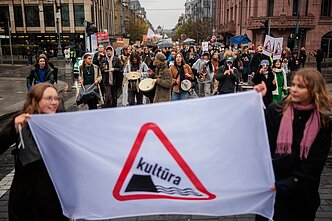
Another example concerns the pressure of the unison itself. I reviewed the comments under an article about Ainė Ramonaitė’s thoughts that the cultural protests in Lithuania crossed the boundaries of healthy civic engagement.
Some commentators simply assigned the political scientist to the enemies and declared her a sell out. If the facts do not fit the propaganda, they are useless.
Others accused the author of being detached from reality, even though she was merely suggesting putting oneself in the opponents’ place and comparing the anti-LGBT protests with the cultural protests.
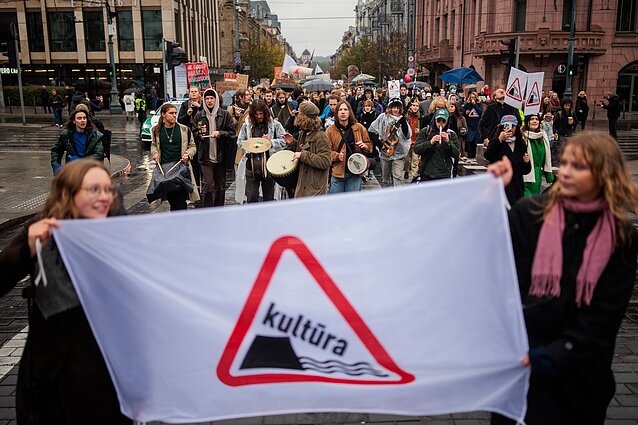
Unfortunately, that is impossible for a person gripped by propaganda and such a suggestion is tantamount to betrayal. After all, perhaps the most important goal of propaganda is precisely to eliminate such empathy – as long as it exists, propaganda is not effective.
In addition to the indirectly exercised social pressure of the patriotic unison, propaganda also uses direct accusations, especially when it fills the public space. Under such conditions, it becomes difficult to notice various manipulations.
For example, it looks strange how increasingly widespread accusations are directed at people – who were not politicians at the time – for visiting Russia after the 2014 annexation of Crimea.
At that time, visits to Crimea were condemned, but not to Russia. Now, post factum, even visiting Russia has become a sin. Scholars travelled to conferences, actors performed there, directors staged plays, and brought films to festivals. Now, it turns out, this has suddenly become a stain on one’s biography.
When patriotic unison prevails in the public space, it seems that the entire society is under the influence of propaganda, and therefore, there is no point in trying to discuss matters using arguments that do not correspond to the dominant view. Nothing will convince anyone anyway.
It is so easy to give up and retreat into yourself, which reduces the number of alternative opinions in the public space and impoverishes it even further.
But in reality, different opinions have not disappeared anywhere, and the power of propaganda is greatly exaggerated. Even during the periods of the greatest rise of totalitarianism, many people did not believe propaganda, did not delve into it, or merely paid lip service to it.
Thus, despite years of public pressure to eliminate all commemorations of collaborators, the majority of society is still not as categorical as recent representative survey results show.
Radicals proposing to remove all controversial memorials, or change nothing at all, each make up about one-fifth. I think a similar picture would appear on other issues sharpened by propaganda.
This does not mean at all that people are indifferent, apolitical, or influenced by the “wrong” propaganda. It is simply that the majority of people are not inclined toward radicalism. However, a public space captured by propagandistic narratives does not allow this to be seen.
The propaganda dominating the public space reflects the opinion of the so-called “Vilnius bubble.” This includes people who are successful – those well-off, those who breathe the air of the global world, and hold relatively liberal economic, social, and cultural views. They are also those who do not really understand the society in which they live.
Global liberal values are alien to a large part of society. People see that their conservative family values and national identity are almost not represented in the public space, or are ridiculed.
This inevitably causes dissatisfaction, sometimes breaking out in articles expressing outrage over ideological censorship. But more often it settles in social networks, contributing to what is called a parallel world – an alternative to the public space.
When you are in the minority and feel that your opinion is being ignored, you naturally become radicalised.
In fields far from politics, people and movements that were initially moderate and sought compromise eventually became radicalised after encountering indifference. This is how frustration works, growing out of hopelessness, out of the inability to be heard and to communicate. It is sad to watch when this happens to sensitive and intellectual people.
When you are in a minority that is not heard, it is difficult not to break. To survive, you need an especially strong backbone and concrete convictions.
Those without such qualities fall away, most often the more moderate ones. Meanwhile, various radicals and marginals, lovers of conspiracy theories, join in, leading to the creation of an internal propaganda mechanism. And then, Kremlin narratives appear alongside them.
Ultimately, people loyal to Lithuania whose opinions are not represented in the public space end up sliding into this parallel world.
This happens not because they are stupid, uneducated, or simply against Lithuania – even if such people are there. This happens because they receive backing and the feeling of being heard only in this parallel reality.
Incidentally, the dominant propaganda also benefits from this – here is obvious proof that enemies exist and that only we can save Lithuania.
Alternative or hostile propaganda narratives and their spreaders then also benefit from this, because it helps expand their circle of followers. And so, Lithuania loses.

Newsletter
Every Friday morning.