















Foreigners working in Lithuania’s service sector have been required since January to demonstrate basic knowledge of the Lithuanian language, but authorities say compliance remains limited and complaints are rising.
The State Language Inspectorate has received 31 complaints so far this year, compared with up to 50 typically filed over an entire year. At the same time, relatively few foreign workers have registered to take the required language exam, according to government data.
An estimated 16,000 foreigners are expected to pass at least a basic A1-level Lithuanian language exam. At that level, a person must be able to ask and answer simple personal questions, such as where they live, whom they know and what items they own. After two years, workers will be required to pass a higher A2-level exam.
Only holders of temporary protection status – such as Ukrainians who fled the war – are exempt from the requirement.

So far, just over 150 foreigners have taken the exam, with about 100 more registered to do so by the end of the month, officials said.
“We have been instructed by the government to consider expanding exam locations beyond the National Education Agency, possibly to universities or other institutions,” Vice Education Minister Rolandas Zuoza said. “But for now, we do not see such a need.”
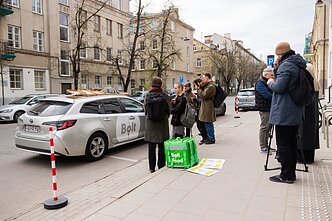
Some service providers continue to warn customers that staff do not speak Lithuanian, including in beauty salons. In the ride-hailing and food delivery sectors, language barriers have drawn particular attention.
Audrius Valotka, head of the State Language Inspectorate, said a violation will be recorded only when a lack of Lithuanian prevents proper service from being provided.

“One delivery driver brought pizza without a thermal bag,” Valotka said. “I asked why it was cold. He didn’t understand in any language – not Russian, not English, not any other.”
The law sets fines ranging from 90 to 170 euros, but none have been issued so far because a six-month transition period is in effect. Valotka said he expects the number of complaints to grow.
Opposition lawmakers say there are loopholes in the law and enforcement. Conservative lawmaker Dalia Asanavičiūtė said some ride-hailing drivers claim to be deaf or mute to avoid communication and language requirements.
“That would be a way to motivate people to learn Lithuanian,” she said, adding that language certificates could be required when registering individual activity or obtaining licenses for ride-hailing services.

Bolt’s head of ride-hailing services in Lithuania, Laimonas Jakštys, said the company generally relies on drivers’ statements about their ability to communicate.
“When drivers contact us, we usually trust them if they say they cannot speak,” Jakštys said, noting that the first language exams only began last week and it may be too early to impose additional requirements.
Some lawmakers from the ruling coalition defended the policy’s intent but acknowledged technical challenges. Social Democrat Kęstutis Vilkauskas said the core issue is ensuring that customers are satisfied not only with services but also with how they are delivered.
Muhammet Ebubekir Karcan, a ride-hailing driver from Turkey who has lived in Lithuania for three years, said he learned Lithuanian at the A2 level mainly by listening on the job. He is studying English philology and said he may continue improving his language skills if he stays in Lithuania after graduation.
More than 200,000 foreigners currently hold residence permits in Lithuania, according to official data.

Newsletter
Every Friday morning.