












Swedbank has raised its forecast for Lithuania’s economic growth this year, predicting that the country’s gross domestic product will expand by 3.5%.
The bank had projected GDP growth of 3.2% in November.
Swedbank also revised upward its outlook for 2027, forecasting growth of 2.5%, or 0.2 percentage points higher than previously estimated.
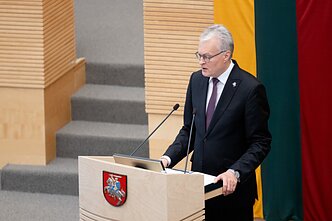
“Taking into account improving growth prospects in the eurozone as well as other domestic economic factors, we have increased Lithuania’s GDP growth forecast,” Swedbank economist Nerijus Mačiulis said while presenting the bank’s economic outlook on Wednesday.

Lithuania is expected to record the fastest economic growth among the Baltic states this year, with Latvia and Estonia each forecast to grow by 2.3%.
According to Mačiulis, domestic demand – rather than industry and exports – will be the main driver of Lithuania’s economic growth this year and next.
“Last year, household consumption grew by nearly 0.5%, and this year we expect it to exceed 5%,” he said. “Retail trade is gaining momentum due to temporary factors and rising household incomes, but also because of more fundamental drivers.”
Mačiulis cautioned that the competitiveness of Lithuania’s industrial sector remains uneven and should be closely monitored when assessing the country’s long-term economic prospects. He noted that nearly all industrial sectors have stagnated over the past six months, with faster growth seen only in electronics and optical manufacturing.
Swedbank expects goods exports to slow this year, with growth of about 2%. “The main task for many Lithuanian industrial companies is to maintain their existing export markets. The potential for expansion is limited,” Mačiulis said.
Preliminary Swedbank data show that exports of high value-added services reached a record 10 billion euros last year, accounting for about 12% of GDP.
“This is a unique achievement, considering that at the beginning of the previous decade exports of such services amounted to less than half a billion euros,” Mačiulis said, citing financial services, information and communications technology, and other business services.
Lithuania also stood out in the region last year for strong investment growth, which rose by nearly 15%, according to the bank. The ratio of investment to GDP climbed to 25%, the highest level since 2008.
Swedbank forecasts that investment growth will remain robust this year, at nearly 10%, driven largely by public-sector spending on defence, infrastructure and modernisation projects.

Newsletter
Every Friday morning.