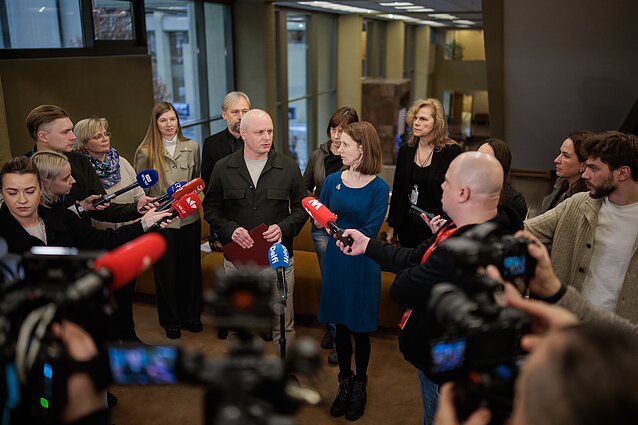















The Association of Professional Journalists and an initiative group of journalists at LRT announced on Friday that they will not take part in a parliamentary working group set up to discuss changes to the Lithuanian public broadcaster.
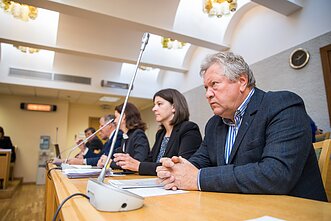
A meeting of the working group, convened by politicians to “improve the legal regulation of LRT governance”, is taking place in parliament on Friday.
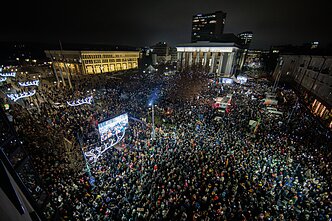
“The Speaker of Parliament told our representatives directly that the group would be considering the same amendments that tens of thousands of people protested against,” Deividas Jursevičius, a representative of the LRT initiative group, told reporters on Friday.
“Our position on this law has been clear since the first protest and has never changed: to reject the amendments on LRT being debated in parliament and not to return to them. Not to revise them, not to repackage them, but to reject them,” he said.
Further reading
“This demand has still not been met. We also asked during the protests to stop the ‘bulldozer’, but the launch of this working group and the frantic scrambling to take decisions as quickly as possible clearly show that the rush has not been abandoned,” Jursevičius added.
According to him, the working group had been constructed in such a way that governing politicians held a position of power over both journalists and the parliamentary opposition.
This showed that the aim was to pass the same amendments after imitating a discussion with stakeholders, Jursevičius added.
“We see new amendments prepared by the parliamentary Audit Committee that would amount to almost direct censorship,” he said. “We do not support this. We will not be a cover that allows you to legitimise your ambitions.”

Davidonytė: real debate cannot come from a position of power
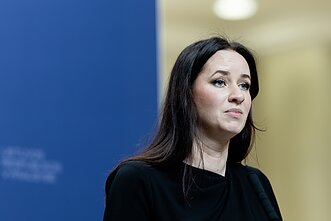
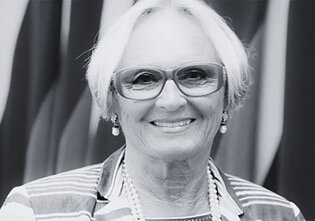
The chair of the Association of Professional Journalists, Birutė Davidonytė, said the journalistic community was ready for democratic discussions on systemic changes to LRT governance.
She said the association supported depoliticising the LRT Council, including by reducing the number of members delegated by politicians and involving more representatives of civil society institutions, organisations, journalists and staff.
“A real discussion does not take place from a position of power, surrounded by politicians favourable to you and with a carefully calculated balance of participants to ensure outcomes that suit those in power,” Davidonytė said.
“You promised dialogue with the media community, but only a small circle of media representatives is at this table,” she added.
Davidonytė said politicians should not select experts on a “like or dislike” basis. Instead, she argued, media experts themselves should decide who represents journalists and the media in such a working group.
Media representatives invited to the group have agreed to submit a joint proposal to the governing parties on which organisations should be included.
“Those sitting at this table now, having received your special favour, are placed in an uncomfortable position in relation to all those left outside, deemed less important,” Davidonytė said.
She said the way the working group was operating did not amount to a democratic discussion.
“For this reason, representatives of the Association of Professional Journalists and the LRT initiative group will not attend meetings of this group until you take into account the proposal of the expert body, the Media Council,” she said.
According to Davidonytė, adding just three more representatives would allow the group to reflect the full breadth of the media sector. If the governing parties agree to include all relevant media organisations, the association and the LRT initiative group would join the group.
Otherwise, they plan to establish their own working group and submit proposals on LRT together with the public.
Background to the dispute
In December, the governing parties sought to fast-track amendments to the law governing LRT, including changes to the procedure for appointing and dismissing the broadcaster’s director general.
The parliamentary opposition submitted hundreds of amendments to block the process, The final vote was further delayed after the chair of the Culture Committee, Kęstutis Vilkauskas, fell ill.
The parliament later agreed to pause the fast-tracked process. A new working group, bringing together parliamentary factions and media organisations, was set up to refine the government’s draft bill by February 14.
The proposed changes include introducing a secret ballot for appointing and dismissing the head of LRT, and allowing dismissal following a vote of no confidence over improperly performed duties or if the council fails to approve the annual activity report.
Such decisions would require the support of more than half of the council’s members – at least seven out of 12.
The proposals have drawn strong criticism from journalists’ organisations and international bodies, who warn they could weaken LRT and open the door to political interference.

Newsletter
Every Friday morning.