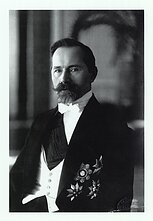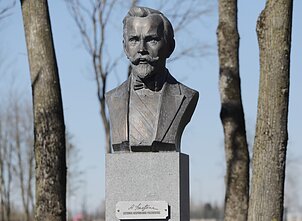















Five finalist designs for a monument to Lithuania’s first president, Antanas Smetona, are on public display in the Lithuanian Artists’ Union exhibition space, as Vilnius moves ahead with plans to erect the monument in the capital.
The monument is to be built in a square opposite the Old Theatre of Vilnius, a location approved by the Vilnius City Council three years ago. Historians say the site has strong historical significance.
Historian Andrius Grodis said the Old Theatre building hosted the 1917 Vilnius Conference, which resolved to seek an independent Lithuanian state. Smetona delivered the main address at the conference and was elected chairman of the Council of Lithuania.
“Commemorating one of those pivotal moments and the role Smetona played there is, in my view, fully justified and appropriate,” Grodis said.
An important figure in Lithuania’s drive for independence after World War One, Smetona was elected the first president of the young republic by the State Council in April 1920 and stayed in the post for one year. In 1926, however, he led a military coup and headed a nationalist dictatorship until 1940. Following the Soviet occupation of the country, Smetona fled the country, initially to Germany and eventually ending up in the United States. He was killed in a house fire in 1944.

While Smetona has been commemorated with monuments in several places, including in Kaunas, the interwar capital of Lithuania from where he ruled, initiatives in Vilnius have stalled, not least because of his controversial legacy.
The square and the adjacent theatre building are part of a protected cultural heritage site. Vidmantas Bezaras, head of the Cultural Heritage Department, said a monument could be integrated into the area without harming its character.
“The idea itself should not clash with the nearby theatre building or overwhelm it with large volumes,” Bezaras said. “I believe the concept can be implemented successfully, but much will depend on which design is selected.”
Five projects were shortlisted in the artistic and architectural competition for the Smetona monument and are now being exhibited at the Artists’ Union gallery. A winner has already been selected, but the competition organiser – the Vilnius municipality – is expected to announce it within two weeks.
“We have to complete public procurement procedures, open envelopes, identify the authors and rank the entries by name, followed by a 10-day standstill period,” said Rūta Pilkytė, an adviser to the mayor of Vilnius. “We expect to have a winner we can publicly announce in the first half of January.”
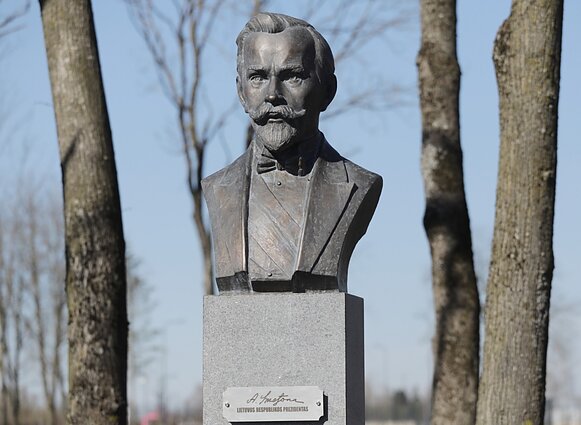
Cultural critic Paulina Pukytė said monuments in public spaces should clearly address their purpose and meaning, reflect the complexity of the historical figure being commemorated and take into account the context of their surroundings.
“Only one of the five shortlisted projects addresses the controversial aspects of this personality; the others do not,” she said. Pukytė also questioned some symbolic choices, such as depicting Smetona wearing a top hat next to a theatre.
“For passersby today, it’s a theatre and a man in a top hat – who is he supposed to be? An opera singer? Eugene Onegin? I’m exaggerating, but context matters,” she said.
Smetona is already commemorated with monuments in Kaunas, Palanga and Ukmergė. The Vilnius monument designs can be viewed at the Artists’ Union exhibition space on Vokiečių Street through January 11. The monument is scheduled to be unveiled in 2027.

Newsletter
Every Friday morning.