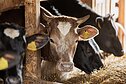













A sharp fall in milk prices has pushed Lithuania's dairy farmers to the brink. Since last autumn, farmgate prices have dropped by roughly a third, leaving many producers behind on payments to fuel, fertiliser and feed suppliers. Some are already selling up, while others are simply waiting to see whether they can survive until the harvest.
A litre of standard-fat milk, which fetched more than 40 cents just a year ago, now brings farmers between 12 and 30 cents – depending on volume and quality. The cost of producing that same litre, farmers say, is 32 to 35 cents. The gap is not sustainable.
The scale of the collapse is striking. According to the Lithuanian Dairy Farmers Association, around 5,000 farms have left the sector in the past year alone. Fewer than 7,400 now sell milk commercially, while, processors, unable to source enough raw milk domestically, are already importing around 50,000 tonnes a month from Latvia, Estonia and Poland to keep their factories running.

Retail prices don't budge
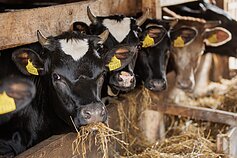
At Ginkūnai Agrofirm in the Šiauliai district, manager Arūnas Grubliauskis oversees a herd of around 1,000 cattle, roughly half of them dairy cows producing 10 to 15 tonnes of milk a day. He is candid about the situation.
"It is no secret – things are bad. We are receiving 29 cents per litre, and our production cost is 32 to 35 cents," he said.
A year ago, the farm was planning to expand. Now it is treading water, offsetting losses from its dairy operation with income from arable farming and the sale of breeding cattle. Not every farm has that option.
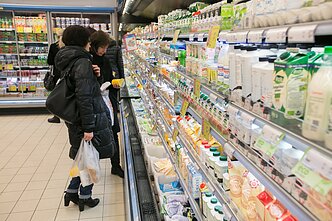
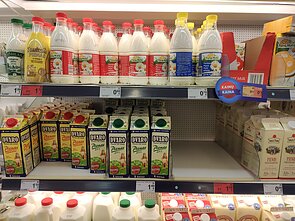
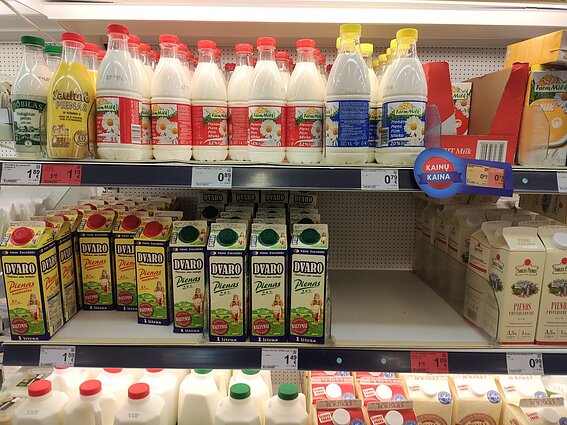
Grubliauskis is frustrated that retail prices have barely moved whilst farmgate prices – the direct sale of agricultural produce from farmers to consumers – have collapsed. A litre of milk still costs around €1.50 in Lithuanian supermarkets.

"The way the profits are divided is not fair. We can see perfectly well that we receive cents whilst the shelf price is €1.50. Fuel prices at petrol stations always respond to changes in the crude oil price. Milk prices do not seem to work the same way," he said.
Though he is not giving up, he admits pinning his hopes on an improvement in conditions once the war in Ukraine ends and market pressures ease.
"We cannot switch off the lights and close the doors. It is equally hard for large and small farms alike. For smaller ones, perhaps it is slightly easier to simply sell a few cows and walk away."
Paying bills months late
In the village of Buožėnai in the Telšiai district, Svetlana Burbienė runs a dairy herd of 44 cows with her husband and son-in-law. The family has farmed here since 2008, but she says they have never been this close to the edge.
Around 500 litres of milk leave the farm every day. At 24 cents per litre, the income does not cover costs, and the family has fallen behind on payments to suppliers.
"We are a month or two late paying for fuel, fertiliser and feed supplements. Fortunately, our suppliers are understanding and will wait," she said.

The farm employs no outside workers – the family does everything themselves, with their children pitching in during the busiest periods. "We are grateful we still get to sleep," Burbienė said.
A year ago, at over 40 cents per litre, the farm was managing well and needed no deferrals or emergency support. Now, she says, thoughts of closure are becoming harder to push aside. Several of her neighbours have already decided to sell.
The Burbienė family cannot easily follow suit – they received state support to purchase equipment and are bound by the conditions attached to it.
She returned recently from a visit to Poland, where she was struck by the number of small farms still operating in every village.
"In Lithuania, it seems only the very largest will survive. But large farms are not immune to disease. Just imagine what would happen if a herd of a thousand animals had to be destroyed. Where would the milk come from then?"
'We have already tightened our belts as far as they will go'
The cooperative Rešketėnai, which collects milk from around 700 farms across the Samogitia region of western Lithuania, is feeling the pressure acutely. Its chairman, Algirdas Leščiauskas, says the last crisis of comparable severity was around two decades ago.
The downturn began last September and has not let up. The cooperative currently delivers around 75 tonnes of milk a day to processors in Lithuania, Latvia and Poland – a figure that will rise to roughly 160 tonnes daily during the summer grazing season.
Smaller farmers supplying unrefrigerated milk receive as little as 15 cents per litre. Larger suppliers receive up to 30 cents – yet the cooperative itself receives only 27 cents from processors.
"We have stopped calculating production costs, because we can no longer do anything about them. We have already tightened our belts as far as they will go. The rise in fuel costs has hit us particularly hard – we cover more than a million kilometres a year. We are now considering whether it would be cheaper to buy fuel in Latvia," Leščiauskas said.
The cooperative has appealed to the government for fuel cost compensation and received nothing.
He predicts that farms will hold on through the summer grazing season, when production is higher and costs relatively lower, but that closures will begin to cascade in the autumn.
"Processors can afford to wait – they stockpile milk powder and butter and can hold stocks for a year. Farmers cannot do the same."
Processors buy from abroad
Eimantas Bičius, director of the Lithuanian Dairy Farmers Association, says the sector is in genuine crisis – and that the warning signs have been visible for some time.
"There are still around 14,000 farms keeping cows, but only about 7,400 are selling milk commercially. The rest consume what they produce themselves or have simply stopped," he said.
He points to a structural problem: Lithuania's processing industry has grown large enough that domestic milk production can no longer supply it. Processors are importing around 50,000 tonnes a month from neighbouring countries to fill the gap – even as Lithuanian farmers struggle to find buyers at viable prices.
"I would describe the situation as very serious, because there is no light at the end of the tunnel. There is talk that demand will grow in a year or two, but the question is how many farms will still exist by then. A farmer needs to put fuel in the tank today, not in 2027 or 2028," Bičius said.
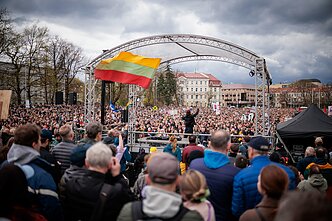
He noted that a recent public protest in Vilnius – at which farmers distributed free milk to passers-by – was intended to draw consumers' attention to the disconnect between what producers receive and what retailers charge.
"For some reason, prices in the shops are not falling," he said.

Newsletter
Every Friday morning.