














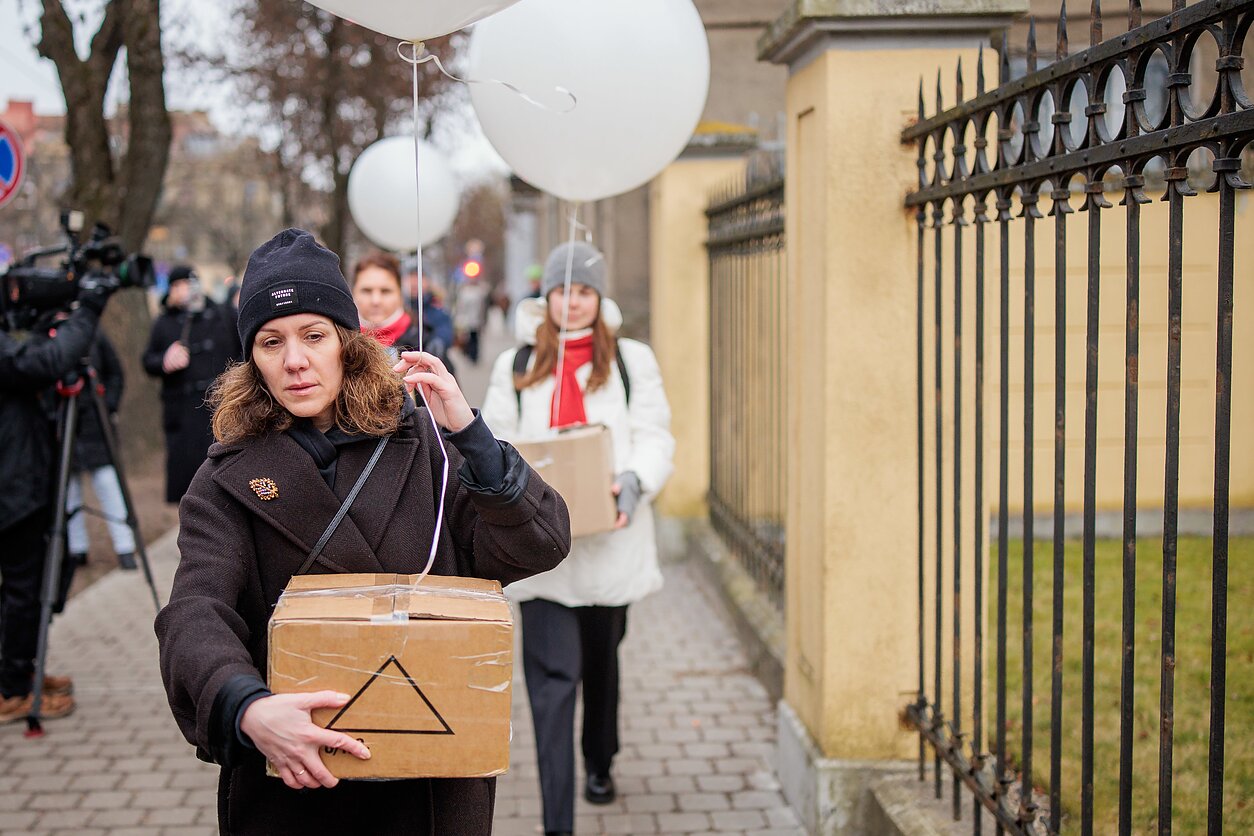
Flights at Vilnius Airport were affected 15 times between October 4 and December 7 amid an influx of smuggling balloons that the Lithuanian officials are calling a hybrid attack by Belarus. Kaunas Airport was also closed once due to threats to aviation safety.
In all, over 350 flights and some 51,000 passengers were affected by these airspace restrictions. Lithuanian Airports and their partners say they suffered losses of over 750,000 euros.
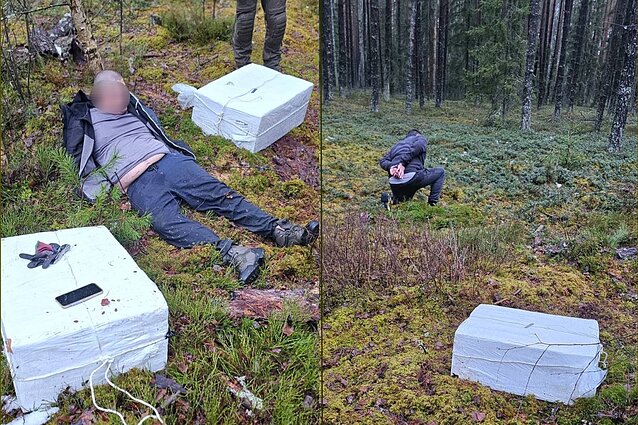
Although officials refer to the contraband balloon threat as a hybrid attack, smugglers have been using balloons for several years. Border guards previously reported finding three contraband balloons in 2023, 226 in 2024, and 623 this year as of December 8.
However, their scale – and disruption – became increasingly noticeable in late 2025, with officials saying they were now being launched deliberately toward Vilnius Airport.
Here’s the chronology of events surrounding the smuggling balloons.

September 28, 2024. At 23:45, a contraband balloon carrying cigarettes landed inside the territory of Vilnius Airport. On October 9, a balloon also came down in central Vilnius, near the CUP shopping centre. After striking a car, it hit the facade of the shopping centre before landing on a nearby terrace.
According to the air navigation service provider Oro Navigacija, its civilian radars were unable to detect balloons in Lithuanian airspace, so the monitoring was taken over by the military. This then allowed the authorities to better detect the balloons launched from Belarus.
September 9, 2025. Vilnius Airport was temporarily closed for the first time due to a “detected flying object”. At the time, officials did not specify whether it had been a contraband balloon.
Later the same month, operations at Vilnius Airport were suspended several more times because of drones spotted nearby—on September 11 and 25.
October 4. Vilnius Airport was officially closed for the first time because of contraband balloons. Officials said 25 balloons had entered Lithuanian airspace from Belarus, affecting around 30 flights and some 6,000 passengers.
At the time, Interior Minister Vladislavas Kondratovičius said there were no signs that this was a deliberate attack by Belarus.
October 21. Vilnius Airport was closed for the second time due to contraband balloons; 30 flights were affected. Dozens of meteorological balloons entered Lithuania from Belarus that day.
“Lithuania will respond firmly to any violation of its airspace: if similar incidents continue, the border with Belarus will be closed,” Prime Minister Ingia Ruginienė said the following day.
At that time, officials also began discussing tools to combat contraband balloons and the causes of the crisis. They raised the idea of blocking SIM cards – which transmit GPS coordinates of the balloons to smugglers – and decided to look for technologies that could be used to neutralise the balloons.

October 22. For the first time, the Medininkai and Šalčininkai border checkpoints were temporarily closed due to balloons entering Lithuania.
October 24. Vilnius Airport was closed for the third time, while Kaunas Airport was also closed that same Friday evening.
October 25. Vilnius Airport was closed for the fourth time on Saturday. Prime Minister Ruginienė then announced she would convene a meeting of the National Security Commission – a governmental crisis response body – to discuss long-term measures to resolve the crisis. Meanwhile, Vilnius Airport was closed for a fifth time on October 25.
October 26. Prime Minister Ruginienė said the border checkpoints with Belarus would be closed for a longer period starting on
October 29. Authorities also said the military would shoot down the balloons, with the Economy Ministry launching a 1-million-euro competition on ideas on how to bring them down.
Officials stressed that shooting down the balloons was difficult – they can fly at an altitude of 11 kilometres and travel at speeds of up to 200 kilometres per hour. They are also hard to detect, as the balloons emit no heat signature and often transmit little or brief GPS signals.
Authorities also said destroying the balloons in the air could be dangerous, as the 20 to 30 kilogrammes of cigarettes could fall and damage property or injure someone on the ground.
October 29. Authorities announced that the remaining two border checkpoints with Belarus would be closed for a month, until November 30.
In response, Belarus effectively seized Lithuanian lorries that remained in the country, refusing to allow them to leave. Belarus began charging 120 euros per day for each lorry, saying it would confiscate them after four months.
October 30. Vilnius Airport was closed for the sixth time because of the balloons.
November. Balloons continued to fly into Lithuania, and Vilnius Airport was closed six more times. Lithuania decided to reopen the border with Belarus on November 19, hoping this would allow the lorries to return. But the regime refused to allow them to leave, again.
Te hauliers’ association Linava said in early December that some 4,000 vehicles – 1,250 of them lorries – were still being held in Belarus. Meanwhile, Lithuanian Customs said that Minsk was still holding 185 Lithuanian lorries and semi-trailers.
December. Vilnius Airport was closed three more times. AirBaltic decided to bring forward the departure times of two flights to Riga, as most closures happen at night when the smugglers are least likely to be caught when picking up the cigarettes. Meanwhile, Finnair decided to cancel its evening route between Helsinki and Vilnius.
On December 1, the authorities announced three proposals on how to bring down the balloons. A working prototype is expected by February 2026.
The military said it had the means to shoot down the balloons, but they were very expensive.

“There are tools, but they are very costly. The question is whether we should start using weaponry designed to destroy fighter jets or drones to shoot down 20–60 objects launched each night,” Raimundas Vaikšnoras, commander of the Lithuanian Armed Forces, told Žinių Radijas radio on December 4.
“Do we exhaust our arsenal on these balloons, leaving our air defence empty and exposed, or do we wait and look for other methods? And we are looking for methods,” he added.
December 9. The government declared an emergency situation over the balloon threat.

Newsletter
Every Friday morning.