


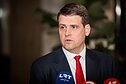







Lithuania’s decision to join the Tribunal’s management framework is not a symbolic gesture, but a legally consequential step that activates the institutional mechanisms needed to hold Russia’s leadership accountable for the crime of aggression, writes Volodymyr Pylypenko, Lithuania’s Honorary Consul in Ukraine.
When Russia launched its full-scale invasion of Ukraine, the world faced a challenge it had long avoided: how to hold a state’s political and military leadership accountable for the crime of aggression. This crime – the “mother of all crimes” – is the one from which war crimes, crimes against humanity, and even acts of genocide may follow. Without the initial decision to wage war, none of the atrocities committed on Ukrainian soil would have been possible.
Yet, the current international legal architecture proved insufficient. Despite its importance, the International Criminal Court (ICC) cannot prosecute Russian leaders for aggression because Russia has never ratified the Kampala Amendments and is not a party to the Rome Statute. The world had a court, but not the jurisdiction to act.
This is why, in 2025, Ukraine and the Council of Europe made a historic move: establishing a Special Tribunal for the Crime of Aggression against Ukraine. It is the first international mechanism since Nuremberg designed to prosecute not only lower-level perpetrators but the top political and military leadership responsible for launching a war of aggression.
Lithuania became the first country, after Ukraine itself, to formally join the Tribunal’s management body. This step goes far beyond diplomatic support. Lithuania has long been one of Ukraine’s most consistent allies — vocal, principled, and unwavering. But now Lithuania has taken a decisive step: it has moved from political solidarity to institutional responsibility.
By joining the Tribunal’s governing framework, Lithuania signals leadership, strengthens the Tribunal’s credibility, and accelerates the transition from political declarations to institutional reality. In international law, institutions begin to exist not when they are announced, but when states begin to fill them with real content.
Creating an international tribunal is not a single event. It is a multi‑stage process that requires legal, political, and administrative effort. Each participating country must complete internal procedures and submit an instrument of participation. Without collective political will, the Tribunal simply cannot function.
The Management Committee – the heart of the Tribunal – will approve the budget, set its operational framework, oversee the selection of judges and the prosecutor, and establish institutional rules. While the founding documents do not impose a minimum number of states, analysts suggest that approximately 16 states constitute a realistic minimum needed for institutional viability – enough to secure funding, credibility, and operational capacity.
Next comes the creation of the Secretariat – the Tribunal's administrative engine, responsible for staff recruitment, case management, technical support, and coordination. Then the Tribunal must select judges and a prosecutor through a transparent, merit‑based competition. This ensures judicial independence, professional competence, and public trust.
The Tribunal must also adopt its Rules of Procedure – its “constitution”. These rules define how evidence is admitted, how witnesses are protected, how proceedings are conducted, and how states cooperate. Only after adopting these rules can the Tribunal open cases, issue arrest warrants, and begin hearings.
By late 2025, at least 25 states had declared their readiness to support or participate in the Tribunal. This level of international backing provides not only financial sustainability but also political legitimacy. A tribunal supported by a broad democratic coalition sends a powerful message: aggression is not geopolitics – aggression is a crime.
The creation of the Special Tribunal is not only about Ukraine’s right to justice. It is about restoring the foundations of the international legal order. The Tribunal revives the principle that starting a war is punishable, strengthens post‑World War II norms that had eroded over time, and creates a precedent that can deter future acts of aggression globally.
Lithuania’s decision to join the Tribunal's governance is more than a diplomatic move. It is a catalyst – a spark that brings the Tribunal closer to operational reality. The Tribunal itself is a historic undertaking. Not because it creates something entirely new, but because it restores what the world once – a clear, principled response to the crime of aggression.
Volodymyr Pylypenko, Honorary Consul of Lithuania in Ukraine and a professor at Kyiv University of Law of the National Academy of Sciences of Ukraine.

Newsletter
Every Friday morning.