









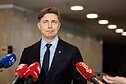


“We should probably have anticipated the threat posed by Russia better, which you here understand much better considering your history,” Philippe Étienne, a former diplomatic adviser to French president Emmanuel Macron, tells LRT.lt. In an exclusive interview, he reflected on the broken hopes for democracy in Russia and shared his insights on how Europe, in an era of shifting alliances, could maintain its influence.
Étienne is one of the most prominent figures in French diplomatic policy – his career has spanned from Romania and Germany to the United States, where he served as the ambassador of France. He also worked in Brussels and was the diplomatic adviser to the French president.
The former diplomat, who took part in the Vilnius Forum organised by the Geopolitics and Security Studies Centre, notes that if Russia was a democratic country, everyone would benefit, and therefore he does not call the earlier efforts to build ties with the Kremlin a mistake, but rather an illusion. However, he acknowledges that Russia’s threat should have been evaluated more cautiously.
“It's also a lesson for the future,” he emphasises.

I would like to begin with a look back to the 90s, when you worked in Moscow. At the time, many in the West believed that there was a genuine wind of change in the Kremlin. What was your experience back then?
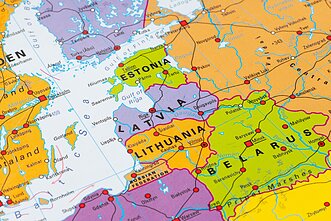
Well, the change of the wind or the tempest of change was a fact, it was history – the Soviet Union disappeared, a new set of countries appeared on the basis of the former Soviet Union. And in particular, we were happy to see the consecration of the independence of the three Baltic republics, because France had never recognised the annexation of your country, of Latvia and Estonia by the Soviet Union. Never.
There was indeed a sense of hope and opportunity not only for your country and its neighbours, but also for Russia itself. I was indeed posted in Moscow as the head of the section for cooperation between France and Soviet Union, and then France and Russia, but also in charge of other former Soviet republics. I travelled a lot at that time through Georgia, Central Asia, Ukraine and other countries, and I must say that my conviction, my belief remains today that things were not necessarily due to happen as they happened finally in a very sad way. We have seen hopes for democracy in Russia. The start of a democratic evolution has been scaled back by repression, especially in the 2010s. So this is a reality, and I was lucky enough to be in Moscow and in the region at the time where this hope did exist.
This hope lasted for a long time. Up until Russia's full scale invasion of Ukraine, Europe continued to strengthen these ties, Russia was one of the biggest trading partners, while Eastern Europe, including Lithuania, was warning about Russia's possible intentions. Looking now, why do you think the threat posed by Russia was so widely underestimated in Western Europe?
I was ambassador in Romania between 2002 and 2005 and I recognised that – it is also the purpose of the European Union – each part of the European Union should benefit from the historical experiences of other nations, other peoples. It goes in two directions – it is not only that we have to learn from your unique experience and I would say sufferings under the Soviet occupation, but also in World War two under the Nazi occupation, but I think also it is not to be underestimated what knowledge countries in the south of Europe can bring about Mediterranean, about Africa to Central and Eastern European countries. I was myself very much impressed when I was in charge from Brussels and in Paris of Africa’s policy how important it was to mobilise because the terrorist threat is still here and the migration challenges are also security challenges.
So yes, indeed, we should have better taken into account the experience of this part of the European Union and I say it again as a former ambassador of France to Romania. But on the other hand, I think it is fair to say that for a certain time – it was a position of my country, I remember quite well – especially under [Boris] Yeltsin and probably at the beginning of [Vladimir] Putin's rule, the priority was to forge relation between EU and Russia and NATO-Russia and nobody objected this. We have created mechanisms of cooperation between NATO and Russia. This was the best option, obviously, and I think we still can understand this today. But things indeed did not evolve as we would have liked and now we see that we should probably have anticipated better the threat posed by Russia, which you here understand much better, considering your history.

Would you describe it as a mistake – strengthening these ties?
No, it was not a mistake. We should all benefit if Russia was a democracy, if there was cooperation. Of course not, I don't think it was a mistake. Maybe it was an illusion, maybe it was a false hope. But nobody objected at that time by the way in Central, Eastern Europe. But still, it is not contradictory to the fact that we should have taken into account better our own knowledge of the situation in our neighbourhood. This is European Union strength – this addition of experiences and very painful experiences sometime, it is one of the strategic assets as Europeans. And we should have better used this and it's a lesson for the future also.
And what event do you think shook Europe – or France more specifically – to understand that there might be illusions set up by Russia?
It was the evolution of Russia, as I said, around 2010s. And I must say that France, if I may speak for my country, has never lost its spirit of defence. We are a nuclear power, we have the nuclear deterrence, we are a permanent member of the Security Council in UN. We have turned our army towards engagements abroad against terrorism because terrorism was at that time the main threat. You must not forget that France was attacked on its soil in November 2015 from Syria by terrorist’ organisations. We have been attacked then, we have asked for the solidarity of other EU countries. Hundreds of people have been killed in Paris. So it's true that we have turned our defence policy more towards this threat. Now we are shifting it again towards the main threat, which is coming from Russia. But we have never, as France, neglected our defence policy. <…>
The time when we realised that we had to shift back, I would say, started to emerge in the beginning of the 2010s, as I said, and this awareness intensified in 2014, and then, of course, the shock was the invasion of Ukraine by Russia in February 2022.

Diplomacy is often a very slow and highly nuanced process. While you have spent your career in diplomacy, Vladimir Putin is in the business of war. So far he rejected any meaningful prospect of negotiations. In your opinion, how can diplomacy function when the aggressor is setting up the rules?
You cannot separate diplomacy in military. They are part of the same pattern and diplomacy is not some art for times of peace. It is still more important in time of tensions. By the way the president of Ukraine and Ukraine itself is not against peace because they need peace and the Europeans have made, I think, a good job until now remaining very close to Ukraine politically, diplomatically and with these new ideas which emerge, we have to stick to this method. We, Europeans, must include the Ukrainians and Ukrainians need also Europeans politically to remain very much united, not to refuse peace, on the contrary, to say we are ready for peace. The ones who have been struggling for a ceasefire were the Europeans mostly recently, together with Ukrainians.
But we must be very consistent and insist on the respect of the sovereignty of Ukraine and also on the capacity of Ukraine now and later to defend itself – it is absolutely essential for it to defend itself, to deter new aggressions. Same for Europe. I consider that Ukraine already is part of European defence, a very important one. By the way, we have a lot to learn from the Ukrainians – the way they waged war to defend themselves with the much, much less military. The best way to deter aggression for Ukraine, like all the European Union members and the Europeans in general, is to be strong, to step up their defence.
You served as a diplomatic adviser to French President Macron. How would you describe his approach to foreign policy and diplomacy?
I think he is somebody who likes to understand not only what's happening, but the deep reasons and mechanisms of what's happening to be able to bring some ideas without remaining in the same scheme of thoughts which have been in the past. He's very, very open, maybe it is linked to his age – he was elected when he was 39. He is very principled, but also pragmatist, if I may say so, in the way he considers issues of foreign policy. Two things which are motivating him very much are the European integration and the idea of giving a strong push to the Europeans to take their destiny into their hands. It is a concept of European sovereignty launched in a speech at the Parisian University of La Sorbonne in September 2017. <…>
The second thing which is moving him, I think, is the recognition that the international system doesn't work anymore. So not to say we must keep the system as it is because it has been to a certain extent broken, it doesn't work, but to keep this a system of cooperation in the world by repairing what has to be repaired or by changing what has to be changed, and especially in the relation to the countries in the South. You see how the Russians, for instance, try to instrumentalize the so-called global South as an ally of Russia and China against what the Russian minister of foreign affairs called the ‘collective West’. This is something which we have anticipated, especially Macron, by reaching out to the South. And I think it is really important in the context of the aggression war of Russia in Ukraine, that the Europeans understand how vital, how strategic it is to build these bridges with the South countries. Not to ask them to agree with us against Russia, because why would they do that? Just to please us? No. But because it's about principles which are of interest to them and because we want to work together with them against the common challenges, for instance, climate change, access to finance, problems of the debt of the poorest countries. We want to build together a better system where they have more voice. This is something which is also really important to him – to rebuild this cooperation system, while others, including big powers, are abandoning this cooperation.

You were also France's ambassador to the United States during a very dynamic period – serving during Donald Trump's first presidency and under President Joe Biden. What did this experience reveal to you about how the US operates?
I think, especially facing the presidencies of Donald Trump, the risk is to see mostly evolutions linked to one president and to his way of doing things – to his transactionalism, bilateralism. We have this, of course, which is important, but we must also keep in mind that there is a longer trend, evolution of the United States, which is displayed by the successive national strategies published by different American administrations, which changed, but with some constant evolutions. So it is a mix of high speed cycles and long term evolution and cycle and we must combine those two timelines to understand the evolution of the United States.
Definitely one evolution is that Europe, for reasons which are completely understandable, which are legitimate from an American point of view, we would do the same if we were Americans, is less of a priority. I don't say it is not a priority anymore, but it is less a priority than it was before and the main reason of this is the growing importance of the strategic competition between the United States and China. So we have to take this into consideration. And when you talk to Americans, especially in the younger generations, as I did when I lived in the United States, with both Democrats and Republicans, you are quite often told by them: "You Europeans, talk about doing things, but you should talk less and do more." And I think they're right. I don't say this as a reproach here in Lithuania, since you are the record holder for the share of the GDP dedicated to defence budgets, but I think we have the responsibility to grow as Europeans and I think it is, frankly, the best way to continue to secure the alliance with the United States to show responsibility for ourselves. <…>

This is what I felt in the United State, and what would have felt in other parts of the world, by the way, including China in Japan, in India, in Africa, in Latin America, where all those people look at Europe, they say "Are they serious about themselves?" Because the European Union is something very unique, very difficult to understand from outside, even from inside sometimes – all those countries who pull that sovereignty together, what do they do with that? And the answer is not simple, but we have to be very ambitious with our own future. I think that it is a lesson I had learned in Brussels and inside the EU, but I learned still more being posted outside Europe, and in particular, when I was ambassador to the United States. Because US is our most important ally. We still depend on the US for security. We have to keep this American commitment. It is really important for us, it's vital. But for succeeding, we need to show responsibility, to show that we are able to do things ourselves for ourselves. And this is the expectation outside Europe.
Do you think Europe is capable of that?
Of course. Of course. The Europeans are capable. We have everything – we have the talents. We have the size. We have knowledge. We have the cultural assets. We have everything.

Newsletter
Every Friday morning.