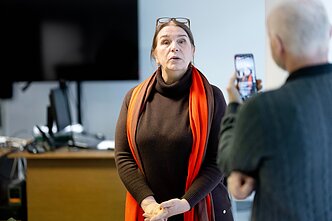















Yulia has worked for several years at a Rimi supermarket and used to speak mostly Russian before starting to learn Lithuanian.
“The course lasted three months. It wasn’t difficult. The teacher was very good and set homework,” Yulia, a sales assistant, said.
Rimi has been offering Lithuanian-language courses to its employees since May, as more than 200 non-Lithuanian speakers work across the chain. Most have already completed the course and passed the exam.
“They want to keep their jobs. In the end, knowing the language allows them to progress in their careers. We’re really pleased that this project, this investment, is paying off,” said Rimi spokesperson Luka Lesauskaitė-Remeikė.
According to her, employees are also encouraged to speak Lithuanian with each other in the workplace. After January, the chain does not plan to stop hiring non-Lithuanian speakers.
“There is a shortage of staff everywhere and in every sector. Customer service is no exception – people are needed, and we want to keep them,” Lesauskaitė-Remeikė said.
Meanwhile, businesses have been turning to the State Language Inspectorate (VLKK) for clarity about the legal changes.
“Essentially, only one thing will change,” said Audrius Valotka, head of VLKK. “Previously, the requirements applied to those working under a full-time contract, and now it will also apply to the self-employed.”
He says the VLKK has received complaints from customers about employees who cannot communicate in Lithuanian.
“Inspections are scheduled and unscheduled. Every year, we inspect several dozen companies according to a set system, procedures and rules, while other checks are done after receiving complaints. Recently, the number of complaints has definitely been increasing,” Valotka said.
Business owners say their main concern is that the implementation of the language requirement should not disrupt operations.
“We believe that level A1 is sufficient to ensure customer service while not placing too heavy a burden on businesses. There is talk of a two-year compromise period during which A1 would be required. We think that could remain in place permanently,” said Emilis Ruželė, deputy head of the Business Confederation.
Businesses also have questions about the examination procedure, as well as how the rules will apply to newly hired non-Lithuanian speakers.
“Someone might arrive in the country tomorrow, after January 1. We need to create conditions where the language requirement is not a barrier but an incentive to integrate,” Ruželė added.
The head of the VLKK said there will be no immediate penalties. New arrivals will be given time to learn the language, with a six-month integration period being considered by officials.

Newsletter
Every Friday morning.