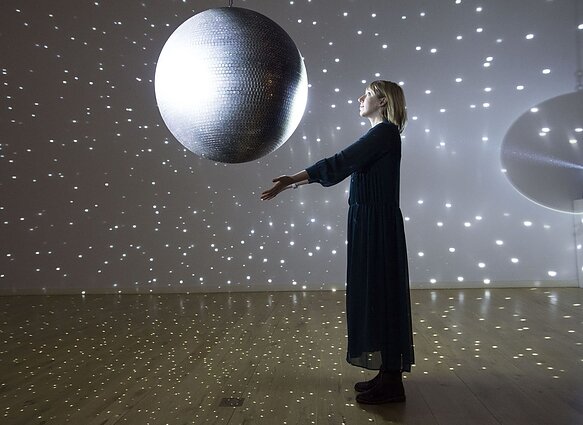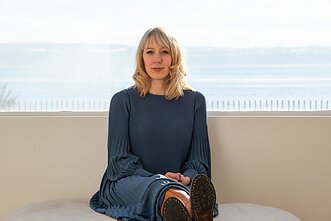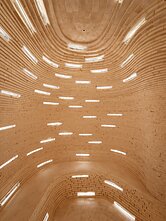










What does it feel like to experience the cosmos through scent, witness the death of a star, or hold the passage of time in your hands? Internationally acclaimed Scottish artist Katie Paterson invites audiences to do just that. Renowned for her daring imagination and boundary-pushing projects, Paterson blends art and science, collaborating with experts across fields to explore the mysteries of the universe and life on Earth.
This year, as Lithuania marks the 150th anniversary of the birth of Mikalojus Konstantinas Čiurlionis, Paterson’s work is featured at the M. K. Čiurlionis National Museum of Art in the exhibition From Amber to the Stars. Together with M. K. Čiurlionis: Now and Then. In this conversation, she reflects on her contributions to the exhibition, her galaxy-spanning artistic experiments, her insatiable curiosity, and even the unusual collection of moon dust stored in her garage.
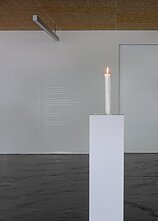
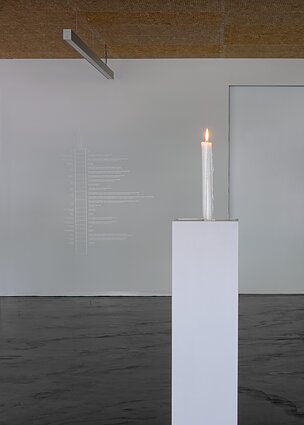
It's not the first time your work has been exhibited in Lithuania. In 2015, at the 10th Kaunas Biennial titled Threads: A Phantasmagoria about Distance, curated by Nicolas Bourriaud, you showcased several artworks. One piece, in particular, left a lasting impression on me. It was a layered white candle, each layer infused with a unique fragrance corresponding to different places in the universe. This installation took visitors on a journey through space. I remember the engaging conversations it sparked among exhibition visitors. What struck me most was that the artwork barely exists without the candle being lit. Once the candle is lit, its existence becomes fleeting; it ultimately fades away, leaving only traces of the sensory experience behind. This creates a poignant yet beautiful allegory for our limited existence as humanity – a concept that feels increasingly relevant today. Now, ten years later, I would like to ask what was on your mind when you created this piece. How did you envision its impact and meaning?
With Candle (from Earth into a Black Hole), I wanted to create a sensory journey through space. The 12-hour burning candle contains 23 layers, each with a unique perfume corresponding to different celestial locations.
I had a clear vision of taking people on an olfactory journey – starting from Earth, through the forest and various atmospheres, past the moon, and ultimately reaching a black hole (which is odourless).
The creation process involved both scientific fact and creative interpretation. While some scents were based on known chemical compositions (like NASA’s recipe for Saturn’s moon being “sweet and bitter almond, cherry, with slight benzene”), others required imagination, like the sun’s scent drawn on from fiction.
The piece reflects my broader artistic approach of making the intangible tangible, allowing people to engage with forces that are too immense for us to experience in other ways.
Like my other works, it aims to collapse the distance between the viewer and the most distant edges of the cosmos, creating an intimate, personal connection to the vast expanse of space through the familiar, everyday experience of scent.
I’m drawn to transience because it helps us understand our place in the vastness of time and space. I’m fascinated by how we attempt to contemplate ideas that seem beyond rationalization – like looking back to a time before Earth existed.
This sense of transience and impermanence runs through everything I make – from a brief phone call to a melting glacier, to the centuries of its demise, to the light from dying stars traveling millions of years through space to reach our eyes.
My work aims to make the invisible visible, the intangible tangible, and illuminate the darkness. By exploring these themes of transience, I hope to demonstrate the brevity of individual life, human life, and even our planet’s life in relation to the cosmos – not to emphasize futility, but rather to celebrate humanity’s power of imagination and our ability to contemplate such vast scales of existence.
A significant part of your work draws inspiration from the cosmos and relies on a certain level of scientific knowledge. When and how did your fascination with the universe and science originate?
I am drawn to timespans beyond human life, from micro time spans to geological time spans – glaciers, fossils, the earth and sun, the moon, dying stars, ancient darkness, the life of the cosmos spanning billions of years. Looking at the moon is like following a compass needle – it points into the rest of the universe, reminding us of the different clocks that tick away throughout the cosmos.
My interest in astronomy and astrophysics came about most directly from a period living in the remote north in Iceland, which opened up a connection to the sky and beyond, seeing the earth as a seething planet alive with boundless energy, one of many millions of others.
It took being in the remoteness of this extraordinary landscape to activate this encounter. More indirectly, from a thirst for the unseen, the unknown. The depth of time and space provides a link to vastness, a reciprocal encounter with the beyond that I find nourishing and imaginative.
Astrophysics probes at the limits of the known, the limits of language and a kind of abstraction that allows a breaking out of rational thinking for me: for example, looking directly at a time where the earth didn’t even exist. Particles at two opposite ends of the observable universe interacting. A black hole singing.
Your art practice is very much research-based and often involves lengthy collaborations with scientists, geologists, botanists, and other specialists. Could you elaborate on your collective modus operandi? What challenges does such an interdisciplinary process present?
When I come up with ideas, I sense their complexity before I fully understand it. My approach to collaboration is organic, unfolding naturally as each idea takes shape.
Over the years, I’ve worked with lighting engineers, geographers, geologists, perfumers, biochemists, technologists, biologists, life-scientists, horologists, foresters, paleontologists, and many others. Each collaboration is entirely unique, shaped by the idea at hand.
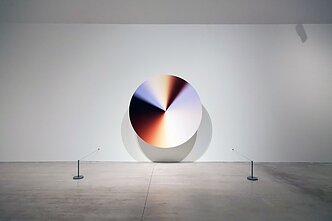
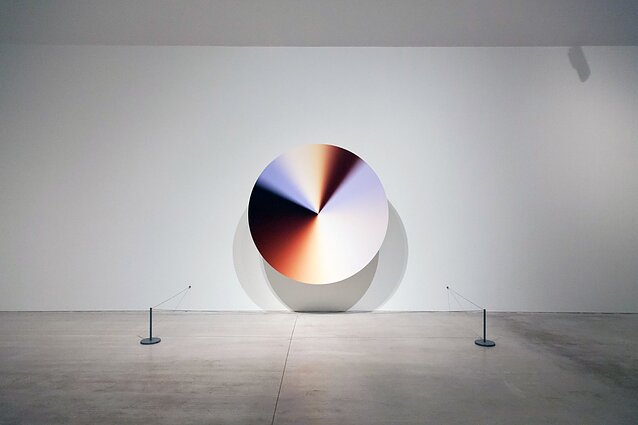
These interactions range from deep conversations to hands-on experimentation. The Cosmic Spectrum began as a simple curiosity about the color of the universe but became a two-year journey involving multiple scientists, graphic designers, and specialist printers to precisely capture the hues of different cosmic eras.
For my outer space candle, NASA shared their formula for the scent of Titan. And for Timepieces, astronomers at UCL helped me determine the exact duration of a day on other planets – turning time itself into something tangible.
I seek out experts in the most specific of fields – Gamma Ray Bursts, Stellar Black Holes – following the thread of an idea into unknown territory.
There’s a deep human connection in these collaborations, something that resonates beyond intellect.
Scientists often tell me that working together offers them a new way of seeing their own research – like when I joined Professor Richard Ellis at the W. M. Keck Observatory in Hawaii. Watching their studies of the earliest galaxies, hearing about the Dark Ages before stars were born – it felt like touching the very fabric of time itself.
These moments open up whole new universes, both scientifically and artistically, where wonder and knowledge become inseparable.
You’ve shown much sensitivity toward environmental issues in your work since the beginning of your career. How did it all begin?
My awareness of the environment began in Iceland, just after art school. Living there reshaped my understanding of the world.
I was overwhelmed by the sheer scale of the sky, the shifting light, the raw energy of the land – experiencing the earth underfoot warm and exploding with life, the deepest silences, and the vastest skies. For the first time, I felt what it meant to be on a spinning planet, passing a sun.
I remember being immersed in Iceland’s cyclical light, watching the midnight sun skim the horizon, and bounce back – a rhythm I had never known before.
It was in Iceland that I first truly realized: we are living on a planet, one among billions. The strata in the rocks provided a link to deep time that I later found in distant stars.
During my studies at the Slade, I became interested in glaciers and made a pivotal connection when I wandered into the Rock & Ice Physics Laboratory next door to my studio.
They were storing large sections of glacial ice, and I was able to use their freezers for my experiments. This experience gave me the confidence to approach people in other fields. It was the beginning of a way of working that continues to shape my art today.
You are mindful of nature not only in your artistic practice but also in your daily life. Even a note at the end of your studio emails encourages recipients to avoid unnecessary responses to help reduce CO2 emissions.
My awareness of environmental issues shapes my art-making, guiding both my concepts and processes. I often work with durational, time-based methods to explore the Earth’s distant past, its geological formations, and our fragile relationship with non-human life in an era of environmental crisis.
One of my earliest works, Vatnajökull (the sound of), made climate change tangible by allowing people to dial a phone number and hear the sound of a glacier melting in real time. It was an attempt to collapse distance, to turn an abstract crisis into something intimate – something felt.
Over time, my work has deepened its engagement with materials drawn from disappearing landscapes. I have transformed stones from islands threatened by rising seas, remnants of glaciers, and fragments of forests lost to wildfires into artworks that bear witness to planetary change. These materials, once part of vast ecosystems, become markers of both loss and continuity.
Projects like Future Library are about more than preservation; they are acts of faith in the future. The 100-year process of nurturing a forest for books yet to be written speaks to environmental stewardship, but also to hope – to the belief that, despite ecological devastation, we can still plant, protect, and imagine across generations.
Future Library which began in 2014 in Oslo, Norway, is one of your most talked-about artworks. Each year, a well-known writer contributes a new manuscript to this library, where it will be stored, unread and unpublished, until 2114. The paper for these manuscripts comes from 1,000 trees planted a few years ago in the Nordmarka forest in Norway specifically for this project. This initiative is impressive for many reasons, from its ambitious timeline to its material self-sufficiency. How does it feel to have a work in progress that you will never see come to fruition? Do you provide any guidelines to the authors at all?
When I conceived Future Library, I knew instantly that it would outlive me – and most of us alive today. I feel it’s important that I don’t see it fully realized – it is a work conceived for an unknown, future generation. I will never read the manuscripts, and I feel entirely at ease with that. I like to accept that a long span of time has to pass before the future reader can open the first page.
Remarkably, Future Library is a project I will spend my whole life tending to. Every decision I make requires thinking a century ahead. How will the Silent Room be experienced in 100 years? What languages will people be speaking? What technologies will exist? What will the printed book mean then, in a world we can only imagine?
The authors, selected for their extraordinary contributions to literature and poetry, write for a future they will never see. Their words can be in any language, of any length – but they must remain unread until 2114.
The Trust selects authors based on their “outstanding contributions to literature or poetry and for their work’s ability to capture the imagination of this and future generations.” Future Library is an act of trust – trust in language, in time, and in the distant readers who will one day turn its pages.
The concept of creating seemingly impossible dialogues is not new to you. Not only your Future Library project allows contemporary writers to engage in conversations with people who will love 100 years from now, but recently your work seemed to get curators’ attention in juxtaposition with some remarkable artistic minds, who lived more than a century ago. Last year, your work was presented in a dialogue with J. M. W. Turner at the Museum of Art Pudong in Shanghai. And this year, your work As the World Turns is showcased alongside that of M. K. Čiurlionis at the M. K. Čurlionis National Museum of Art. How does being part of such dialogues with the long-gone feel?
I’ve always been drawn to time’s vast scales – deep time, planetary cycles, the rhythms of the cosmos. Much of my work exists in dialogue with both the past and the future, bridging eras and making time tangible.
Future Library is a direct manifestation of this – a living artwork unfolding over a century, where contemporary writers entrust their words to readers not yet born.
Many of my works create dialogues across time in other ways – bouncing Beethoven’s Moonlight Sonata off the surface of the moon, mapping the locations of dead stars, or stringing together a fossil necklace that traces major events in Earth’s evolution.
Like Turner, my work explores the nature of the sublime. At Turner Contemporary in Margate, my works were shown alongside his atmospheric paintings, revealing how both, though separated by centuries, are rooted in sensory experience – landscape, color, light, and the elements.
At the Museum of Art Pudong in Shanghai, I’m honored to be part of a similar conversation, where my work enters into dialogue with Turner’s visions of light and space.
Soon, my work will be shown alongside M. K. Čiurlionis, whose paintings seem to move beyond time itself, blending music, myth, and the celestial.
I’ve always been interested in what lies beyond us, in the vastness of time and space. This draws me to phenomena like starlight, moonlight, meteorites, glaciers, and ancient forests – fragments of the universe that hold deep histories within them. For me, art is a language of connection – a way to find rootedness, to explore where we’ve come from, and to feel our closeness to other civilizations, other lives come and gone. To exist in these dialogues – whether with the past or the future – is a reminder that art is never fixed in time.
What resonates with you about M. K. Čiurlionis’ work?
I’m familiar with Čiurlionis’s work, particularly his fusion of music and visual art, which I find resonant. His ability to translate sound into painting – aligns with my interest in bridging different realms of experience, whether it’s time, space, or the natural world. There’s a dreamlike, cosmic quality to his landscapes. His paintings feel like portals to other worlds.
Tell me more about the artwork that is now displayed in the exhibition at the M. K. Čiurlionis National Museum of Art.
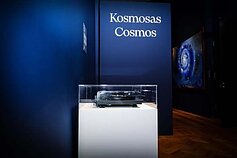
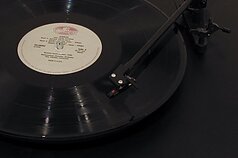
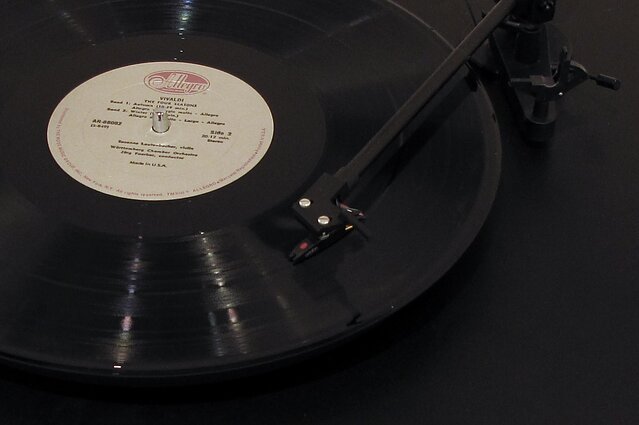
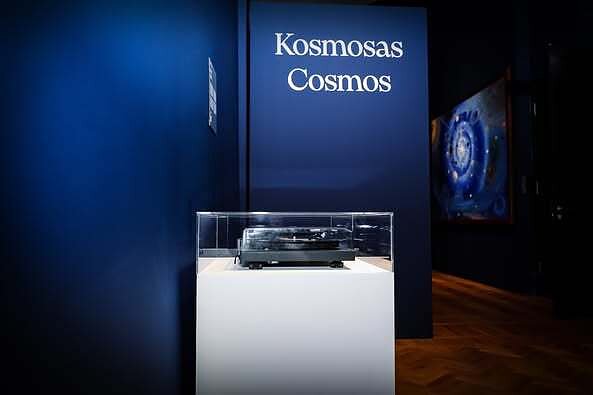
The artwork I’m exhibiting at the M. K. Čiurlionis National Museum of Art is As the World Turns (2010) a turntable that rotates in synchrony with the Earth, completing just one revolution every 24 hours. It plays Vivaldi’s Four Seasons, but at such an imperceptibly slow pace that if left undisturbed, the record would take four years to complete a single cycle. The music, barely audible, unfolds on a timescale almost beyond human perception.
I have long been fascinated by cycles of time – planetary, geological, and cosmic. As the World Turns is part of a broader exploration of time’s vast scales, from my Timepieces (Solar System) (2014), a series of clocks ticking at the length of days and nights on other planets, to works engaging with the deep rhythms of the Earth, such as the formation of mountains and the shifting of sand.
I’m drawn to how all these cycles connect – from the internal rhythms of living beings to the expansive trajectories of the cosmos, stretching from the first moments after the Big Bang to a future where the last starlight fades. These cycles remind us that we are part of a vast, interconnected web of time and existence – fleeting, yet inseparable from the fabric of the universe.
One of the aims of the exhibition is to show how universally curious M. K. Čiurlionis was. Why do you think it’s vital for us to be curious about all things surrounding us?
Curiosity and creativity are my driving forces. I think it’s vital to be curious because curiosity allows us to keep a space open for the unknown. While there’s a constant quest for knowledge and progress, it’s the mysterious and the uncharted that truly activate our minds and imagination.
These unknowns challenge us to look beyond the surface and ask deeper questions – these questions that have the potential to reshape how we understand the world and our place in it.
Being alive today, with all the knowledge and technology that currently exists, gives us the rare opportunity to reflect upon who we are, where we’ve come from, and how we relate to the vast universe around us.
In my work, I often explore these unknowns – from the distant past to the far future – because it’s in this space of uncertainty that we can find profound insights.
What makes you wonder most in your daily life?
In my daily life, I’m struck by the simple yet profound realization that we’re on a planet, one of billions of others. Every time we look into the sky, we are gazing into the past – even the light from the sun and moon has travelled minutes or even years to reach us.
It’s astonishing that we can never truly witness what is happening around us in the universe at this very moment.
I’m fascinated by life beyond human existence – the cosmos, nature, and the more-than-human world. It amazes me how we’re just one planet among billions, all ticking away at different rates.
In my daily life, I find inspiration both in grand cosmic phenomena and intimate, natural moments. I find wonder in experiences as varied as gazing through telescopes at distant galaxies, tending to a small moss garden in a Zen monastery, or watching a single ray of light mark the longest day of the year.
My garage is full of moon dust, mammoth bone offcuts, and wood samples from 10,000 different trees – all representing a connection to something vast and awe-inspiring. 'I’m moved by these objects and by the remnants of moments from history, like the white cloth at Ise Jingu Shrine or letters from long-gone astronomers about comet discoveries.
The exhibition From Amber to the Stars. Together with M. K. Čiurlionis: Now and Then will be held at the M. K. Čiurlionis National Museum of Art, located at V. Putvinskio Street 55 in Kaunas.
It will be open from March 21 to October 12 of this year. The exhibition is held under the patronage of the President of the Republic of Lithuania and is funded by the Ministry of Culture of the Republic of Lithuania.
Learn more about the exhibition here.