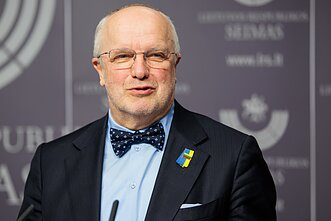















Lithuanian Foreign Minister Kęstutis Budrys said Thursday that European Union countries remain sceptical about proposals to use frozen Russian assets to support Ukraine.
“There is still a lot of scepticism in the EU about this, even if one can convince them about the need and why it should be done,” Budrys told Žinių Radijas radio.
Last week in Copenhagen, Budrys presented Lithuania’s proposal to fellow EU foreign ministers to use the Russian central bank’s frozen funds as a loan for Ukraine or transfer them to a special EU-managed fund.
He acknowledged his colleagues’ concerns about potential legal and economic consequences but stressed that Russia’s full-scale invasion of Ukraine is such a grave violation of international law that it requires a response.
“We must share the burden of risk. Let’s outline various measures and move in that direction, because we will need it,” Budrys said.
In a written proposal to EU members, Lithuania argued that seizing frozen Russian assets could be justified as a lawful countermeasure aimed at forcing Moscow to end its aggression or pay reparations.
International law requires such countermeasures to be temporary. Lithuania has therefore suggested two options: granting Ukraine a loan backed by frozen assets or transferring those assets into a special EU fund or a newly created entity that could manage them more actively to generate higher returns.
The EU has frozen about 210 billion euros of Russian central bank assets. Interest generated from those funds is already being used to support Ukraine, but Budrys said the money is being invested too conservatively to maximise its potential benefit.

Newsletter
Every Friday morning.