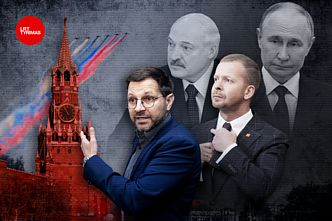














LRT Investigation Team took a deep dive into Eduardas Vaitkus, a pro-Russian politician and former presidential candidate who recently visited Belarus, where he claimed the Lithuanian government and president were illegitimate.
In last year’s presidential election, Vaitkus finished fifth, securing the most votes in Šalčininkai and Visaginas – Lithuania’s largest Russian-speaking population centres.
Vaitkus failed to win a seat in last year’s parliamentary elections, where he ran as the lead candidate on the list of the Lithuanian People’s Party (LLS) – a party cited in the State Security Department’s (VSD) threat assessment report.
He aligned with the party after unsuccessful attempts to establish his own political group, which was to be called the New Political Force. He first spoke publicly about founding the party in February 2024, during the presidential campaign, claiming it would be needed should he win the presidency.
A year ago, he also published a 32-point manifesto, which included goals such as renewing ties with Russia and Belarus, ending support for Ukraine, and publishing lists of former KGB collaborators.
In November, he declared that at least 250 active supporters would be needed to form the new political group, each required to recruit ten more people. All of them were to become the founding members of the New Political Force. However, to date, only about 1,000 people reportedly signed up.
Despite lacking a formal party, Vaitkus continues to position himself as a voice of protest in Lithuania’s political system. One of his latest and most controversial moves was a trip to Belarus in May.
“It was very good that I went. To begin with, I deliberately sent a letter to the ambassadors of the Scandinavian countries, asking for a meeting. I was ready to present data and evidence that Lithuania does not have a legally elected president.
All four embassies replied, saying they could not interfere in Lithuania’s internal affairs. [...] Then I sent a letter to the Russian embassy offering to share information, but received no response. The Belarusians, however, wanted to hear my presentation on how elections are conducted in Lithuania,” Vaitkus told LRT.

Shortly after returning from Belarus, Vaitkus requested permission to visit Algirdas Paleckis in prison. Paleckis is currently serving a sentence for spying for Russia.
Vaitkus denied acting on behalf of anyone, saying he was asked by a Belarusian journalist to deliver a book to Paleckis. However, he claimed prison rules prevented him from handing it over.
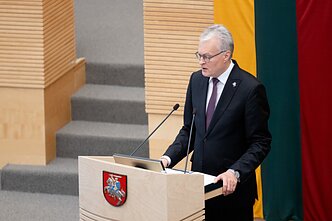
While in Belarus, Vaitkus claimed that Lithuania has no legitimately elected president – a statement considered anti-state by Lithuanian authorities. Vilnius County Police have launched a pre-trial investigation, while President Gitanas Nausėda said Vaitkus “a prime example of a fifth column”.
People behind Vaitkus
One of his visible supporters was a fringe activist Vaidas Žemaitis Lekstutis, who helped collect signatures and distribute campaign materials. However, during a campaign broadcast on LRT RADIO in May, Vaitkus denied having ties with him.
Instead, Vaitkus claimed he had invited former MP and minister Povilas Gylys to join his team, but Gylys declined. He also mentioned approaching independence signatory Zigmas Vaišvila – who was cited in a 2016 VSD report as attempting to unite pro-Russian forces..
Vaišvila, however, was cautious in acknowledging any affiliation with Vaitkus. “I met him during the election. Before that, I’d only seen him on ekspertai.eu [a Eurosceptic, fringe news website]. I hadn’t encountered him anywhere else,” he said.
Recently, Vaitkus counted on the support lawyer Mažvydas Misiūnas, who joined him during the presidential campaign.
“He sent me a letter. We talked, I invited him to join. I haven’t regretted it [...] he’s a true ally,” Vaitkus said.
Misiūnas confirmed that he responded to Vaitkus’ public call for assistance. “After some time, I offered [legal help] pro bono. That’s how we started [...] I represented him as his lawyer,” he recalled.
When asked why he chose to enter politics himself and run as the second candidate on Vaitkus’ LLS electoral list, Misiūnas said it was a logical step after witnessing what he described as injustices in the election process.
Vaitkus and Misiūnas also shared similar views on Russia.
The lawyer said he specialised in migration law. According to documents from the Centre of Registers, in the course of his work he established companies that were later transferred mainly to Russian nationals.
“Whether the clients are Russian or not – Lithuania has had very strong and close ties with Russia. […] They want to invest their money here, and that's a good thing. […] They bought real estate here, set up companies, and continued working – well, maybe not anymore. We weren’t the only ones doing this,” explained Misiūnas.
The bulk of the companies that were later passed on to Russian nationals were established by Misiūnas at the end of 2013 and in 2014. Official records state that their areas of activity include computer or car repairs, consultancy, real estate, and similar fields.
Each firm generated annual revenues ranging from several thousand to tens of thousands of euros. However, no public information can be found regarding their operations. Some of the companies have no employees at all, while others report just one or two staff members.

Financial statements show that, in many cases, these companies reported higher expenses than income and therefore did not generate profit. The shareholders of these companies often declared their residential address as either that of Misiūnas himself or that of staff from his law office.
Misiūnas explains that the companies were created to help Russian citizens and their families obtain residence permits in Lithuania.
“This was a form of legalising their lawful activity through Lithuanian companies that suited Russian nationals. We offered this option to various third-country nationals to invest in Lithuania. Through acquaintances, knowing us, they came to invest in real estate here and in this way obtain permits for themselves and their families. This was standard practice. […] Russia was not considered a hostile country until 2022,” said Misiūnas.
The website of Misiūnas’s law firm still states that his wife, who works there, advised a Belarusian real estate company in 2020 on the acquisition of a property worth €2 million. The announcement notes that she continues to advise the same Belarusian company on a development project valued at €10 million. The company in question is not named.
This year, 19 new small partnerships have been registered under Misiūnas’s name.
Political career
In 2005, Vaitkus accepted an invitation to serve as an adviser on pharmaceutical matters to then-Minister of Health Žilvinas Padaiga, who represented the Labour Party.
Upon accepting the adviser’s role, Vaitkus also joined the Labour Party, claiming it would otherwise have seemed inappropriate to hold a politically appointed post. He ran unsuccessfully on the party’s list in the 2008 parliamentary elections and soon left the party.
A new phase of Vaitkus’s political activities, which continue to this day, began in 2020 when he sought to align himself with Vytautas Radžvilas’s far-right party-in-formation – the National Alliance.
“I thought I’d finally have someone to vote for: Professor Radžvilas and so on. I signed on as a founding member, went to Vilnius for the founding meeting. A couple of months later, the first meeting in Kaunas was held, but then it turned out they treat moral values as objects,” Vaitkus said last year during a presidential campaign broadcast.
The National Alliance’s vice-chairman, MP Vytautas Sinica, told the LRT he did not know how Vaitkus ended up on the party’s founding list.
“To become a founding member, one had to sign a political declaration with five points. Among them was a commitment to a pro-NATO stance and opposition to Russia. Vaitkus became a founder. Soon after the party was established, the Covid-19 pandemic began – no one was in contact. Only after the first lockdown ended, I believe in early June 2020, I went to meet the Kaunas chapter. There, Vaitkus declared that NATO bases contradict the Lithuanian Constitution. We had a heated argument, he told us off, and we told him off,” Sinica said.
That same year, 2020, Vaitkus stood as a parliamentary candidate for the party Way of Courage, associated with former judge Neringa Venckienė, although he did not formally join the party.
Way of Courage, whose identity was linked to a campaign against an alleged paedophile ring in Lithuania, had entered the parliament in 2012. By 2020, however, the party struggled even to form a candidate list, and its de facto leader, Venckienė, was on trial at the time.
After his unsuccessful 2020 campaign, Vaitkus became increasingly visible in circles associated with Paleckis, the former politician sentenced for spying for Russia.
In larte October 2021, a rally was held outside the LRT building in Vilnius under the banner “For Freedom of Speech”. Organisers made no secret that the event was essentially a follow-up to a show of support for Paleckis, who had been sentenced earlier on the same day.

Following the event, Paleckis posted a photo on Facebook with the caption: “Unity, unity. If we have it, we’ll return LRT to the people and Lithuania to all of us.” The photo showed Paleckis, controversial activist Vilmantas Povilaitis, the activist Lekstutis, and Vaitkus standing together. Vaitkus not only spoke at the rally but also read out the final resolution.
Earlier, in May 2021, Vaitkus spoke from the stage of the so-called Great Family Defence March and addressed a rally outside the Seimas in August that year, which ended in riots. He also took part in other similar events.
In many photographs from these actions, Vaitkus is seen standing next to Paleckis.
In July 2021, online platforms describing themselves as anti-establishment reported the formation of a new civic movement called Resistance and its public address “to the people of the country”.
The statement once again questioned Lithuania’s membership of the EU and NATO, demanded new parliamentary elections, called for “friendship with neighbours”, and so on.
It was signed by four informal associations: the Lithuanian Centre for Civil Resistance to Occupation (LGPOC, Lietuvos Gyventojų Pasipriešinimo Okupacijai Centras), represented by Eduardas Vaitkus; The Dawn of Resistance (Pasipriešinimo Aušra), led by Algirdas Paleckis; Samogitian Resistance (Žemaičių Pasipriešinimas), coordinated by Lekstutis; and Nobody Wanted to Die (Niekas Nenorėjo Mirti), headed by former MP and ekspertai.eu fringe news website leader Audrius Nakas. The website was previously named by a State Security Department (VSD) report as pro-Russian.
Further reading
Although Vaitkus claimed the organisations were not connected, Lekstutis said they worked together.
“They [Vaitkus and Paleckis] were supposed to work together as part of the Dawn of Justice. And they did, at first. At every one of Paleckis’ rallies, Eduardas would give a speech and express support, including at the protest outside LRT,” he said.
But according to him, a conflict eventually blocked their joint efforts.
“Paleckis started by organising trips to Belarus. Erika Švenčionienė and Kazimieras Juraitis went there, and Paleckis did all the logistics because he had the contacts in Belarus. Eduardas wanted to go too – he wanted to lead the delegation. Paleckis refused. Then Eduardas got angry and offended. He took part of Paleckis’ programme and broke away, starting his own activities,” Lekstutis said.
Vaitkus did not deny he had planned a trip to Belarus with Paleckis’ associates, but said the circumstances were different. “I don’t know how much I should or shouldn’t say,” he told LRT.
He claimed the idea of the trip came from Paleckis after Vaitkus, in May 2021, told him he had written a letter of support to Belarusian dictator Alexander Lukashenko, in response to public statements offering rewards for the autocrat’s capture.
“When I told Paleckis I’d written such a letter, he came up with the idea of going to Belarus. That’s when he launched the Good Neighbourhood Forum [Geros Kaiminystės Forumas, now dissolved and under investigation by the authorities]. But I didn’t agree with his organisational methods. It was about how he organised things, his methods or principles – I didn’t agree with them. That’s why I wasn’t part of that cooperation,” Vaitkus said.
In May 2022, a delegation made up of Paleckis’ associates travelled to Belarus, with Erika Švenčionienė speaking with Lukashenko directly. Vaitkus said he was supposed to lead that “delegation”.
“I even signed as its leader. But then I said ‘no’,” said Vaitkus.
The Lithuanian Centre for Civil Resistance to Occupation (LGPOC) became more active at the end of 2022. Around that time, platforms claiming to be anti-establishment began circulating invitations to join the movement. Membership was directly linked to a financial contribution.
“To become a member of the Centre, you must transfer an annual membership fee to the personal account of the LGPOC leader, professor and haematologist Eduardas Vaitkus, in Belgium. This transfer will confirm your membership. The size of the fee is set by the member based on their means. LGPOC members will remain anonymous (for obvious reasons), unless they choose otherwise,” the recruitment message said.
Promotion of LGPOC was handled by the ekspertai.eu website, run by Nakas. It published information about Vaitkus’ efforts to build a political group.
Last year, during his presidential campaign, E. Vaitkus claimed in public broadcasts that LGPOC had attracted around 550 members. No information was released on how much money the so-called founders had transferred to his account.
However, Vaitkus said part of the funds had been allocated to ekspertai.eu to support its role as an “information mouthpiece”.
Records also show that Vaitkus has been collecting donations through a public institution called Enough is Enough (Gana Yra Gana), founded in late summer 2023. According to its announcement, the institution aimed “to promote democratisation in Lithuania by enforcing the rule of law and preparing for elections”. It holds charitable status, and its sole employee is director Vaitkus.
Data from the Centre of Registers show that in 2023, Enough is Enough received almost €13,000 in its bank account. It declared an operational surplus of €5,200. In the previous year, funding was similar, with a net surplus listed at nearly €3,800.
Vaitkus stated that in 2023 he paid himself €5,000 in salary from Enough is Enough. He admitted that the funds were partly used to cover the non-refundable losses of over €9,000 from his failed presidential campaign deposit.
Following his Belarus visit, Vaitkus was stripped of his state award by Nausėda, which was originally handed to him by the former Lithuanian president Rolandas Paksas who was impeached and removed from office over ties to a Russian businessman.

Newsletter
Every Friday morning.