


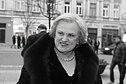








"I am a postcolonial product, a product of the Russian world. My friends were from Russia and Belarus and we watched the same TV channels and children's cartoons. With Lithuanians, it's like we were from slightly different worlds," says Irina Jarec.
Jarec was born in Visaginas – Lithuania's youngest city, built 50 years ago to house workers from the Ignalina Nuclear Power Plant. The city is known for its Soviet-style architecture, its ethnically diverse population (predominantly Russian-speaking), and its scenic surroundings – it is nestled among forests and lakes.
"My family is originally from Belarus – my parents came to Lithuania in the 1980s. They arrived in a wonderful, still-developing, young and promising city," she recalls.
Jarec says she grew up in an entirely Russian-speaking environment, where everyone she knew – family, friends, neighbours – spoke Russian.
"Naturally, we spoke Russian at home, just like everyone around us. It was the main language, and I learned Lithuanian at school. I do have a knack for languages, and I speak Lithuanian and English fluently. Of course, I owe a lot to my Lithuanian teacher – we simply loved to talk. When you enjoy talking to someone, you practise the language naturally," she says.
But that wasn’t always the case. In childhood, Jarec felt connected to the post-Soviet space. In first grade, she enrolled in music school – and had her first cultural shock: the songs were in Lithuanian.
"I really didn’t like choir rehearsals, because we had to sing in Lithuanian. I didn’t understand the lyrics. It was hard for me, and I really didn’t want to go to rehearsals," she remembers.
However, this disappointing experience turned out to be a turning point in her search for identity.

"I was so disheartened that I decided not to complain but to learn the language. I got a little notebook and started from scratch," she says.
"By the tenth grade, I had a pretty good grasp of the language," she adds. "What helped was participating in academic competitions, especially at the national level, which meant travelling to other towns. You meet kids from all over, find out where they're from – it was really interesting."
Jarec decided to study Creative Industries at Vilnius Tech (Vilnius Gediminas Technical University), where she faced not only academic challenges but also a new cultural environment. Despite Lithuanian becoming an important part of her life, she still felt a disconnect between her identity and her surroundings.
"When I arrived in Vilnius, it was hard. I think the lecturers could have spoken Russian, but I didn’t want them to. From the start, I realised that my Lithuanian level was lower than that of native speakers – not a surprise, really. There were plenty of opportunities to discuss and work on creative tasks, but at first I was terrified. To motivate myself, I would draw a star every time I managed to ask a question in Lithuanian," she says.
That sense of insecurity stayed with her during the early months of her studies – Jarec felt that the "Russian" side of her identity prevented her from fully opening up in the new linguistic and cultural environment.
Still, she managed to overcome her fears and began integrating into Lithuanian society. Her search for identity became a part of daily life.
"Over time, as I started speaking more Lithuanian and made Lithuanian friends, the barrier disappeared," she says.
According to Jarec, her native culture and language will always remain important to her, but she increasingly feels a part of Lithuanian society as well.
Still, the process of navigating and reconciling her dual cultural identity has not been easy.
"At some point, I realised that not only Russian, but also Lithuanian and English are important to me. These languages became part of who I am – I learned to use them in different situations. But what really mattered was understanding that I don’t have to choose one identity. I can embrace them all," Jarec says.
A major turning point in Irina’s life came with the full-scale war in Ukraine, which profoundly changed her view of her native culture and language.
"I think everyone would agree – the world fell apart," she says.

In 2022, together with her friend Maksim Paukštė, she initiated a petition on behalf of Russian-speaking residents of the Baltic states, condemning the war.
"It was a petition from Russian speakers in the Baltics against Russia’s war in Ukraine. It was important for me to say that we do not support the war," she explains.
Jarec stresses that, despite her cultural ties to the Russian language, she felt hurt and disillusioned by Russia’s actions. She felt it was her responsibility to show that Russian-speaking people do not support the war or aggression.
"On behalf of Russian speakers in the Baltic states, I wanted to say: we don’t need to be 'rescued'. We’ve integrated here. We live here and we build our lives in peace – preserving our culture while being part of Lithuania and the countries we live in," she explains.
Around 3,500 people signed the petition.
Like many others, Jarec began to question her attitude toward the Russian language and culture after 2022. She admits she was raised to believe in the superiority of Russian.
"I grew up believing that Russian was the greatest language in the world – a grand, incredibly rich language – and that Russian culture was the richest. But after all these events, I realised you can’t frame things that way. There are so many cultures, so many languages, so many human experiences in the world – it’s not all about one thing," she says.
This realisation became central to her continuing self-reflection and search for identity.
"I became interested in Ukrainian and Belarusian culture, their literature and music. I understood that these cultural resources shouldn't be used to glorify just one culture – they should also shine a light on those that have long been forgotten," Irina explains.
She recognises that cultural identity is fluid and can change depending on circumstances and personal experience. Like many people raised in multilingual and multicultural environments, Irina sees identity not as a fixed concept, but as an ongoing process of discovery and development.

"I speak many languages, and each one brings a bit of another culture into me. I feel that I speak a bit differently in Lithuanian and in Russian – but that, too, has meaning," she observes.
Today, Jarec continues to work in the cultural sector in both Vilnius and Visaginas. She actively organises cultural events and connects with people from a wide range of backgrounds and languages. She believes successful integration into society is impossible without a willingness to understand and respect other cultures.
"It's important not to isolate yourself, but to look for ways to connect. In Vilnius – as in any multicultural city – it's crucial to create space for exchange and dialogue," she says.
"I’ve come to understand that, regardless of my background, I am a part of Lithuania," she adds.

Newsletter
Every Friday morning.