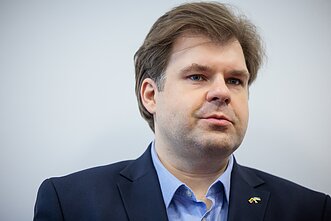
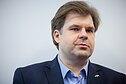








Around 20 dancers from all over the world are part of the modern dance theatre Aura based in Lithuania’s Kaunas. Heung Won Lee from South Korea has been dancing here for six years.
From Korea to Kaunas
Lee says he was not particularly interested in science or sports at school. But he was flexible, could do flips easily, and often heard people say he should become a gymnast. His mother, a big ballet fan, wanted her son to dance.
“But I didn’t want that at all. I thought it was shameful for men to wear tights, that dancing was not a man’s job. When I started dancing professionally, of course, my attitude changed,” Lee shares.
Before turning to dance, Lee practised taekwondo, a Korean martial art.
“Then one day I saw breakdancing. I wanted to learn it myself. But I couldn’t find any information about it anywhere, and there were no dance studios where I could learn breakdancing,” says Lee.
Then his mother took him to a contemporary dance studio.
“She took me to a small studio where the teachers were teaching contemporary dance. I knew straight away that it wasn’t breakdance, but I was interested. I stayed in that style and started exploring it,” the dancer recalls.

He then went on to study contemporary dance at the Korea National University of Arts. After graduating, he worked with several modern dance companies in Korea.
Lee came to Kaunas after seeing an invitation to audition for Aura on a website. He left South Korea in 2016, and after a few months in Germany and two years in Poland, he has been living in Kaunas since 2019. Lee says that he was inspired to go to Europe by his teachers, most of whom had experience working here.
“We are a small group, about 20 people. Most of the dancers are foreigners, everyone is different – we have different nationalities, different personalities. You can see how different we are when we dance together,” Lee says about Aura.
The group trains together from Monday to Friday, and their training includes ballet, contemporary dance, and improvisation.
“Sometimes we take part in commercial events, but our main goal is to work in the theatre. [...] Some months are quiet and some are very busy,” the dancer says.

Choreography and children
In addition to his ongoing career as a dancer, Lee has also started choreographing his own works in recent years. He says he likes to explore the themes of meaning, ageing, and humanity in his work.
“In art, we can talk about anything. Many choreographers talk about politics, philosophy, the ideas of famous authors, history, religion. For me, as an artist, it is important to talk about my own experiences,” he says.
“I don’t want to adapt topical issues such as war or political upheavals. I know what war is, but I have never experienced it with my own skin. That is why I cannot talk about things that are far away from me. If I’m going to talk about something, I want to talk about what is familiar to me,” Lee adds.
Lee has already received recognition from professionals in the field. His choreography ‘Un fil’, which he created together with his stage and life partner, Marine Fernandez from France, was awarded in a competition in Erfurt, Germany, last year.

In addition to the usual Aura activities, Lee also organises performances for children. Such performances are very different from those for adults, says Lee.
“It all depends on the children, on their mood. It’s different every time. They are active, they don’t sit in one place,” Lee says. “Usually in performances, we have to concentrate and give our best. But with children it’s different. You prepare the choreography, but it can change depending on the behaviour of the children. So, it’s better to just relax and trust that we can find a common language.”
Artists need change
Lee says he got used to life in Kaunas easily and now feels at home here. However, life in Lithuania’s second city is very different from his hometown Seoul.
“Seoul, where I grew up, is crowded and the pace is huge. Compared to Korea, the atmosphere in Kaunas is much calmer. It suits me, I’m used to this environment. Every time I go back to Korea, I feel strange. The last time I was there, I felt really uncomfortable because of the never-ending movement,” Lee says.

However, the dancer doesn’t think that he will stay in Kaunas for the rest of his life. According to him, it is important for the artist to draw inspiration from different sources and not to stay comfortably in one place too long.
“I think no more than ten years. I love it here, but I think it will be time for a renewal. My partner is French. She has lived in Lithuania for almost ten years. I have been in Kaunas for almost seven years. And I don’t ask the question of whether this city is good or bad. It’s just about asking yourself if it’s not time for a change,” Lee shares.

Newsletter
Every Friday morning.