














With Washington signalling a shift in foreign policy and Europe taking the lead on Ukraine, the Baltic countries do not want to be left out. They were, however, not present at the Ukraine summit in London over the weekend.
Reacting to the public spat between Donald Trump and Volodymyr Zelensky, which sent shockwaves around the world, UK Prime Minister Keir Starmer organised an urgent Ukraine summit in London on Sunday.
Attended by the president of Ukraine, the leaders of NATO and the EU, as well as heads of Canada, Turkey, and twelve other European countries, it nevertheless left the Baltic countries out.
The Baltics were reportedly “very unhappy” about not being invited to discuss Ukraine in London, while Lithuanian Foreign Minister Kęstutis Budrys called it a “mistake”.
According to Lithuania’s top diplomat, the participation of the Baltic countries in such summits is necessary because they are among the largest supporters of Ukraine and the consequences would directly affect their neighbourhood on the eastern NATO flank. “That is why we have to be there,” Budrys said.
Power and influence limits
However, the Baltic countries should not feel bad about not being invited to the summit in London, political analysts told LRT.lt
“I think that factually, it was a mistake not to invite the Baltic states because they have contributed quite substantially to supporting Ukraine. Also, they are in a position which is very much at the forefront. So, both in terms of geography and in terms of commitment, the Baltic states should have been there,” said Stefano Braghiroli, an associate professor at the University of Tartu.

“On the other hand, we have to understand how these summits work. I think that the reason why the Baltic states were only marginally involved [had an online meeting with Starmer] is that in these summits, where decisions have to be taken relatively fast and relatively effectively, the more we are the more complicated it is to take decisions,” he added. “The main reason why the Baltic states were not there is their size.”
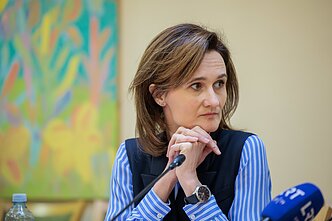
According to Dovilė Jakniūnaitė, a politics professor at Vilnius University, Lithuanian leaders’ discontent with not being invited to the Ukraine summit in London was aimed at the home audience.
“What we see is that there are negotiations going on and those countries that can decide something and have the capacity to do so are being included, while those that are perceived as not being able to contribute more than ideas are not being included. This is the reality,” she told LRT.lt.
The fact that the Baltic states are not invited to European leaders’ meetings does not mean that they are not respected. However, it does show the countries’ power and influence, Jakniūnaitė noted.
“When it is thought that we need to quickly convene and bring together countries that are worth negotiating with and have the power to do something, it is obvious that Lithuania is not there, and this simply shows Lithuania’s place,” the political analyst said. “Of course, it would be good to participate, but at the same time, we are being shown the limits of the Lithuanian state’s influence and power.”
Braghiroli also pointed out that it is now particularly important to maintain European unity. However, the Baltic discontent was not irrational and was communicated in a constructive way, he said. This has already led to concrete results, with Starmer promising that Lithuania and its neighbours will be invited to future meetings on Ukraine.
What can we offer?
While there may be rational explanations for why the Baltic states were not at the table with the European leaders in London, the countries’ desire to be included in the discussions on Ukraine is understandable, experts say.

“I think that for the Baltic states being able to sit there is important not only in terms of supporting Ukraine but also to signal primarily to Russia, but also other opponents, that the Baltic states are taken seriously. Of course, the conversation is about Ukraine but it’s also the signal that the Baltic states are a consistent part of the core of European security,” said Braghiroli of the University of Tartu.
However, it is important not only to be able to discuss but also to have concrete proposals at such meetings, according to Jakniūnaitė.
“The question is what we can offer. If we come up with what we can offer, then maybe we could participate in such meetings in the future,” she said.
“This is not the first such meeting and it will certainly not be the last. Such meetings will continue to take place at different levels. Of course, it’s important to participate in as many discussions as possible to observe and to know what is happening. That’s why it will also show the capacity and capability of our diplomacy,” the professor added.
According to Braghiroli, the Baltic states should participate in future meetings on peace in Ukraine as a symbol and reminder to allies that “if peace in Ukraine is not secured with enough guarantees, the threat comes directly to them and directly to the EU”.
Russia not ready for peace
UK and France would work with Ukraine to develop a peace plan and then “discuss it with the US”, Starmer said after the summit on Sunday.

Asked whether the current US administration might still be prepared to listen to European proposals on how to end the war and ensure peace in Ukraine, Jakniūnaitė noted that the question should not be about the US.
“At the moment, Russia is not ready to end the war and therefore it is irrelevant who wants to end the war – the Americans or the Europeans – and on whose terms. So far, there is no sign [from Russia] that it is willing to make concessions and to make any compromise, whatever it may be,” the political analyst said.
“We are now discussing whether or not peace talks are possible without US involvement. I think the end of the war is possible without the US or Europe if Russia behaved differently. In this case, it’s unlikely that Russia is going to make any concessions in the near future. They enjoy watching the current bickering between the transatlantic partners and how Europe is trying to mobilise itself in every possible way,” she added.

Newsletter
Every Friday morning.