










In case of emergency or martial law in Lithuania, the state would ensure the operation of 125 pillar stores. They would be protected, and the supply of goods would be guaranteed. These stores also accept card payments without a connection.
The National Crisis Management Centre (NKVC) has compiled a list of stores across Lithuania that would remain open and sell food, medicines, and other essential goods in case of emergency.
“The aim is to be able to provide 50 percent of the population with essential products in one day. For example, it is planned that around 20 of these stores, known as ‘pillar stores’, would operate in Vilnius,” said Vilmantas Vitkauskas, the head of NKVC.
The operation of these stores would also be guaranteed in the event of power outages and connection interruptions.
“The NKVC is working closely with businesses, and it is important to note the responsible attitude and willingness of businesses to get involved in the implementation of the plan to meet the most important needs of the population,” Vitkauskas said.
Offline payments
In case of martial law in Lithuania, businesses and state institutions would operate under a special regime. For example, banks would be able to accept payments in shops even in the absence of a connection.
This provision was established by the Bank of Lithuania last year in a special resolution.
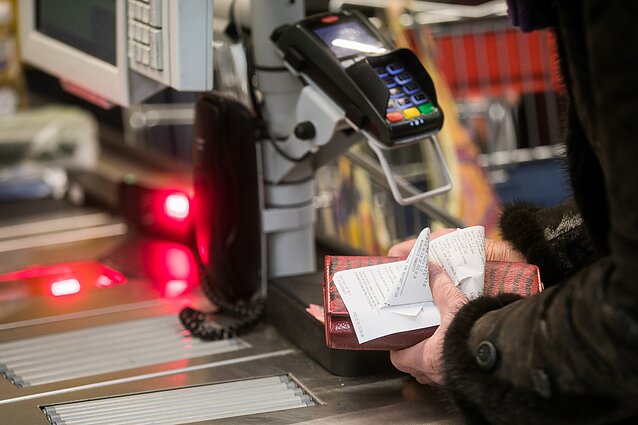
Bank cardholders would be able to purchase essential goods (food, medicine, fuel) from pillar stores for no more than the amount set by the Bank of Lithuania. The latter does not specify what this amount could be.
“When making offline payments, [...] the card must be inserted into the card reader and the PIN code must be entered. Whenever possible, online payments should be made. Targeted offline payment is prohibited. Offline mode will only be used when all the conditions necessary for its operation have been met,” the central bank’s resolution reads.
People would also be able to pay in cash as usual.
Taking risks
Rūta Vainienė, the head of the Association of Lithuanian Trading Companies, also says she does not know what the maximum limit for offline payments could be.
“It will be a decision on what risk banks can take, because when there is no connection, there is no possibility to check whether there is money in a person’s account,” she said.
According to her, traders were also willing to discuss the possibility of allowing offline payments with bank cards in the rest of the stores, not only the pillar ones.
“But this time the risk [of people not having money in their accounts] would be borne by the businesses,” Vainienė stressed.

Sharing responsibility
The head of NKVC Vitkauskas also notes that people are responsible for stockpiling food for the first three days of an emergency. The municipalities are responsible for the next three days and further responsibility falls on the state reserve.
“It is important to mention that last year, Lithuania also changed the model of ensuring the state reserve, replacing unprocessed products (such as grain), which would be difficult to process and turn into consumable products in an emergency, with a reservation system for the storage of ready-to-use or ready-to-prepare products,” Vitkauskas said.
According to him, NGOs would distribute food to people who are unable to go to a store themselves.
“It should be noted that the Lithuanian food production industry fully supplies the country’s population with food products, and its production capacity would be sufficient to provide food to citizens even in the event of a serious crisis,” the NKVC head said.

Newsletter
Every Friday morning.