








With the new US administration indicating in no uncertain terms that Washington is moving away from Europe, Lithuania, having long been staking its security on NATO and the US, is grappling with the new possible scenarios.
On LRT TV’s The Lithuania Future Forum programme, Jonas Vytautas Žukas, former commander of the Lithuanian Armed Forces, stressed that Vilnius must consider even the possibility of NATO’s disintegration, as well as the scenario of how to act if Article 5 does not work.
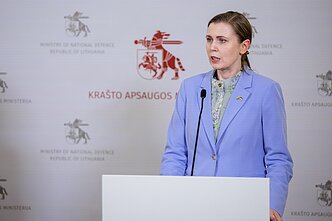
Defence Minister Dovilė Šakalienė, meanwhile, reassured that Europe is rapidly changing its approach after the positions expressed by the US representatives at last week’s Munich Security Conference.
“It has become absolutely clear that we have moved from the concept that the US will defend Europe to the concept that Europe will defend itself with the help of the US. There is no need for drama, this is not the time for being dramatic. Everybody in Europe understands this,” Šakalienė said.
Keep the enemy out
The defence minister also insisted that the US has not changed its position and is not claiming to be leaving NATO and its allies, only signalling it will not be accepting “imbalances” anymore.
According to Šakalienė, when it comes to self-defence, Lithuania has an objective and a plan for how to achieve it.
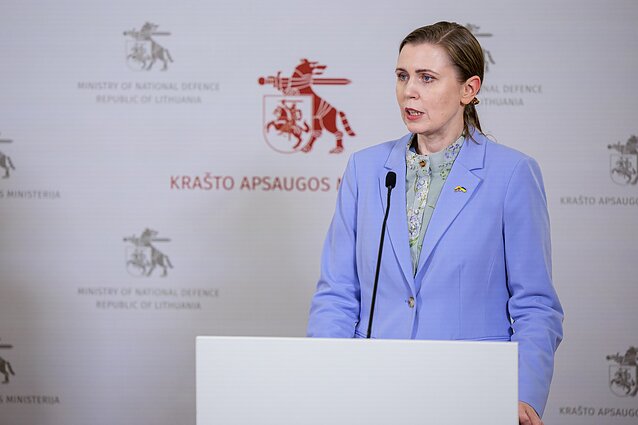
“Our goal is to keep [the enemy] out of our territory. The second thing, of course, is to destroy targets on enemy territory and to destroy them seriously and in places where that affects us. The main objectives range from the recapture of territory to the denial of entry. For this, we are going to invest as much as we can barely afford, to get American help.
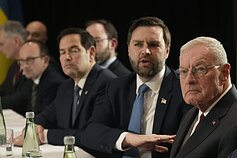
“I had three brief conversations with [US Secretary of State Pete] Hegseth. His main point was that if we are investing that kind of money and taking on a load that huge, they will work with us as a team. That is why we are hoping that we could get Patriot [air defence systems] from the Americans and other systems that we cannot afford,” said Šakalienė.
Lithuania needs not panic but to mobilise and think about what can be done immediately: to start weapon acquisitions as soon as possible and to pay the advances that guarantee a better place in the queue for the equipment.
According to Šakalienė, there are six main areas in which Lithuania has decided to invest: land manoeuvres, indirect fire support, integrated air defence, military engineering, intelligence and logistics capabilities, as well as maritime domain awareness, coastal and harbour defence, maritime operations and air operations.

Meanwhile, former defence minister Laurynas Kasčiūnas stressed that, given that air defence is the most underdeveloped capability in all NATO countries, it is worth investing in.
Lithuania’s main priority at the moment is to develop a national division within its armed forces, but, according to Kasčiūnas, it may not be enough.
“Division belongs to the war of manoeuvre and I would very much like to see deterrence working and not to be invaded in any way. But that may not be enough. We need counter-mobility,” the conservative politician.
He also believes that Lithuania needs to withdraw from the Ottawa Convention which limits the use of landmines.
Debt is not the only option
Lithuania needs some 12–14 billion euros over the coming five years to implement its defence plans, or 5–6 percent of GDP.
President Gitanas Nausėda has ruled out tax raises and argues that borrowing will be the primary source of funding.
“Borrowing would have a bigger weight in the beginning. All the preconditions are there. Even the president of the European Commission [Ursula von der Leyen] has recently stated very boldly and openly that defence spending will be treated very differently from standard spending,” Nausėda said on the LRT TV programme.

Experts have pointed out that there are other non-tax sources. For example, pension funds should be encouraged to invest in Lithuania rather than abroad.
President Nausėda has also suggested borrowing directly from people.
However, observers believe that some new taxes or tax raises are inevitable.
Živilė Simonaitytė-Vasiliauskienė, a researcher at Vilnius University, pointed out that Lithuania is still reluctant to introduce some of the taxes that other countries have.
One of them is the car tax.
It is estimated that if Lithuania were to introduce a tax on cars alone, such as the one currently in place in the UK, it would add around 300 million euros to the government budget annually. Dozens of millions could be raised by introducing a French-level tax on real estate.
Gediminas Šimkus, governor of the Bank of Lithuania, also mentioned a sugar tax and a pollution tax.
Assessing the situation
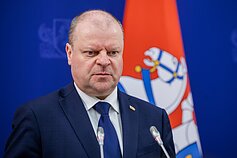
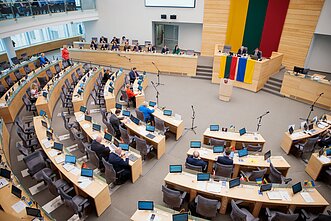
Like the defence minister, Parliament Speaker Saulius Skvernelis stressed the need to act and achieve set defence boosting goals faster.
He also thinks the public needs to be told that higher military spending will have a positive impact on the Lithuanian economy.
“Of course, we will not produce the howitzer ourselves, but many things needed to equip individual soldiers are produced here and the production can be expanded. Lots of jobs, lots of things related to servicing. Many things will remain in the Lithuanian economy,” said Skvernelis.

Meanwhile, former prime minister Ingrida Šimonytė stressed that the changing geopolitical situation calls for a reassessment of the circumstances. The current target of spending 5–6 percent of GDP on the military may not even be enough anymore, she said.
“As politicians, we take military advice, but reflecting on the changes in geopolitics is a necessity,” according to Šimonytė. “It will be our interest and our responsibility, Europe’s responsibility, to mobilise support for Ukraine. And this is our chance to somehow avoid the worse things that are coming.”
She believes recent events force Lithuanian leaders to reassess their assumptions.
“We just need to think from a different point of view, whether the assumptions we have made about the things we will need are still correct and where total defence stands in our line of priorities.
“We say now: ‘We will get allies to deliver what they need to deliver, while we will buy what’s our responsibility.’ But what if we don’t? Do we have a plan?” Šimonytė asked.
Skvernelis said that the last week did make him reassess his approach to security and defence.
“What I realised during that week is that the rescue of the drowning is the work of the drowning themselves. We have to do everything we can so that we’re not judged by history for having failed to do something in hopes that someone else will come to our rescue.
“That is why today, when it comes to [military] funding, we have to be able to defend ourselves. Moreover, our resources should signal very clearly that this region, this eastern flank is very unattractive to attack,” said Skvernelis.

Newsletter
Every Friday morning.