
















At the end of last year, the Bank of Lithuania held 7.15 billion euros of official international reserves. Most of it consists of securities, cash, and deposits, but there is also monetary gold. The central bank keeps 466 gold bars in vaults in London.
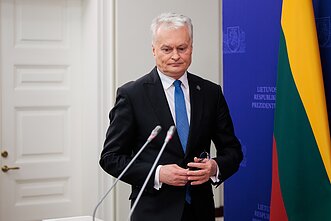
President Gitanas Nausėda proposed this week to use these reserves to fund Lithuania’s plan to spend 5–6 percent of its GDP on defence in 2026–2030.
However, the central bank says that direct financing of the government from foreign currency reserves is not allowed under the Treaty on the Functioning of the European Union.
In addition, a sufficient level of official international reserves is also necessary to ensure the central bank’s independence.
What for?
The foreign currency reserves were built before the euro was adopted in Lithuania. According to the Law on the Credibility of the Litas, litas issued by the Bank of Lithuania had to be fully covered by official international reserves.
Following the adoption of the euro in 2015, the Bank of Lithuania’s official international reserves were reduced to 1–2 billion euros, as investments in euro-denominated assets could no longer be classified as foreign reserves.
As part of its activities, and in order to manage emerging financial and geopolitical risks, the Bank of Lithuania has started to consistently build a portfolio of official international reserves.
Where necessary, the official international reserves can be used indirectly to adjust international payment imbalances, influence exchange rates, and for other purposes.

Composition
According to the Bank of Lithuania, Lithuania’s official international reserves amounted to 7.15 billion euros in December 2024, an increase of 1.55 billion euros from the year before.
At the end of last year, the value of securities amounted to 4.04 billion euros, consisting of short-term debt of 52.5 million euros, long-term debt of 3.5 billion euros, and equity instruments and investment fund shares worth 481.9 million euros.
Cash and deposits from reserves amounted to 1.76 billion euros, of which 1.73 billion euros were claims on monetary authorities, namely the International Monetary Fund (IMF) and the Bank for International Settlements.
In December 2024, the value of Lithuania’s monetary gold amounted to 470.6 million euros. At that time, special borrowing rights amounted to 748.6 million euros and reserves with the IMF amounted to 142.2 million euros.
The Bank of Lithuania did not have any derivatives or other claims at that time.
Recovered gold
Lithuania’s gold reserves include gold accumulated during the interwar period and recovered from England, France, and Switzerland after independence in 1993.
It is held in the vaults of the Bank of England in London and is invested. There is no plan to bring it back to Lithuania, as this would be expensive, and it would no longer be available for investment.
The Bank of Lithuania holds a total of 466 bars of gold weighing 5.8 tonnes. Over the last ten years, the central bank has earned 6.5 million euros from this gold, an average of just over 600,000 euros each year.
Although it cannot use the official international reserves directly for government spending, the Bank of Lithuania transfers part of its profits to the budget each year. Last year, for example, this amounted to 14.38 million euros.
The Bank of Lithuania also pays interest to the Ministry of Finance on the funds it holds at the central bank – around 260 million euros over the last two years. In addition, the bank has purchased more than 8 billion euros worth of Lithuanian government securities together with the European Central Bank.

Newsletter
Every Friday morning.