















Lithuania’s new government will seek to soften the ban on the export of dual-use goods put in place by the previous cabinet.
The outgoing government banned the export of an extended list of goods that can be used by Russia for military purposes, including industrial centrifuges, filtration and purification devices for liquids or gases, as well as various components of vehicles and tractors.
These goods were also banned from being transported by air worldwide, with the exception of the European Union and several partner countries.
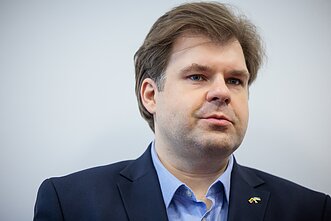
Luckas Savickas, the new economy minister, stressed in a press conference on Friday that the previous sanctions would remain in place. However, some of the expanded measures were taken without consulting businesses first, he added.
“I have not heard from our business partners that anything has been negotiated with any of the associations present at the table,” Savickas said.
In the press conference, the minister said the restrictions must not harm exporters of high-tech products.
“We hope that together with the government we will be able to adjust the decision, to find a solution that is also effective in terms of sanctions,” Savickas said.
“There is no question of sanctions – they must continue,” he added.

Vidmantas Janulevičius, President of the Lithuanian Confederation of Industrialists, also stressed the importance of the sanctions and underlined that the resolution will not be revoked, but will be adjusted.
“For road transport, things will stay the way they are, [the possible changes] only concern the transport of certain groups of goods by air and the banning of certain countries. Taiwan, Singapore or Israel, for example, are probably not hostile countries,” Janulevičius said.
Simonas Černiauskas, director of Lithuanian Digital Technology Association Infobalt, said that high-tech products are particularly affected.
“We are not talking about limiting sanctions, we want to keep them, but it has to be done sensibly. The critical thing is not to be a pioneer in the EU and not to be completely out of context, because this directly affects our competitiveness and investment,” he said.
Savickas said exports should only be restricted if a particular business circumvents sanctions.
The minister estimates that the current restrictions would result in a loss of over €250 million a year in revenue for businesses.
“It is clear that this has a major impact on our economy. Most of these goods, country by country, go mainly to Ukraine,” said Savickas.
On Thursday, Arvydas Paukštys, the owner of the high-tech group Teltonika, also criticised the previous government's decision to restrict the exports by air.
“All Teltonika goods will no longer be accepted on planes and can no longer be sent to our offices in Latin America and Asia. Can anyone explain the logic behind the decisions?” Paukštys posted on his LinkedIn account.
SEB economist Tadas Povilauskas also wrote on Facebook that in the first ten months of 2024, exports from Lithuania of the sanctioned goods amounted to 720 million euros. Exports of such goods of Lithuanian origin alone amounted to 477 million euros.
“Of the 477 million euros of Lithuanian exports, 203 million euros in exports were sent to EU countries, 124 million euros to partner countries and 71 million euros to Ukraine. This leaves around 79 million euros of Lithuanian-origin exports to the remaining third countries,” the economist wrote.
According to him, the main markets among third countries are the United Arab Emirates, Mexico, South Africa, India, Brazil, and Singapore.
The decision to expand the export sanctions was taken by the former economy minister, Aušrinė Armonaitė. She quoted data, saying that some of the goods being shipped via Lithuania to non-EU countries were being used by Russia in its war against Ukraine.

Newsletter
Every Friday morning.