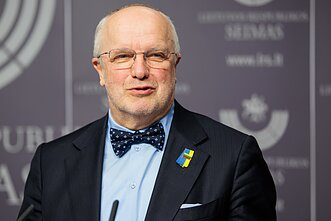











The majority of South African Lithuanians of the old generation were simple workers and craftsmen, says Dainius Junevičius who researches the community. However, there were also famous painters and wealthy merchants among them.
Junevičius searched the archives in Cape Town for historical sources on the life of the Lithuanian diaspora in South Africa. He notes that attempts to research the old generation of South African Lithuanians have been made before. The historian Vitalija Kasperavičiūtė gave new impetus to the research by discovering and publishing the 1930 report of the priest Juozas Janilionis from his trip to South Africa.
According to Junevičius, Lithuanians started looking for a better life in South Africa as early as the end of the 19th century. Especially in interwar Lithuania, there were rumours that emigrants could settle and earn money in a distant country, so some Lithuanians decided to travel there. Most of them came from small Lithuanian towns.
“Many came from Žemaičių Naumiestis, Šeduva. People were probably attracted by the success stories of those who went before them,” the researcher says.
However, he adds that the number of Lithuanians travelling to South Africa was not significant.
“The migration of Lithuanians to South Africa cannot be compared to migration to the United States, which was the main destination. It is difficult to explain why some people came to South Africa. It could be explained by chance,” Junevičius says.
During the interwar period, far more Jews emigrated from Lithuania to South Africa than Lithuanians.
“At this time, almost all of the 40,000 Jews living in South Africa had roots in Lithuania,” Junevičius notes.
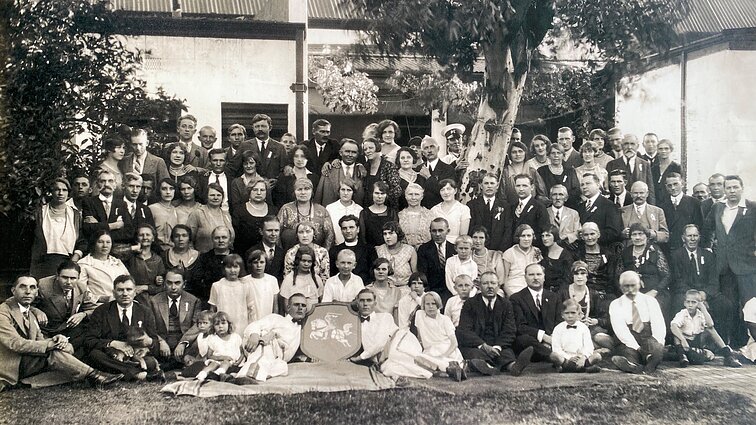
In the interwar period, around 400–500 Lithuanians lived in South Africa. The majority of them – around 300 – lived in Johannesburg and the rest in Cape Town. According to the researcher, most of the South African Lithuanians were ordinary workers and worked in the mines or as carpenters or tailors.
Lithuanian societies
According to Junevičius, the cultural life of South African Lithuanians was not intense in the interwar period. However, it was somewhat enlivened by Christian activities.
“Lithuanians did not have their own church but they attended one together with Italians in Johannesburg. There were also attempts to set up a Lithuanian society in 1906–1907, but it did not last long,” he says.
The Lithuanian Cultural Society was also founded in South Africa in 1939. According to the researcher, the aim of the society was to maintain commercial relations between Lithuania and South Africa.
“The majority of the members of the society were Lithuanian Jews. There were more societies of a similar nature in South Africa: The Lithuanian Jewish Society and the Lithuanian Cultural Association of South Africa. Both were founded in the 1930s and were made up of Jews rather than Lithuanians,” Junevičius explains.
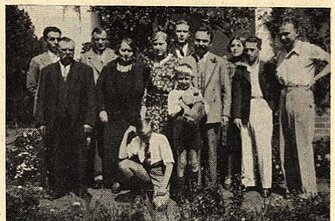
The memoirs of General Vladas Nagevičius, who visited South Africa, reveal that members of the Lithuanian Cultural Society used to celebrate February 16, Lithuania’s Independence Day. One of the chairmen of the society was Leonas Vaškis, a tailor from Šeduva. He and his wife Ona had eight children.
“During his son’s wedding, he [Vaškis] gave the bride and groom a cutlery set with the society’s emblem, but this is the last trace of the society I’ve been able to find,” Junevičius says.
Intelligentsia
Although the majority of South African Lithuanians were ordinary workers, a small number of them held managerial positions and worked in the cultural field, says Junevičius. One such intelligent family was the Antanaičiai family.
“In 1905, two young people met in Cape Town, fell in love, and got married. They later lived in the Johannesburg area. When their children started school – around 1910–1915 – they did not know any language other than Lithuanian, but the Antanaičiai family achieved a lot,” the researcher notes.
He says that one of the Antanaičiai family’s offspring learned Afrikaans: “He later became the headmaster of the biggest Afrikaans boys’ school in South Africa. That’s a really nice example.”
Kuisys, a wealthy trader, also settled in South Africa. His family contributed to the care of the less socially advantaged Lithuanians.
“The daughters came to Kaunas several times and visited relatives in the vicinity of Žemaičių Naumiestis. They donated money and set up a social house. They maintained such ties with Lithuania,” Junevičius says.
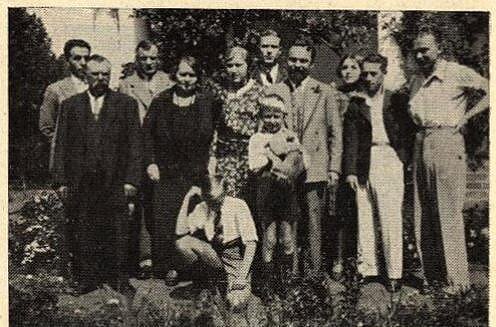
After the Second World War, the artist Pranas Domšaitis also settled in South Africa.
“His wife was an opera singer who got a job at the Music Department of the University of Cape Town. Domšaitis came with her. As an artist, he was already an elderly man, but he recovered, began to paint in an innovative way, was immediately recognised by the local artistic community, and left his mark on South African history,” notes Junevičius.
Today, the researcher says, the old generation of migrants from Lithuania is almost extinct in South Africa. “I know of three immigrant families who came to South Africa at the beginning of the twentieth century.”

Newsletter
Every Friday morning.