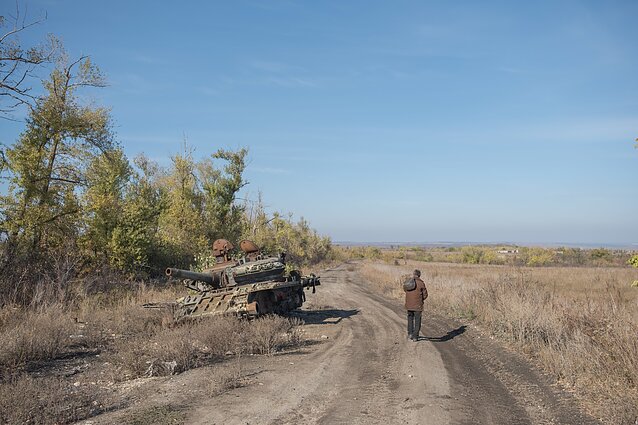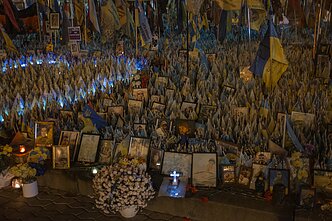
















Donbas is heaving with death.
Corpses are unearthed in old trenches lying in layers. The different winter and summer uniforms give a clue about how long the treeline was being fought over.
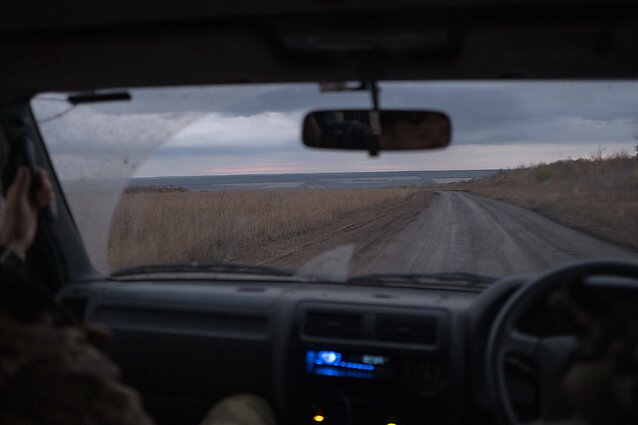
At any given time, dozens of reconnaissance drones circle above, guiding kamikaze drones and artillery. Every SUV is covered with antennas that detect or suppress the drones, their sensors beeping as soon as the vehicle gets within ten kilometres of the frontline. The only way forward is to wait for a window in the sky.
Many do not see that window. The wounded are evacuated only in the evenings and mornings when the drones return to swap between their day and night cameras, or when the ground is blanketed by a thick layer of fog. “Please don't take pictures, you must understand,” pleads a medic. The Azov Brigade fighters brought to the stabilisation point are already dead.
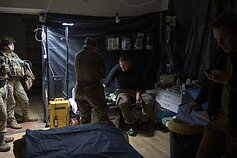
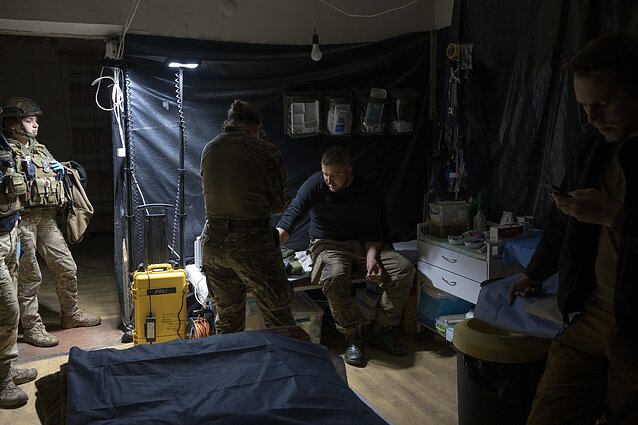
These first-care medical centres are located below ground and out of the range of the drones. Despite their closely guarded locations, the Russians are still able to hit them.
“They shoot at medics, they don't follow any conventions,” says Valeria, a medic. Her words are followed by laughter – what conventions, asks another doctor rhetorically.
Casevac teams, extracting the wounded from the trenches, continue working despite the enormous risks. However, there are no more medical evacuation teams that treat the wounded on the way to a stabilisation point. We are a priority target, says one medic who used to work with a medevac team.
A soldier injured by a drone-dropped grenade is later brought to the stabilisation point. His trousers are bloodied. Although he looks middle-aged, he is just 25 years old.
“This is my thirteenth injury, my seventh contusion, I’ve gotten used to it,” he says.
Running out of men
Major General Dmytro Marchenko, famous among soldiers for the defence of Mykolaiv in southern Ukraine, has said the frontline is collapsing.
“There are no people, there is no one to replace them. The soldiers are tired,” he said in an interview with an Ukrainian blogger published on October 28. The general himself was allegedly removed from command after political intrigues over his support for the former Ukrainian president, Petro Poroshenko.
In Donbas, soldiers also talk about brigades being constantly reorganised after heavy losses. Sometimes what’s left of the troops is simply attached to other units.
The increasingly critical shortage of infantry is costing Ukraine heavily – there are no longer enough forces to stabilise the frontline, with Kyiv officials being increasingly open about the dire prospects.
Much of the information about problems affecting the Ukrainian armed forces is not made public. However, soldiers are increasingly willing to talk about them, at least anonymously, in an attempt to force changes in the leadership.
To understand the situation in Donbas, LRT.lt spent a week at the end of October talking to dozens of soldiers from different units at the critical Pokrovsk frontline.
Troops talk about creeping demotivation due to incompetent commanders, lack of weapons and exhaustion, as well as the psychological need to have a perspective – how long they will have to stay in service and what they can expect in the near term. However, the debate on demobilisation or end-of-service dates has stalled.
According to the Prosecutor General’s Office, there are over 35,000 cases of troops going absent without leave this year alone, as well as 18,000 investigations into desertion which could lead to a minimum of five years in prison.
There are also few mentions of Ukrainian troops fleeing the frontline, allowing Russia to occupy one village after another. This does not necessarily mean desertion, according to a soldier nicknamed Haidiuka, who has encountered such cases – “I would simply call it a will to live.”
“Two categories of withdrawals have emerged at the frontline – one is when mobilised people who are not unaccustomed to the brutality of war abandon their positions,” says Alvydas Medalinskas, an analyst based in Ukraine and a contributor to LRT RADIO. “But there is another category, professional highly experienced units that start to move back without receiving the order to withdraw.”
When a unit flees, the others must follow suit to avoid being encircled, thus starting the partial collapse of that part of the frontline. “We might hold until the last man, but the inexperienced and unmotivated units deployed next to us might retreat as soon as they get into contact,” says Haidiuka. “Our flank is gone and then we need to retreat as well. This way we slowly start rolling backwards.”
There are few people left, he adds, and even fewer motivated ones. Many of them were killed because Western aid stalled earlier this year, forcing the infantry to defend themselves without the help of shell-starved artillery.
Chronic problems and internal intrigues lead to soldiers attempting to transfer to other units but commanders are often reluctant to let go of people who are already in short supply. Soldiers say there are cases when someone leaves their unit without permission, but immediately enrols to fight with another crew.
They also mention cases of people deserting, but requesting to come back once they have rested and recovered. In August, Kyiv adopted legal amendments to address this issue, officially allowing soldiers to return voluntarily without facing repercussions – as long as the commanders are not against it.
Stanislav Aseyev, a well-known writer, soldier and survivor of Donetsk tortures, has now retired from the military and spends his time raising awareness of the issues faced by the common soldier. Speaking to the French daily Le Monde, he said there was “an army of deserters” roaming the streets, as Kyiv simply lacks resources to persecute them.
Earlier this week, Kyiv announced that it would mobilise an additional 160,000 troops over the coming months. But scenes of officers dragging people off the streets have already left the society divided, with rampant corruption among enlistment officers further plaguing Ukraine’s push to fill its army ranks.
According to Medalinskas, the blame for the lack of resources and mounting losses also falls on Western shoulders. “There is a ban on attacking Russian jets that carry glide bombs, which are one of the worst things in this war,” he says.
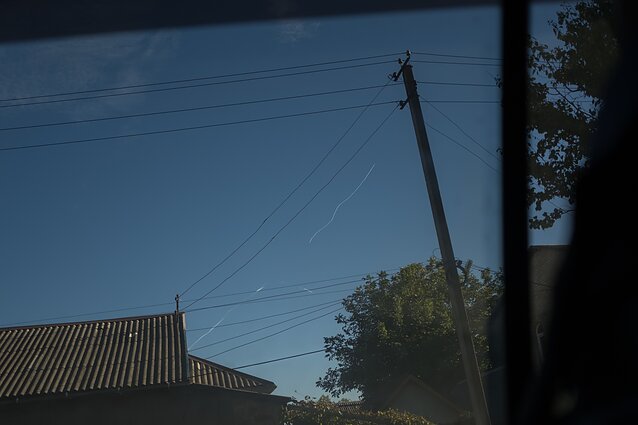
Ukrainian forces and towns have been under constant shelling by aerial glide bombs, but Kyiv has not been permitted to stop them with long-range strikes. Even fortified positions offer little protection against direct hits from these weapons – and Russia has used over a hundred of them each day. They carry a similar destructive force despite being tens of times cheaper and more accessible than ballistic missiles.
“If an aerial bomb is launched at you, there is a very good chance that you will be buried underneath all the fortifications without firing a single shot in return,” says Medalinskas.
This has left a sense that one risks dying senselessly on the frontline.
“The biggest problem is that the professional forces, which have been at war for so many years, are difficult to replace,” says Medalinskas. “Because the mobilised troops, unfortunately, are quickly sent to the front, and [...] the statistics on the percentage of them who die on the first day are frightening.”
“We imagine that war is like in the old days – when the enemy is assaulting, the defenders fire back, etc,” he added. “But it’s simply hell in there.”

Finding hope
While Ukrainian President Volodymyr Zelensky tries to maintain a public face of optimism, even the influential head of the president’s office, Andriy Yarmak, recently admitted that Kyiv is ready to talk about China’s peace proposals that were previously dismissed.
Lithuania views all this with concern – Russia’s 2021 ultimatum spoke not only about Ukraine, but also about fragmenting NATO’s defence architecture by pulling allied forces to the 1997 borders that ended with Germany. Any territorial concessions pushed for by the West could open the path for Moscow to return to the same scenario disastrous for the Baltic countries.
But not everything is hopeless.
Soldiers fighting on the Pokrovsk and Chasiv Yar frontlines say the Russians no longer have a massive advantage in artillery and are forced to use assault drones to fill the gaps. Despite the ongoing problems, the Ukrainian army is nowhere close to surrendering, the soldiers say.
Meanwhile, the terrifying Ukrainian losses are surpassed by the colossal numbers of Russians killed during their assaults. If given permission to strike them deep inside Russia, the Ukrainians could destroy this creeping force. But they do not get the green light.
With North Korea joining the war on the Russian side, this could change, Washington has signalled.
Observers, journalists and analysts also only have access to clear information on one side – Ukraine. The Korean reinforcements, while dangerous for Ukraine, may signal how close Russia is to collapse.
NATO Secretary General Mark Rutte called the North Korean involvement a sign of Vladimir Putin’s “desperation”. “[Putin] is incapable of continuing the offensive against Ukraine without foreign support,” Rutte said.
But the frontline is moving closer.
“If they bypass Kurachove [south-east of Pokrovsk], it won’t be fun,” says a soldier nicknamed Khimyk. “They are pushing deeper and there are no more big obstacles in their way.”

Newsletter
Every Friday morning.