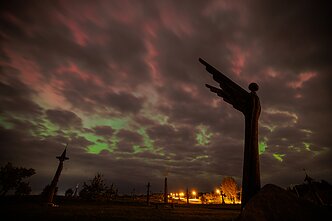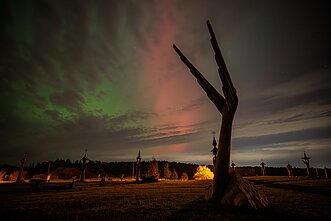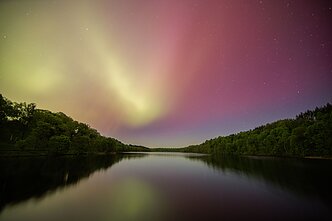

















The Northern Lights lit the sky over Lithuania with unusual frequency and intensity this year. This is because the Sun is at the peak of its 11-year activity cycle, say scientists. They also warn about the possible adverse effects of so-called solar storms.
Vidas Dobrovolskas, an astrophysicist at the Faculty of Physics of Vilnius University, and Kęstutis Ikamas, a scientist at the Faculty of Physics of Vilnius University, talk about this in LRT RADIO’s programme 10–12.
The Northern Lights, or aurora borealis, are the most visible part of storms to the human eye.
“The Northern Lights are the glowing layers of the Earth’s atmosphere at an altitude of 200–300 km. They are excited, or caused to glow, by the flow of electric particles from the Sun. It doesn’t always flow at a steady pace, and sometimes there are more intense bursts. We call these moments magnetic storms. The most visual manifestation is the Northern Lights,” explains Dobrovolskas.
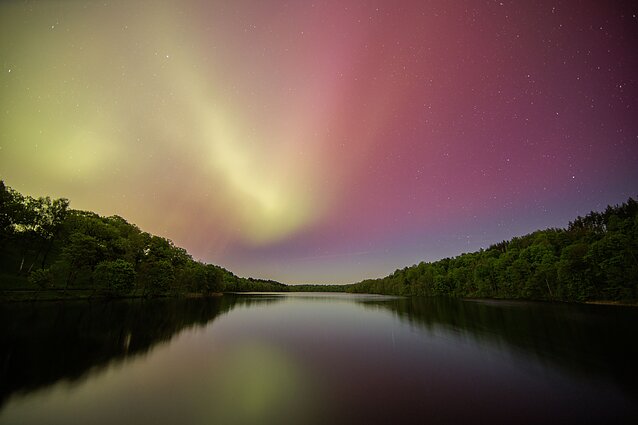
The colour spectrum of the aurora borealis depends on which air particles are glowing and how strongly they are excited. “Oxygen, the oxygen atoms at high altitudes, glow red and green. Nitrogen gives off a blue hue,” says the astrophysicist.
In Lithuania, the Northern Lights have become more frequent in recent months as the Sun has reached its maximum intensity.
“This happens about every 11 years. During these periods of intense activity, there are often solar flares, ejections of electric particles into space, which is why we are now seeing auroras much more often,” he says.

Peak solar activity lasts for a year or a year and a half, rather than weeks, according to the researchers.
“Now, activity seems to be stabilising. [...] It probably won’t go much higher. It is to be expected that it will remain at a fairly high level for at least another year. We can only start to expect a fall perhaps towards the end of next year. And the trough will come in another seven years,” Dobrovolskas predicts.
Not just spectacular sights
Solar storms are not only beautiful, but they can also cause damage, says Kęstutis Ikamas. It can damage equipment, power grids and telecommunications systems.
“Not telephones, not computers, but electricity transmission equipment, telecommunications satellites flying in space,” the scientist says.
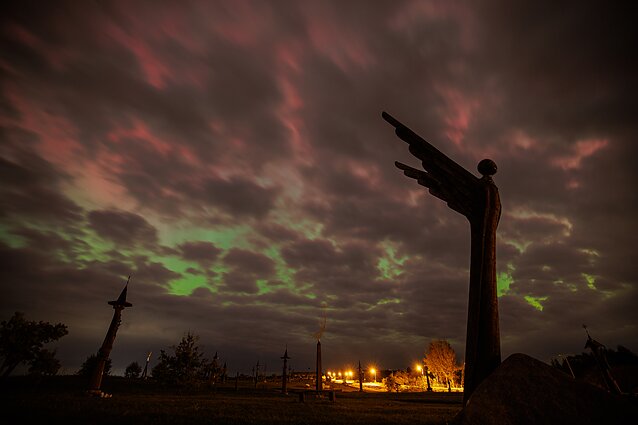
However, the electromagnetic storms that are currently taking place are not strong enough to affect the population. “The Earth hasn’t seen many very strong storms, except perhaps the Carrington Storm more than 150 years ago. If a storm like Carrington were to happen now, we would really feel it – the effects would be quite profound,” says Ikamas.
The 1859 Carrington solar storm affected telegraph wires, disrupting their operation. “At that time, on the scale of the Earth, the damage was small. But if such a storm were to happen now, since today’s society is heavily dependent on communications and electricity, we would feel it quite strongly,” explains Ikamas.
The worst that could happen, he says, is that the power goes out. This would lead to a pause in the operation of electricity-based systems. We would lose connectivity, no longer be able to use our computers and telephones. Without electricity, there could be disruptions to heating and plumbing systems.
The areas most affected by an electromagnetic storm are closer to the North and South Poles. At mid-latitudes and the equator, the effect would be minimal, says Dobrovolskas.

Newsletter
Every Friday morning.